
Interactive · 3 questions
Circles can be divided into sections, like slices of a pizza. When we cut a slice in a circle, we have created an arc, from point A to point B, along the circumference of the circle. On the pizza, the arc is the crust of the slice we cut. The rest of our slice (shaded below) represents a sector of the pizza.
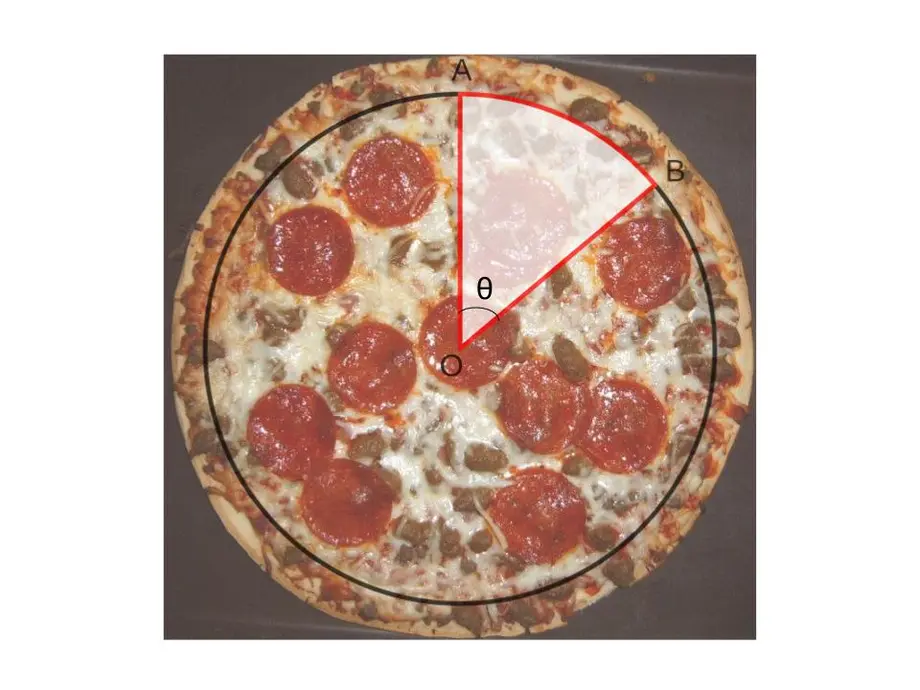
SECTORS
A sector is a portion of the* area* of a circle. A sector is determined by two different lines that extend from the center of the circle to some point(s) on the circumference of the circle (A & B). The size of the sector is determined by the angle, , formed by the two lines at the center of the circle.
As long as this central angle ≠ 0º or 180º, these two lines will create two different sectors within the circle. The minor sector has a central angle < 180º (shown below in red). Meanwhile, the** major sector** makes up the rest of the circle and has a central angle > 180º.
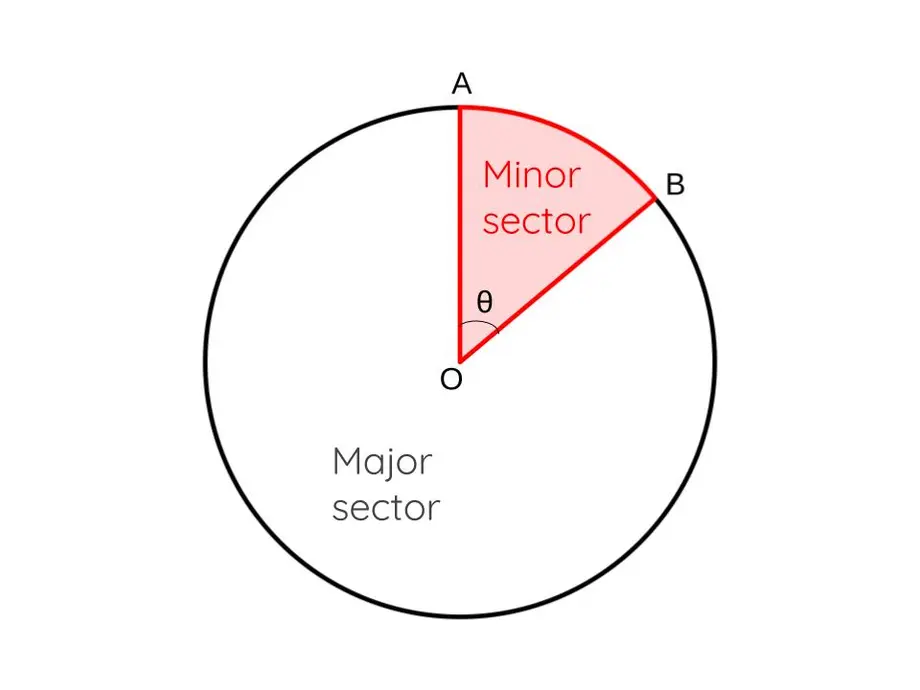
Why can we not use the terms "minor" and "major" sector if the central angle is 0º or 180º?
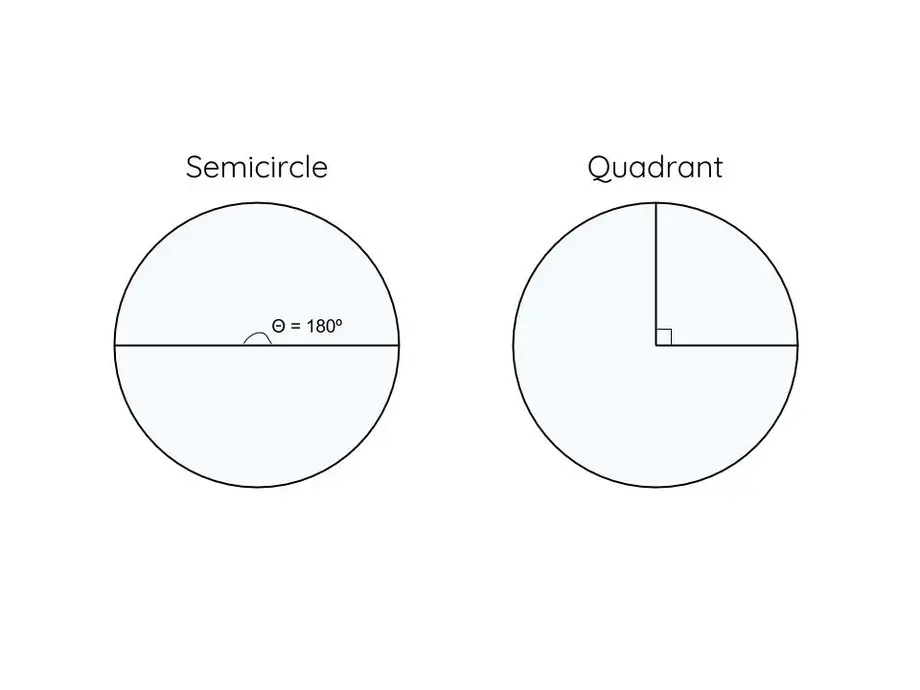
Certain sectors are special! For example, a semicircle is a sector that makes up half of the whole circle. A quadrant is a sector that makes up a quarter of the circle, resulting from a central angle of 90º (a right angle).
Finding the area of a sector
We already know how to find the area of a circle using the equation: . The variable = the area of the circle and = the circle's radius.
However, in this case, we only want to calculate the area of a certain sector. Well, we know that a sector is a fraction of a circle and we can calculate that fraction based on the central angle, .
To find the fraction, we divide the sector's central angle by the angle of a full circle (360º):
For example, looking at a quadrant (shown in the figure above), we would divide and get a fraction of . This tells us that the sector makes up one fourth of the total area of the circle.
From here, we simply multiply the area of the circle by the fraction to find the area of the sector:
= the area of the sector, = the sector's central angle, and = the radius of the circle
A circle has a diameter of 12 cm. A sector is drawn inside the circle with a central angle of 120º. What is the area of the sector?
ARCS
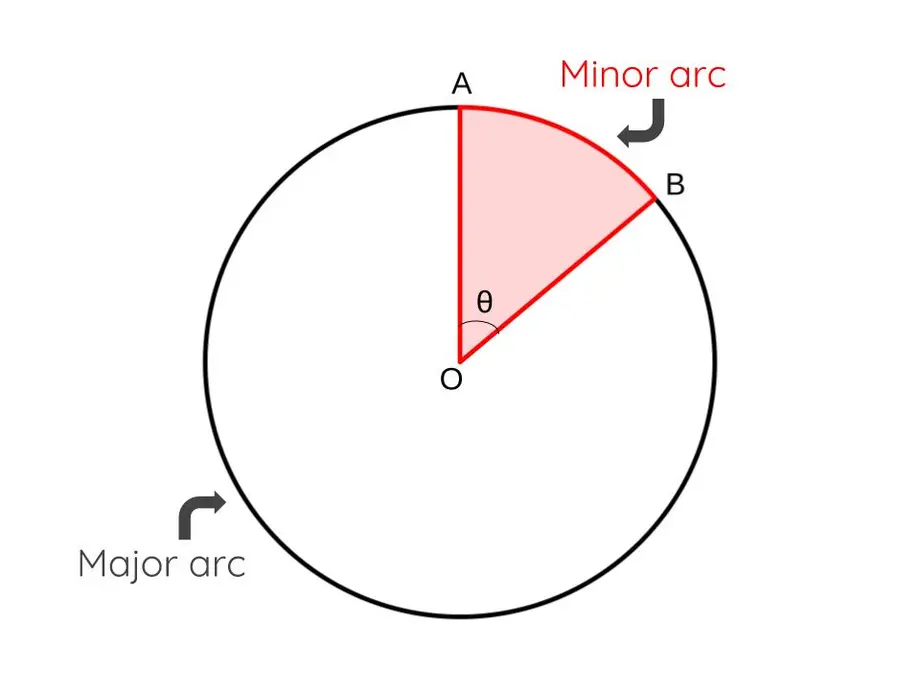
An** arc** is a segment of the circumference of a circle. In the same way as a sector, an arc is established by two different lines that extend from the center of the circle to the circumference and a central angle, . An arc is the measurement of the distance from point A to point B along the circumference of the circle.
Similarly to sectors, as long as the central angle ≠ 0º or 180º, the two lines will create two different arcs. The minor arc has a central angle < 180º (shown below in red) and the** major arc** has a central angle > 180º.
Finding the length of an arc
Similarly to calculating the area of a sector, we must use fractions to find the length of an arc. In this case, however, we will focus on the circle's circumference rather than its area. We already know the equation for the circumference of a circle: . In this equation, = the circumference of the circle, = the circle's radius, and = the circle's diameter. We can use either or to calculate the circumference because a circle's diameter is equal to twice its radius.
In order to find the length of a specific arc of a circle, we must once again use the central angle, , to determine the fraction of the circle that contains the arc:
Next, we multiply the circle's total circumference by the fraction made up by the arc:
= the length of the arc, = the arc's central angle, = the diameter of the circle, and = the radius of the circle
*Note: These two equations are the same; you may use either one depending on the data you are given.
An arc, = 90º, is denoted on a circle with a radius of 1 ft. What is the length of the arc?