Here's a great video by ThinkwellVids. He very clearly explains what exponential functions are and shows some examples.
Summary
An exponential function is one where there's a constant being raised to a variable. The constant has to be positive and cannot equal 1. So for example, 4x is an exponential function.
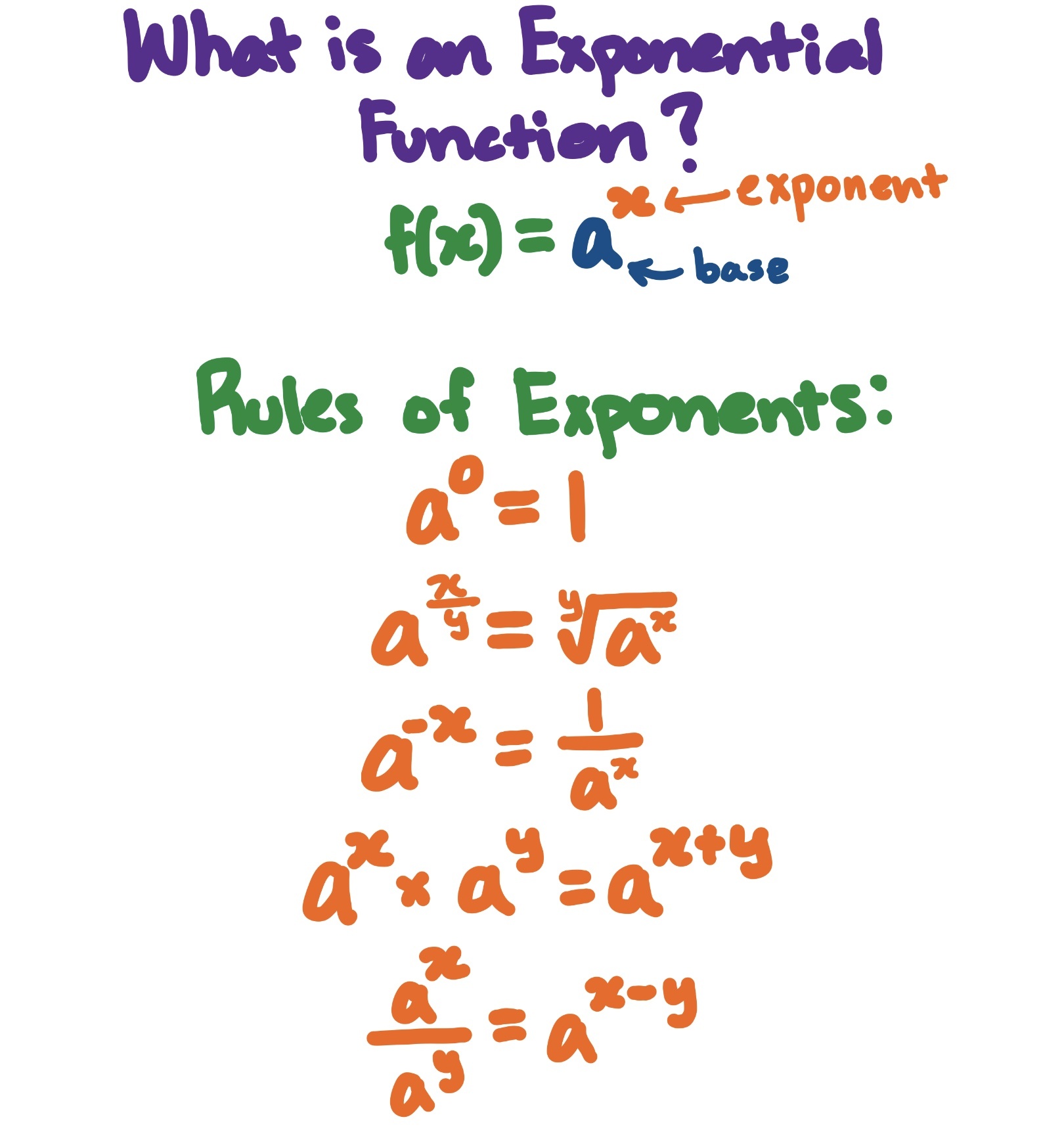
An exponential function is a mathematical function in the form:
f(x)=ax
Here a is a positive, real number (called the base) and x is the input (independent variable). The thing you need to note about exponential functions is the fact that the independent variable is always in the exponent. This could by x, 3x or 15x3. The exponential function is an important function in math!
Typically, exponential functions are used in growth and decay problems. Check out the hyperlinked lessons for explanations on how a function grows and decays.
Rules of Exponential Functions
There are some tips and tricks when dealing with exponential functions.
If you have x=0, then a0 is always going to be 1, no matter what a is.
If you have ayx, it can be rewritten as yax=(ya)x
If you have a−x, it can be rewritten as ax1
If you have ax×ay, it can be rewritten as ax+y
Similarly, if you have ayax, it can be rewritten as ax−y
Graphs of Exponential Functions
Since an exponential function can only have a positive base, you might think that all of the graphs are going to look positive. Think again. We are going to think of the graphs in terms of a≥1 and 0<a<1.
Notice how as x increases, y also increases, but at a more rapid pace. The graph of other numbers a≥1 (greater than zero) will also follow a similar construct.
Now let's look at when 0<a<1, specifically when a=0.5
Notice how as x decreases and becomes more negative, y increases at a rapid pace, similarly to above. The graph of other numbers between 0 and 1 will follow a similar construct.
An exponential function is a function in which a constant base is raised to a variable exponent. Unlike linear functions, which change by adding the same amount each time, exponential functions change by multiplying by the same factor repeatedly.
You may have seen exponential functions used to model many real-world problems, like population growth, compound interest, and radioactive decay.
Image source: by Trisha
####The General Form
An exponential function is usually written as:
f(x)=abx
, where a is the initial value, b is the base, and x is the exponent.
In order for this function to work, there are some rules:
b must be positive
b=1
the variable must appear in the exponent
For example, y=2x is an exponential function because the variable x is in the exponent.