সমদ্বিবাহু ত্রিভুজ উপপাদ্য

Interactive · 2 questions

তুমি কী সমদ্বিবাহু ত্রিভুজের মধ্যে কোন সম্পর্ক খুজে পেয়েছ ?

Choose one answer

Put ideas together

Contest problems often need this idea together with one or two others. That is where understanding goes deeper than memory. These are real problems from the AMC 8, AMC 12 and AIME, the national math competitions for middle and high school students, each with a worked solution on LIVE by Po-Shen Loh.

Illustrated · 1 min

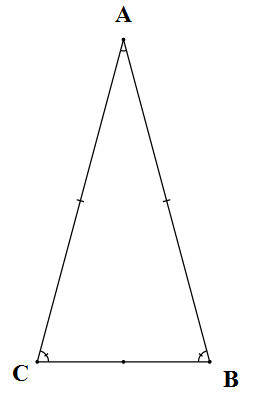
The isosceles triangle theorem simply states that "If two sides of a triangle are congruent, the angles opposite them are congruent." This is quite obvious to most, as many people take it for granted that the two base angles of an isosceles triangle are congruent.

The proof for this theorem is also quite straightforward.

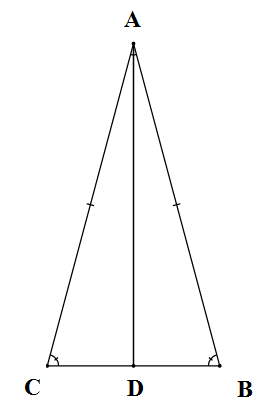
The first step requires you to draw the angle bisector AD.

Now, because of the triangle congruency postulate SAS, we can say that triangle CAD is congruent to triangle BAD. Because Congruent Parts of Congruent Triangles are Congruent(CPCTC), we can say that angle ACD is congruent to angle ABD.

Interactive · 1 question

Isosceles triangle theorem

The isosceles triangle theorem is a very important theorem. It states that the angles opposite the two equal sides of an isosceles triangle are equal. Aryaman Khandelwal proved it by defining an angle bisector. I will show you a different proof which doesn't require you to draw any new points.

Let △ABC\triangle ABC be a triangle such that ∣AB∣=∣AC∣|AB|=|AC|. △BAC≅△CAB\triangle BAC \cong \triangle CAB, because ∣BA∣=∣CA∣|BA|=|CA|, ∣AC∣=∣AB∣|AC|=|AB| and ∠BAC=∠CAB\angle BAC = \angle CAB. So, ∠ACB=∠ABC\angle ACB = \angle ABC.

We can prove the converse of this theorem similarly. Let △ABC\triangle ABC be a triangle such that ∠ACB=∠ABC\angle ACB =\angle ABC. △BAC≅△CAB\triangle BAC \cong \triangle CAB, because ∣BC∣=∣CB∣|BC|=|CB|, ∠ACB=∠ABC\angle ACB = \angle ABC and ∠BAC=∠CAB\angle BAC = \angle CAB. So, ∣BA∣=∣CA∣|BA|=|CA|.

Is this awesome?

Choose one answer

Illustrated · 1 min

The Isosceles Triangle Theorem States that if a triangle contains 2 congruent sides, then the angles opposite those sides are congruent. This theorem can be proved using the Law of Sines:

The Law of Sines states that: asin⁡A = bsin⁡B = csin⁡C ⁣\begin{align} \frac{a}{\sin A} \,=\, \frac{b}{\sin B} \,=\, \frac{c}{\sin C} \! \end{align} If a=ca=c, making △ABC\triangle ABC an isosceles triangle, then \begin{align} \frac{a}{\sin A} ,=, \frac{a}{\sin C} ! \end{align} By simply dividing both sides of the equation by a and raising to the power of negative 1, we are left with \begin{align} {\sin A} ,=, {\sin C} \end{align} And therefore m∠\angleA=m∠\angleC.

The converse of the Isosceles Triangle Theorem can be proved in a similar manner.

Read · 1 min

On each of the worksheets just linked to, please try problems 4-10. Have fun!

Type a concept, like “slope” or “photosynthesis”.

↑ ↓ to choose · Enter to openSearch explanations and problems