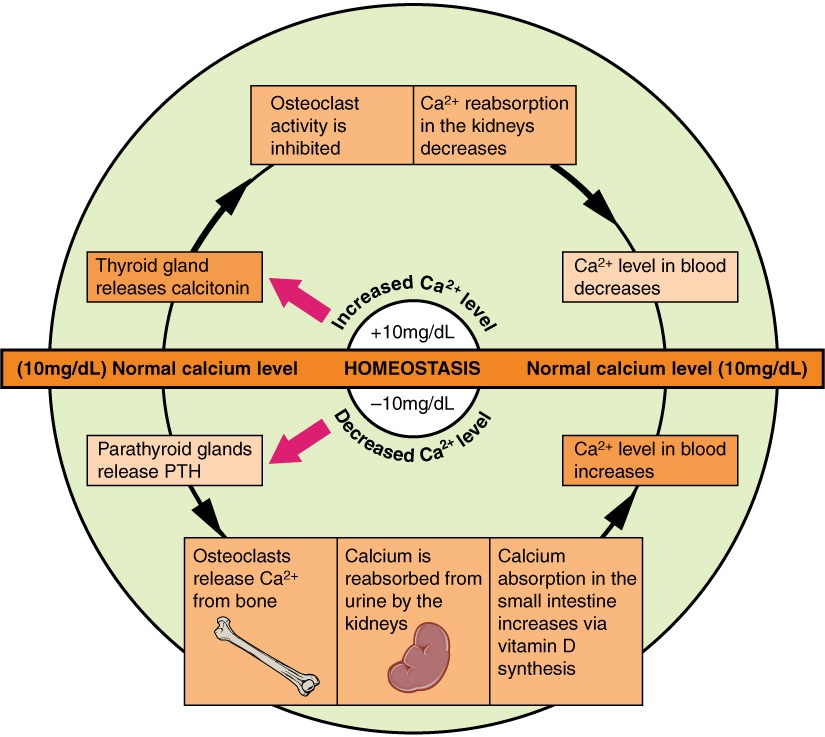
When the calcium ion concentration is too high, the thyroid gland releases calcitonin. This inhibits osteoclast activity and decreases the calcium ion reabsorption in the kidneys. The calcium ion level in the blood then decreases.  On the other hand, if the calcium ion concentration is too low, then the parathyroid glands release PTH.  This causes osteoclasts to release calcium from bone, calcium to be reabsorbed from urine in the kidneys, and calcium absorption in the small intestine to increase. The calcium levels in blood then increase.

Image Source: OpenStax College, [Connexions Web site](http://cnx.org/content/col11496/1.6/, Jun 19, 2013.), CC BY 3.0, via Wikimedia Commons

Study the diagram shown above for calcium levels. Which of the following options actually happens when there are too few Ca2^2+^+ ions in the body?

Choose one answer

Type a concept, like “slope” or “photosynthesis”.

↑ ↓ to choose · Enter to openSearch explanations and problems