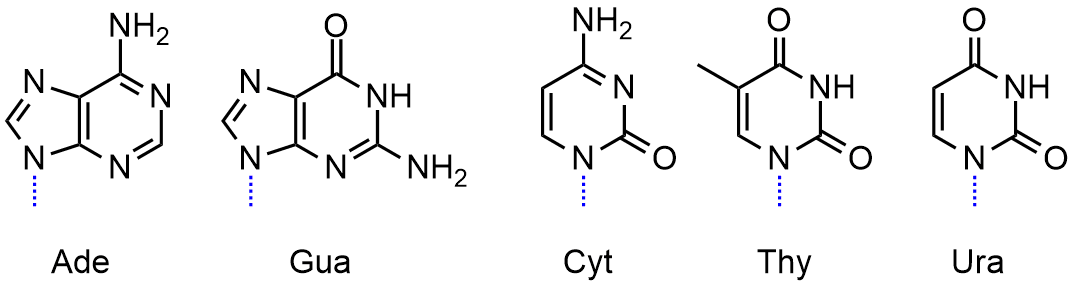
The five common nucleobases.  Adenine, a 5-membered ring conjoined to a 6-membered ring with a primary amine attached to the 6 membered ring.  Guaninea, a 5-membered ring conjoined to a 6-membered ring with a primary amine, and ketone attached to the 6 membered ring, and a secondary amine within the ring.  Cytosine, a 6 membered ring with a primary amine and ketone in para positions across a nitrogen.  Thymine, a 6-membered ring with 2 ketones in para positions across a secondary amine.  Uracil, a 6-membered ring, ring with 2 ketones in para positions across a secondary amine.

Image source: By Michal Sobkowski CC BY 2.0, via Wikimedia Commons

Nucleobases bond to each other within DNA through hydrogen bonding. As a reminder, hydrogen bonds are formed between an oxygen or nitrogen on one molecule and a hydrogen which is covalently bonded to either an oxygen or nitrogen on a different molecule. Based on these structures, and hydrogen bonding, which pair of bases will bond to each other?

Choose one answer

Type a concept, like “slope” or “photosynthesis”.

↑ ↓ to choose · Enter to openSearch explanations and problems