Rate of Reaction (Enzymes) — Role & Importance

Before this, knowCatalysts (Enzymes) — Overview & ExamplesSubstrate (Biology) — Definition & Role

Illustrated · 1 min

Speeding Up Reactions

Enzymes are biological catalysts. Catalysts help speed up chemical reactions.

This image is a graph showing the difference in reaction energy for a reaction catalyzed by an enzyme versus one not catalyzed by an enzyme. Energy is on the Y-axis and Reaction Progress is on the X-axis. When the reaction is not catalyzed, the activation energy is higher and therefore the reaction takes longer because there is a higher energy barrier for the reaction to proceed. When the reaction is catalyzed, its activation energy is lowered and the reaction can happen at a much faster rate.

Image source: By Sylvia Freeman

But, how exactly do enzymes speed up reactions?

Well, all reactions that are catalyzed by enzymes could happen without the help of enzymes (meaning that the reaction is spontaneous). The process would just go very, very slowly.

Imagine a reaction involving one compound molecule breaking apart into two smaller molecules. A specific example of this is the dimer sugar lactose being broken down into its component monomer sugars, glucose and galactose (don't worry too much about all these names). Eventually lactose would break down, but it might take hundreds of years. Remember that in a cell, molecules are just floating around, bumping into each other. For a reaction to happen, the starting molecule(s) have to collide in just the right way. Enzymes help by putting the substrate(s) in the right position to react.

Like all catalysts, enzymes increase the rate of chemical reactions by lowering the reaction's activation energy. Activation energy is the energy needed for the reaction to proceed. By definition, all catalysts, including enzymes, do their jobs without getting used up or transformed during the reaction.


Interactive · 3 questions

Changing the Rate of Reaction

Enzymes lower the activation energy barrier of a reaction because they are catalysts. This means that reactions can progress much faster than they can without a catalyst. In other words, the reaction speeds up.

The reaction progress vs. energy plot of two reactions. The reaction without an enzyme has a massive activation energy barrier. With the enzyme, it is a much smaller hill. The overall energy released during the reaction is the amount of energy in the reactants minus the energy of the products.

Comparing Rates of Reaction

Image source: By Fvasconcellos CC BY-SA 3.0, via Wikimedia Commons

"Rate of reaction" sounds so abstract, so let's break it down. Chemical reactions can only happen when the reactants smack into each other hard. You can speed up a chemical reaction by making collisions happen more often and with more force. This idea is known as collision theory.

Low concentration = few collisions, high concentration = more collisions

Image source: By Sadi_Carnot [Public domain], via Wikimedia Commons

Okay, let's get back to the whole idea of activation energy.

Remember the analogy about the hill in your backyard? If it's a really big hill, then it will take a long time to walk over. However, if you lower the height of the hill (the activation energy), then the reaction can go much faster. You can walk over the barrier in no time.

The enzyme plus substrate are the reactants and the formation of the enzyme substrate complex is the activation energy. The enzyme and product are lower in energy than the other two groups.

Image source: By Muessig CC BY-SA 3.0, via Wikimedia Commons

What does "rate of reaction" mean?

Choose one answer

Illustrated · 2 min

How Do Enzymes Change the Rate of Reaction?

The rate of reaction or reaction rate is a measurement of how fast a reaction occurs.

Most often, we look at how quickly products are being made or how quickly substrates are being used up in order to determine the rate of reaction.

Reactions go faster when enzymes are involved.

Image source: By István Mihály (Mhy) CC0, via pixabay.com \\ Image source: By Gregory Wilson (Director and cinematographer) CC BY 3.0, via Wikimedia Commons

Adding an enzyme or other catalyst to a reaction will speed up its rate by decreasing activation energy.

The energy required for a chemical reaction to occur is called activation energy.

Activation energy is like a hill that a reactant has to get over before it can start.

Image source: By Hannah Bonville

Enough energy has to be added to the reactants to get a reaction to start. It's like pushing a car up a hill: you have to keep adding more and more energy, but once you're at the top of the hill, the car (or the reaction) can begin to roll on its own.

It takes time to get enough energy to start a reaction. Enzymes shorten this time by reducing the activation energy required for a reaction to begin.

Enzymes lower the activation energy required to start a reaction.

Image source: By Hannah Bonville

Compare the two reactions. The reaction with an enzyme has a much lower activation energy. It takes much less energy (and less time) for that reaction to begin.

How Can We Increase the Rate of Reaction Even More?

There are a few ways to make a reaction go even faster:

To make a reaction go faster, increase the temperature, add more enzymes, or add more substrate.

Image source: By Hannah Bonville

Let's consider each of these briefly.

  1. Increasing temperature ===

Increasing temperature increases the speed at which molecules move. More movement means more collisions. In chemical reactions, collisions are a good thing; they bring substrate molecules and enzymes together.

The faster enzymes and substrates are brought together, the faster the reaction can begin.

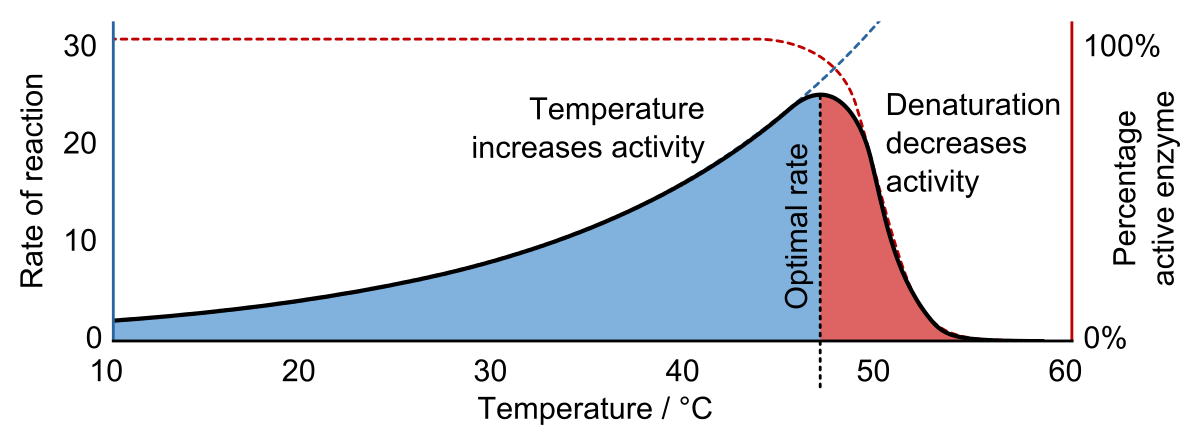
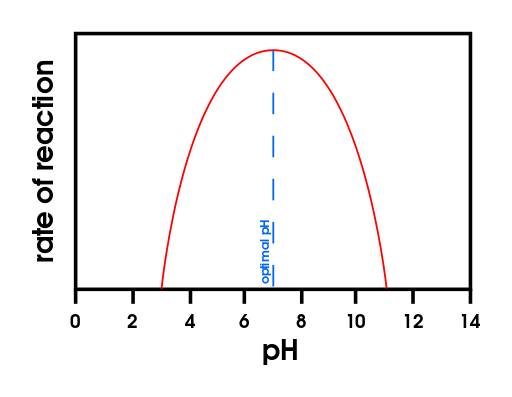
Each enzyme has an optimal temperature at which it works best.

Image source: By domdomegg CC BY 4.0, via Wikimedia Commons

When temperature is increased too much, the rate of reaction decreases rapidly, as shown in the graph above. This is due to denaturation. Enzymes become denatured when they lose their shape.

Denatured enzymes mean deformed active sites that don't match up with substrates. If substrates can't bind to enzymes, enzymes can't catalyze reactions.

All reactions have an optimal temperature beyond which denaturation occurs.

  1. Increasing enzyme concentration ===

Increasing the enzyme concentration will increase the reaction rate as long as there is enough substrate available to work on.

If we assume that there is an endless supply of substrate available, increasing the enzyme concentration will make the rate of reaction increase in a straight line, like so:

Rate of reaction increases when you add more enzyme.

Image source: By Hannah Bonville

  1. Increasing substrate concentration ===

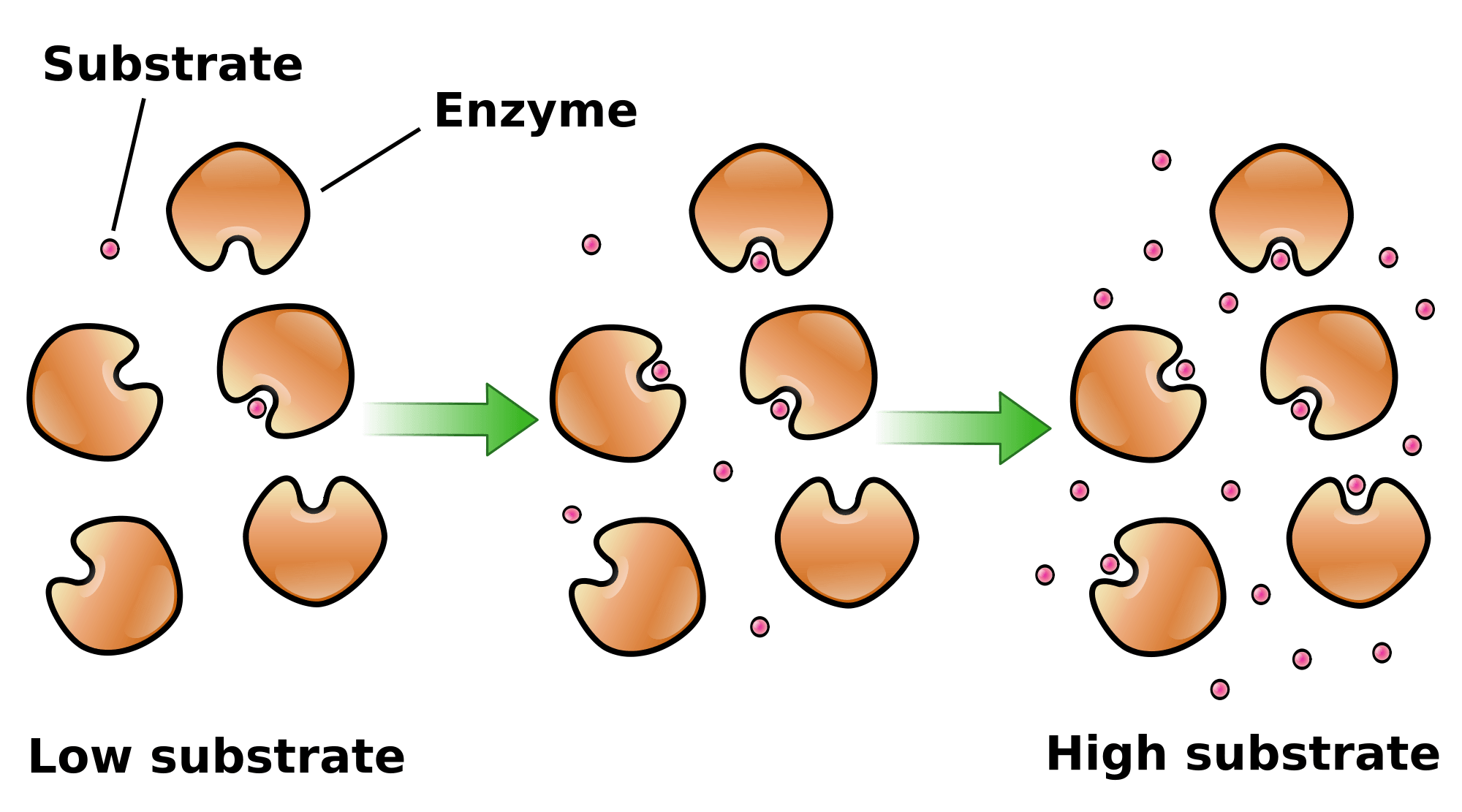
Increasing the substrate concentration will increase the reaction rate until all of the available enzymes become saturated or in use.

Once all of the enzymes available are occupied (have substrate bound to the enzyme active sites), increasing the substrate concentration further will have no effect on the reaction rate.

Eventually, no matter how much substrate you add, the rate of reaction will max out.

Image source: By GYassineMrabetTalk [Public domain], via Wikimedia Commons

Key Vocabulary:

  1. Enzyme
  2. Reaction
  3. Activation energy
  4. Catalyst
  5. Substrate
  6. Rate

Illustrated · 1 min

How to Increase Rate of Reaction

The rate of a reaction is the speed at which a reaction occurs. It is the rate at which reactants are converted into products. There are five ways to increase the rate of reaction:

  1. Reducing the size of the container: This places reactants closer to each other and they are more likely to encounter each other and react.
  2. Increasing available energy: The most common way to increase reaction rate, this increases the energy of the molecules so that when the reactants encounter each other they will react.
  3. Increasing surface area of reactants: Breaking up the reactants will increase the number of molecules that are exposed to react. If there are big chunks of reactants, only the molecules on the outside will react and those hidden in the middle won't be able to react.
  4. Adding a catalyst: Enzymes and other catalysts orient the reactants in a way that requires less energy to be present for the reaction to occur.
  5. Increasing the number of reactants: By increasing the concentration of the reactants present, they're much more likely to run into each other and react.
Increasing temperature increases enzyme activity up to the optimum temperature. Then the enzyme begins to denature.

This image shows that increasing temperature increases the rate of the reaction.

Image source: By Thomas Shafee CC BY 4.0, via Wikimedia Commons

Video

(Video) How to Speed up Chemical Reactions (and Get a Date)

by Aaron Sams on TED-Ed

How can enzymes help you get a date to the dance? Watch the video above to find out.

Type a concept, like “slope” or “photosynthesis”.

↑ ↓ to choose · Enter to openSearch explanations and problems