Illustrated · 1 min

Image By: E. Burnham

Illustrated · 1 min
Image By: E. Burnham
Video
by Bozeman Science
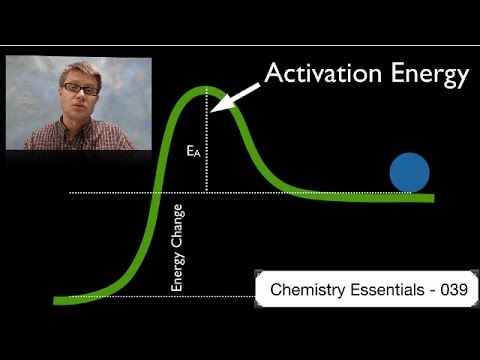
Activation energy is the minimum amount of free energy needed for a reaction to take place. In this video, Mr. Andersen talks about factors that affect this amount, including temperature and orientation. He also discusses Maxwell-Boltzmann distributions.
Illustrated · 4 min
We've been studying kinetics. It's a branch of physical chemistry that seeks to explain reaction rates. So far, it's been very math focussed. We spent a lot of time talking about rate laws, reaction order, and the method of initial rates. Now, we're starting to examine the concepts behind kinetics. We've already examined collision theory. But, now let's look at the big picture of how reactions occur.
A reaction's activation energy () is the energy needed to start the reaction. It has units of joules per mole (). So, it's the quantity of energy. If we don't have enough energy, the reactants will just sit there. As you can imagine, the larger the activation energy, the more difficult it is for a reaction to proceed. The lower, or smaller it is, the easier it is for a reaction to proceed.
On an energy diagram, it is the difference between the reactants and the transition state. The transition state is the point of highest energy in a reaction. On our energy diagram, it's at the peak energy. Remember, that's before the formation of an intermediate or product. The transition state is unstable. Why? The bonds are partially broken and partially formed. The electrons are still bound to the original atom. But, at the same time, they are attracted by another atom.
The reaction does not stay in the transition state for very long. It quickly proceeds to a more favorable state. In a multi-step reaction, it continues to a reaction intermediate. In a single-step reaction, we go from the transition state directly to our products. But, don't get confused! It is crucial to remember that activation energy tells us the energy difference between the reactant and the transition state. It does not tell us if the reaction is exothermic or endothermic. To determine that we compare the reactant and product energies.
As a side note, remember to indicate which way your reaction is progressing. Often it is assumed that describes the forward reaction. If in fact, you are calculating for the reverse direction, be sure to denote this. For example, you could write . Check out our page on predicting reaction directions if you need a refresher.
Yes, catalysts lower it. How? Catalysts create an alternative reaction mechanism. Typically, the reactants experience an electrostatic interaction with the catalyst. It can occur via Van der Waal's forces or bonding. While on the surface of the catalyst the reactants still react. But, the catalyst helps to stabilize the reaction. So, the activation energy is lessened. By adding a catalyst, the reaction has less energy to overcome and an easier time progressing. That's why catalysts are one method for increasing reaction rates.
Yes! If you are lucky enough to be provided with a graph of the reaction progress, like below -- very simply put -- the difference in the y-axis values will tell you .

Image By: Erica Burnham
There are two main theories that go into finding the activation energy of a reaction. They are Collision Theory and Transition State Theory. Both are encompassed by the Arrhenius Equation.
Remember, to start a reaction, the molecules need sufficient energy and proper orientation. The variable A measures the fraction of properly oriented molecules or atoms. So, A is representative of the frequency of these favorable collisions. K is the rate constant. “e” is called Euler’s number. It's a mathematical constant with a value of 2.718. It is also the base of the natural log. is the activation energy, R is the ideal gas constant (), and T is the temperature in Kelvin.
Note: In chemistry – and every STEM course you take – it’s so valuable to take some time and understand what different values for these variables mean. If a reaction is placed at a high temperature what does that mean for the rate of our reaction using the Arrhenius equation? When is a small number, what does this mean for the rate of the reaction? And when there are barely any collisions between the atoms, affecting our variable “A”, what is the outcome?
Well, if activation energy is necessary to tell us if a reaction is able to proceed, it is also necessary if a reaction wants to progress in the reverse direction. The activation energy for the reverse reaction () can be found from our energy diagram the same way as the forward reaction and additionally through the use of the Arrhenius equation.

