
Adaptive Radiation — Definition & Examples

Illustrated · 2 min

What Is Adaptive Radiation?

Adaptive radiation is when a species rapidly adapts to fill available niches in an ecosystem. It is a pattern of evolution that is usually seen in habitats where new ecological niches have opened up. This could be due to habitat destruction, mass extinction, or new habitat formation (like new islands being formed by volcanoes).

An Example of Adaptive Radiation:

Anoles are a family of lizard closely related to iguanas. There are many species of anole, found mainly in the Caribbean islands. What's so cool about anoles is that they have separately evolved to occupy specific niches in the ecosystem on every island that they are found.

All the species on each island came from a single ancestor species who arrived on the island. Let's take a look at their evolutionary history.
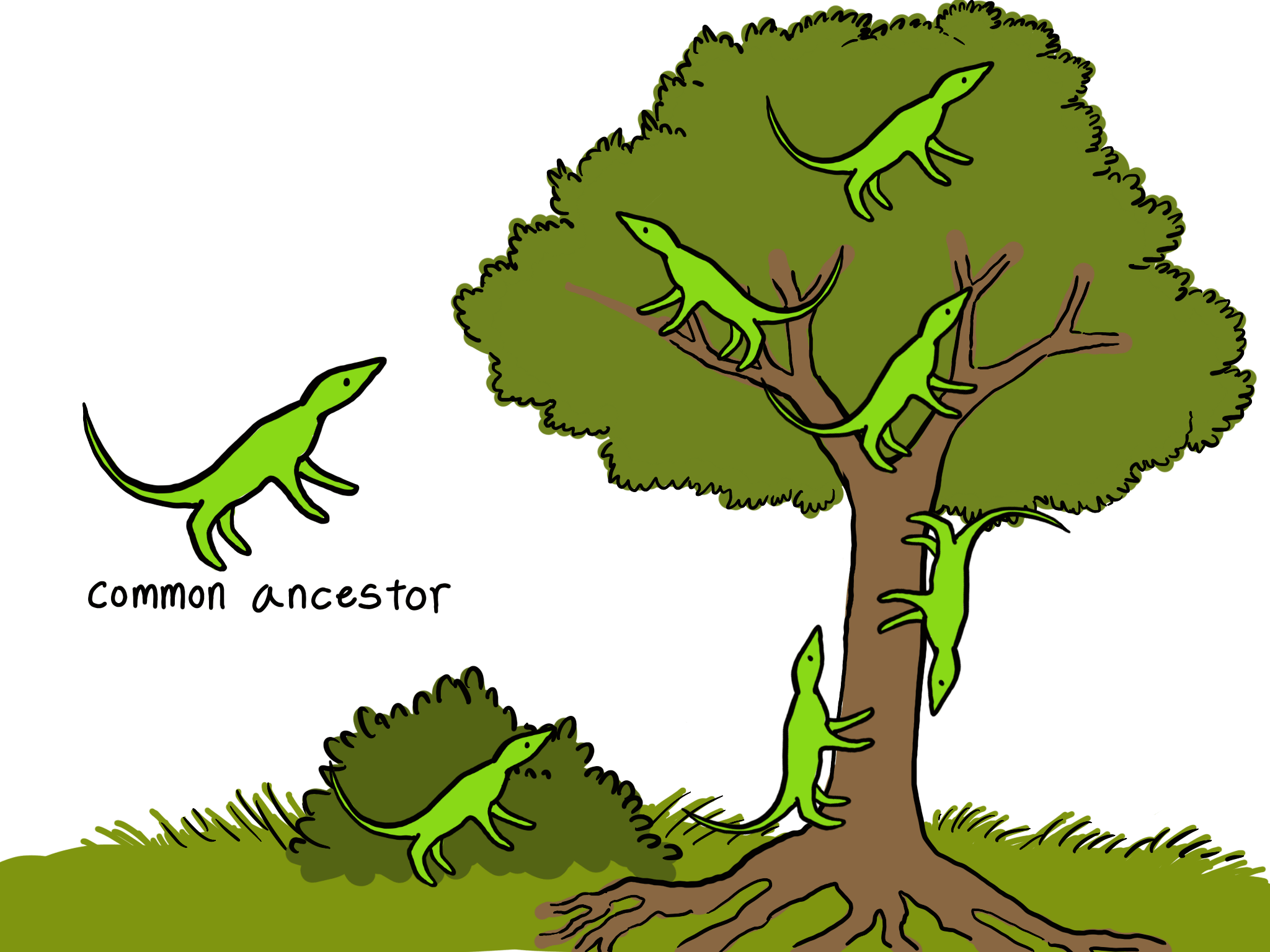
This is a cartoon illustration showing an example of adaptive radiation. The image shows an anole lizard on the left. It has the label "common ancestor" underneath it. The rest of the image shows lizards crawling all over a tree and on the ground. All the lizards look the same because they are still the same species.

Image source: By Sylvia Freeman

Imagine that a lot of anoles suddenly arrive on an island. On this new island, there aren't any other animals living in similar niches to the anoles (no competition). There also aren't many predators to influence the anoles' evolution. With so many resources available, the population spreads out. Some lizards go high up in the leaves of trees, some stay down in the grass, and the rest spread out in the trees. Over time, the populations of lizards each adapt to their individual niches.

This is a cartoon illustration showing an example of an adaptive radiation. The image shows six unique anole lizard ecomorphs. The lizards are all over different parts of a tree and on the ground. The different ecomorphs are labeled as: grass-bush, trunk-ground, trunk, trunk-crown, crown-giant, and twig. All the lizards look different because they have adapted to their niches. They are all separate species.

Image source: By Sylvia Freeman

After many generations, they are specialized to fit their ecological roles. The different types of anole are no longer able to interbreed and have become unique species.

These six distinct forms, also called ecomorphs, are so consistent on each island that they've been sorted into specific categories (see image above). This is also an example of convergent evolution since the various ecomorphs each evolved independently on different islands.

To Recap: A Quick Summary

Under the right conditions, a colonizing species will rapidly adapt in multiple ecological "directions" to take advantage of available niches. This process leads to speciation. Adaptive radiation leads to high biodiversity in a relatively short amount of (evolutionary) time. Keep in mind though, "short" might still be a million years.

Illustrated · 1 min

Developing Quick Adaptations

Adaptive radiation is the rapid evolution of different species from a single common ancestor.

It happens when:

  1. A change in the natural environment opens up access to new resources. For example, a natural disaster occurs or a species becomes extinct.
  2. This changed environment contains many available niches for organisms to occupy. Meaning: there are resources available that are not being used by organisms.
  3. The changed environment is relatively isolated. Meaning: new species can colonize the region and fill the available niches. These species can then experience adaptive radiation.

Being able to take advantage of unclaimed resources in this way is called ecological opportunity.

The Hawaiian Honeycreeper experienced adaptive radiation and formed many subspecies.

The Hawaiian Honeycreeper is one well-known example of adaptive radiation. Just one ancestral species colonized the Hawaiian islands and evolved into about 50 unique subspecies due to a lack of competition.

Image source: By Gabi Slizewska

When members of one species settle in an environment that meets the criteria above, they can occupy different niches and make use of different resources.

This also means that they are facing different environmental pressures. If you remember, those pressures are what drives evolution.

Quickly, the various members of this species will start to develop new adaptations to deal with the different challenges they face in their new niches. They will end up looking and acting differently according to what their niche requires.

Over time, this one population can split into several unique species.

Illustrated · 2 min

Adapting in All Directions

In evolutionary biology, adaptive radiation is when a single species quickly adapts to fill available niches in an environment. It's one pattern of speciation that leads to high biodiversity in a (relatively) short amount of time. This process typically takes place in new habitats that are somewhat isolated, like islands or lakes.

Darwin's finches are a famous example. The finches are a group of 15 or so bird species found on the Galápagos Islands. The finches are thought to have evolved from a single ancestral finch species that arrived on the islands. Over time, each species has adapted to a specific niche by evolving to have a unique beak shape. The variation in beak shapes means that every species eats different foods. This allows them to avoid competing with each other when resources are rare.

This is a cartoon illustration of Darwin's finches. The image shows how one common ancestor species evolved into multiple, diverse finch species through adaptive radiation.

Disclaimer: not all of Darwin's finches are shown

Image source: By Sylvia Freeman

How Does It Occur?

The process usually follows a pattern something like this:

  1. A new environment arises (like a volcanic eruption creates new islands in the ocean) or some event causes big changes in an existing environment, opening up niche spaces in the ecosystem.
  2. Some population of a species arrives at the new environment (this would be an example of the founder effect), or a portion of an existing species survives the destructive event (this is an example of the bottleneck effect).
  3. The species begins colonizing (or re-colonizing) the newly available niches.
  4. In the process of filling multiple niches, the species diverges to adapt to each niche. Over time, each portion of the species becomes better suited to their respective niche through natural selection. After a long time, all the different populations are no longer able to interbreed. They are now considered separate species.

Let's Break It Down

A great way to remember scientific terms is to break down the meaning of the component words.

  • Adaptive: Adaptation is the process of a species becoming better suited to its environment through natural selection. Adapting often leads to speciation.

  • Radiation: Radial means circular.

So, you can think of adaptive radiation as a species adapting in all directions, like a circle.

Video

(Video) Adaptive Radiation

by Micayla Lamb

This video uses the example of those cute, famous, little Galápagos finches to demonstrate the process of adaptive radiation. This is where one parent species diversifies into several unique species.

A wheel of finches

Image source: By Valeri Natole

Type a concept, like “slope” or “photosynthesis”.

↑ ↓ to choose · Enter to openSearch explanations and problems
