
Illustrated · 2 min

+4 contributors



What Is Adaptive Radiation?
Adaptive radiation is when a species rapidly adapts to fill available niches in an ecosystem. It is a pattern of evolution that is usually seen in habitats where new ecological niches have opened up. This could be due to habitat destruction, mass extinction, or new habitat formation (like new islands being formed by volcanoes).
An Example of Adaptive Radiation:
Anoles are a family of lizard closely related to iguanas. There are many species of anole, found mainly in the Caribbean islands. What's so cool about anoles is that they have separately evolved to occupy specific niches in the ecosystem on every island that they are found.
All the species on each island came from a single ancestor species who arrived on the island. Let's take a look at their evolutionary history.
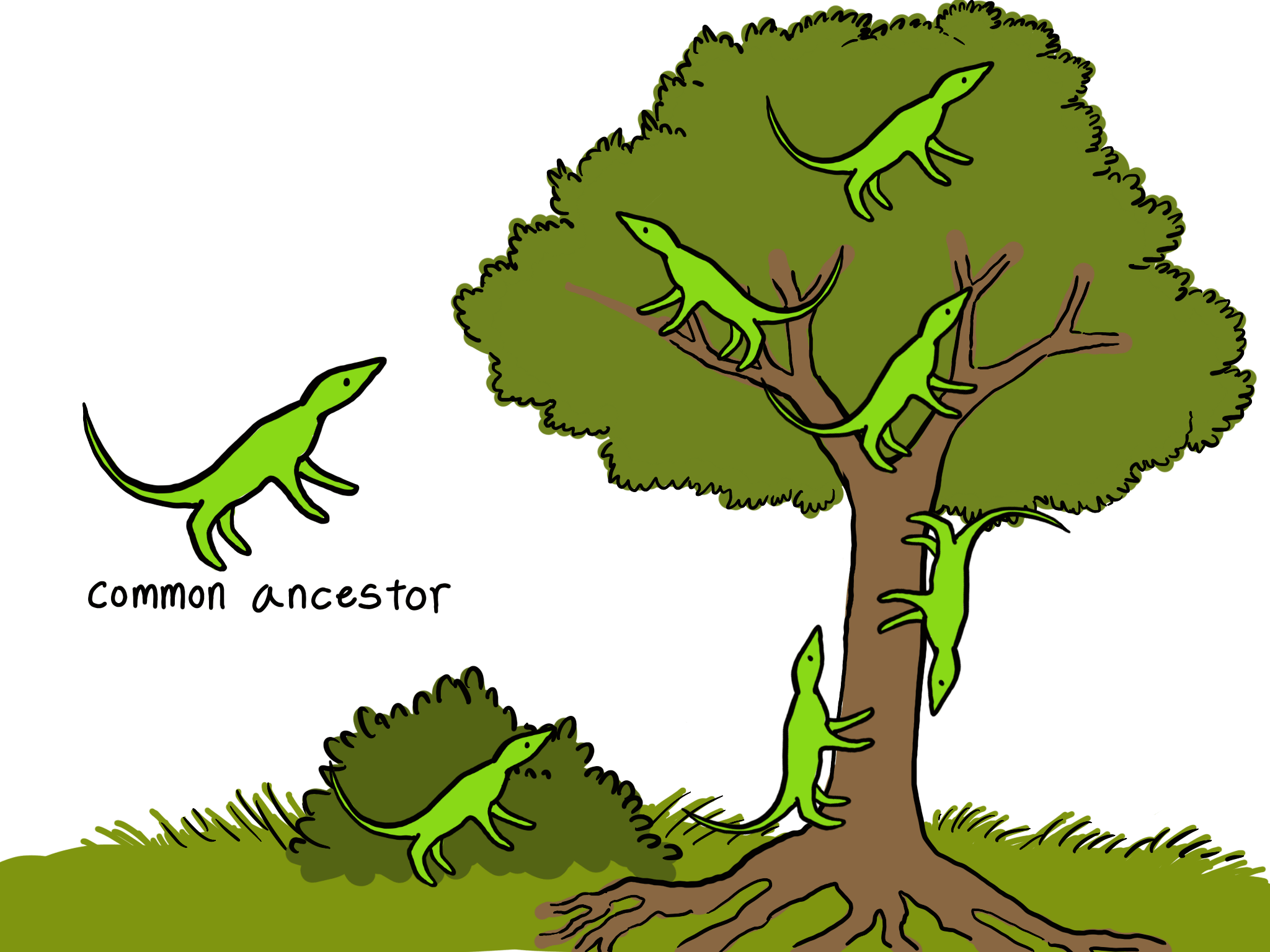
Image source: By Sylvia Freeman
Imagine that a lot of anoles suddenly arrive on an island. On this new island, there aren't any other animals living in similar niches to the anoles (no competition). There also aren't many predators to influence the anoles' evolution. With so many resources available, the population spreads out. Some lizards go high up in the leaves of trees, some stay down in the grass, and the rest spread out in the trees. Over time, the populations of lizards each adapt to their individual niches.

Image source: By Sylvia Freeman
After many generations, they are specialized to fit their ecological roles. The different types of anole are no longer able to interbreed and have become unique species.
These six distinct forms, also called ecomorphs, are so consistent on each island that they've been sorted into specific categories (see image above). This is also an example of convergent evolution since the various ecomorphs each evolved independently on different islands.
To Recap: A Quick Summary
Under the right conditions, a colonizing species will rapidly adapt in multiple ecological "directions" to take advantage of available niches. This process leads to speciation. Adaptive radiation leads to high biodiversity in a relatively short amount of (evolutionary) time. Keep in mind though, "short" might still be a million years.


