Adding and Subtracting Fractions with Unlike Denominators — Process

Before this, knowAdding and Subtracting Fractions with Like Denominators — Process

Interactive · 1 question

Adding and Subtracting Fractions

Fractions are a pain in the butt to add or subtract. They're superficial and picky. They only want to combine with other fractions that have the same denominator. Drama queens.
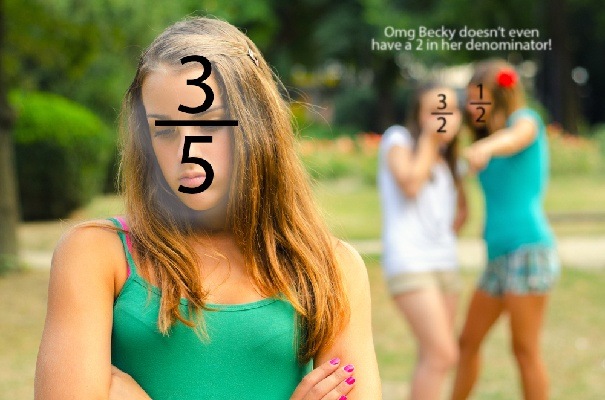
3/5  does not have a common denominator with 3/2 and 1/2

Image source: By OluGW CC BY-SA 4.0, via Wikimedia Commons

Same Denominator

When fractions have the same denominator, it is very easy to add and subtract. Just leave the denominator alone and add or subtract the numerators.

Let's try this with the two fractions in the background of the photo. What is: 32−12\frac32-\frac12

Since they have the same denominator, 22, we can subtract the numerators. 32−12=3−12=22=1\frac32-\frac12=\frac{3-1}{2}=\frac22=1

Different Denominators

Now what about fractions with a different denominators? We need to alter one or more of the fractions so that they have a common denominator. Once they share a common denominator, we can add or subtract like we did above, leaving the denominator alone and focusing on the numerator.

Let's use the fractions in the photo. 35+32\frac35+\frac32 They have different denominators, 55 and 22. A quick way to find a common denominator is to multiply the denominators together. So, a common denominator for 22 and 55 is 2×5=102\times5=10. This 1010 is also a common multiple of 22 and 55.

Now, we multiply or divide each fraction's top and bottom by a number that turns their denominator into the common denominator, 1010. We will produce equivalent fractions. Since the denominator changes, the numerator must also. Read on for more info.

Adding Fractions with Unlike Denominators: 3/5 + 3/2 = (2/2 x 3/5) + (3/2 x 5/5) = 6/10 + 15/10 = 21/10

Image by Caroline Kulczycky

Try it Yourself!

What is 85−56+12\frac85-\frac56+\frac12?

Choose one answer

Put ideas together

Contest problems often need this idea together with one or two others. That is where understanding goes deeper than memory. These are real problems from the AMC 8, AMC 10, AMC 12 and AIME, the national math competitions for middle and high school students, each with a worked solution on LIVE by Po-Shen Loh.

Video

(Video) Adding and Subtracting Fractions / Mixed Numbers

by PatrickJMT

This video by PatrickJMT covers adding and subtracting fractions with unlike denominators.

Summary\large{\text{Summary}}

The first example is: 79−215\frac79-\frac2{15}

The first step is to find the LCD. 9:3⋅315:3⋅5\begin{array}{lr} 9:&{\color{#29A603}{3}}\cdot3\\ 15:&{\color{#29A603}{3}}\cdot5 \end{array} 3⋅3⋅5=45{\color{#29A603}{3}}\cdot3\cdot5=45 The LCD is 4545.

We want to multiply the denominator of each fraction by some number that will make it equal the LCD. We also multiply the numerator by that same number. This will make sure the new fraction is equivalent to the previous. 79× 5× 5=3545215× 3× 3=645\begin{gather} \frac79{\color{#29A603}{{{\times\,5}\atop{\times\,5}}}}=\frac{35}{45}\\ \frac{2}{15}{\color{#29A603}{{{\times\,3}\atop{\times\,3}}}}=\frac{6}{45} \end{gather}

Now that we have fractions with similar denominators, we can go ahead and subtract. 3545−645=35−645=2945\frac{35}{45}-\frac{6}{45}=\frac{35-6}{45}=\frac{29}{45}

As with any fraction problem, we want to make sure our final answer is in simplest form. Since 2929 is a prime number, its only factors are 11 and 2929. Factoring out a 11 doesn't do anything to help reduce fractions. We cannot cancel out a 2929 either, because 4545 is not a multiple of 2929. Therefore our answer is already fully simplified.

Interactive · 1 question

To subtract with unlike denominators, equalize the denominators, then subtract.

Saying that two fractions have unlike denominators is the same as saying that they have different denominators. While subtracting fractions with like denominators is relatively simple, subtracting fractions with unlike denominators is really hard. So, we make sure that our fractions have the same denominator before we try to subtract. In other words, in order to subtract fractions with unlike denominators, follow these steps:

  1. Make both denominators the same.
  2. Subtract the numerators.

Step 1: Make both denominators the same

You can make the denominator of two fractions the same by multiplying each fraction (the numerator and the denominator) by the denominator of the other, or by finding their lowest common denominator.

For now, just multiply each by the other. This may make it necessary to reduce the final answer. However, that's easier than finding the lowest common denominator.

Step 2: Subtract the numerators

Now that your denominators are the same, you can just subtract one numerator from each other. Just use the strategy for subtracting fractions with like denominators, since now your fractions actually do have like denominators!

During this step we do not change the denominator. We took care of that in Step 1.

An example

What is 35−26\frac{3}{5} - \frac{2}{6}? Simplify your answer.

Choose one answer

Type a concept, like “slope” or “photosynthesis”.

↑ ↓ to choose · Enter to openSearch explanations and problems
