Read · 2 min

In order to be able to add and subtract rational expressions, it's important that you first understand what rational expressions are. Our next step is being able to combine them!
Combining Fractions with Different Denominators
Before we dive into adding and subtracting rational expressions, let's go back to adding and subtracting fractions with unlike denominators. Remember how to combine fractions with like denominators, where we added the numerators together over the same denominator. With unlike denominators, we had to first find the Least Common Multiple in order to have the same denominator.
If we want to find the sum of , we need to find a common denominator. We can see that we can combine the second fraction by .
Extending to Rational Expressions
We use this same concept when we are evaluating rational expressions! Since rational expressions are essentially a ratio of two expressions, we set up the expressions like a fraction.
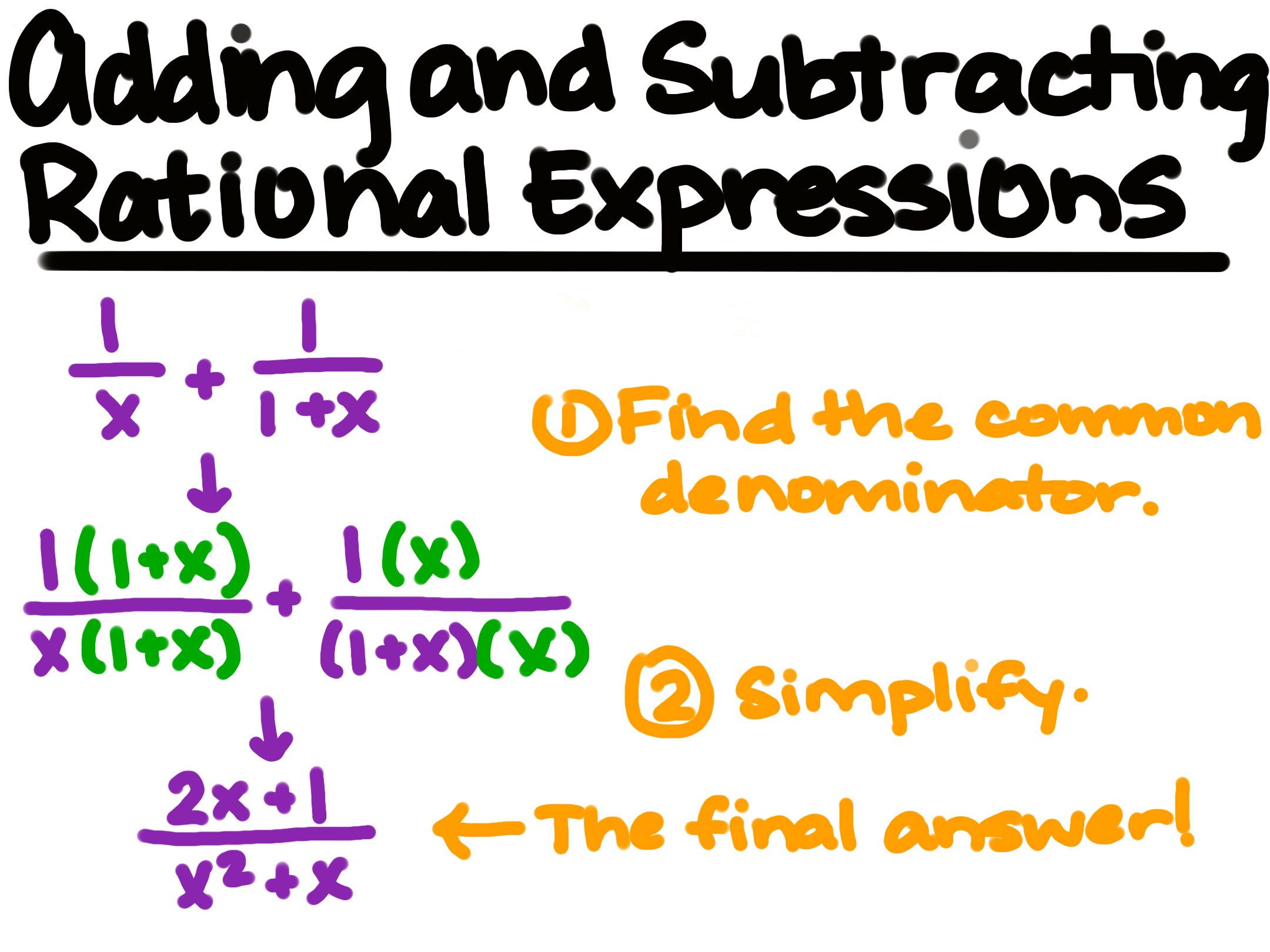
Let's think about what would happen if we wanted to add two rational expressions together. Then we're adding two fractions together!
Right now, we can't add the two rational expressions. That’s because they do not have the same denominator.
To add or subtract rational expressions, the denominators must be the same. This rule is just like adding regular fractions.
Let's think about what we can do.
We need to find a Least Common Multiple (LCM) of the denominators. The LCM helps us create a common denominator so we can combine the expressions.
Once the denominators match, we can add or subtract the numerators.
Let's start with the first fraction, . We can multiply the numerator and denominator both by .
We're now going to do the same thing for the second fraction!
Now that we've got two fractions with the same denominator, we can add them together!
This new expression probably looks very daunting, but remember that you did the bulk of the work by ensuring both fractions have the same denominator. Now you can add the numerators!
We solved it!
We use the same process when subtracting rational expressions.
First, make sure the denominators are the same. This is called finding the Least Common Denominator (LCD).
Once the denominators match, you simply subtract the numerators. The denominator stays the same.
You do not need to learn any new rules. Adding and subtracting rational expressions with a common denominator works just like regular fractions.