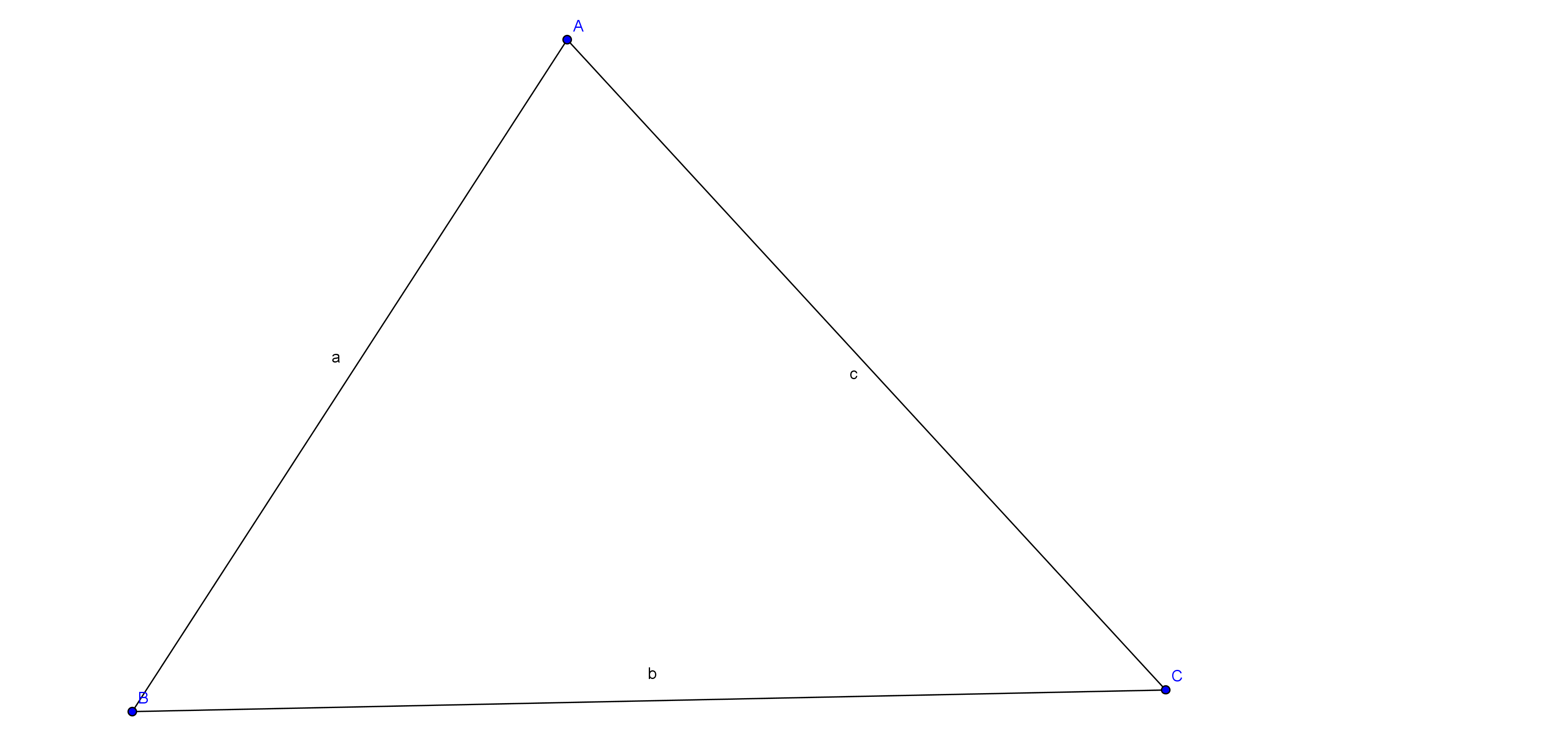
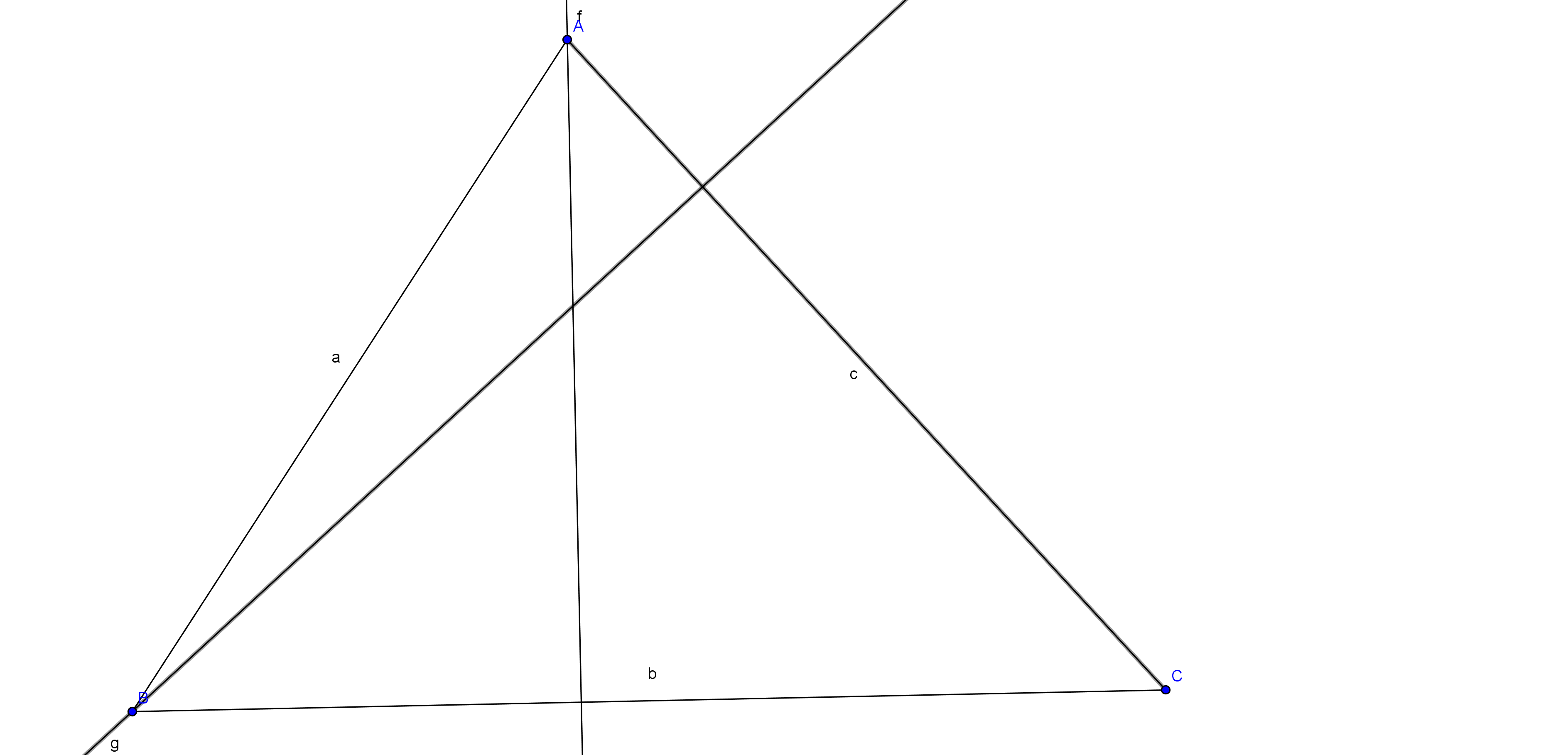
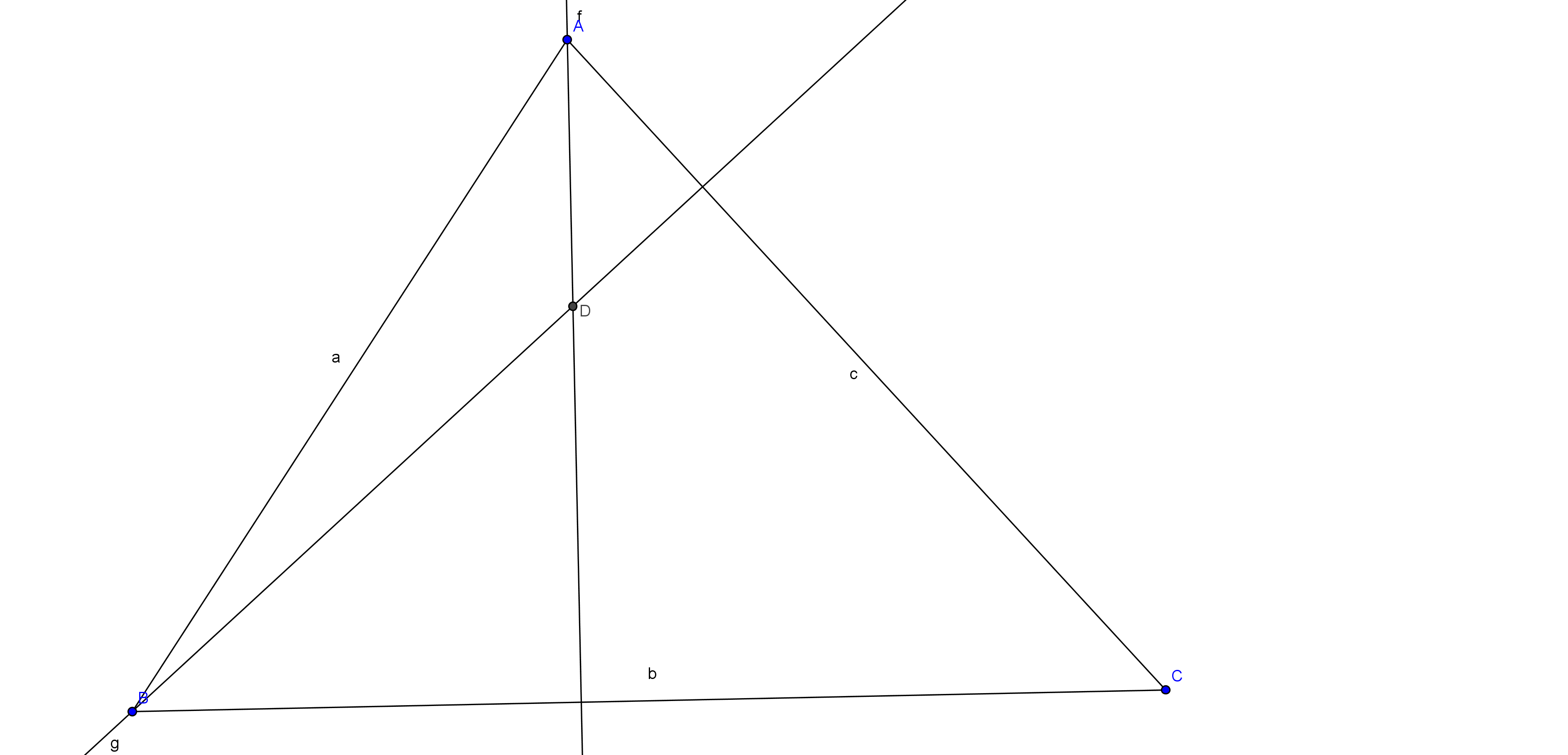
The orthocenter of ΔABC is the point where the altitudes of ΔABC concur.
PROOF OF CONCURRENCE:
Suppose that ΔABC is the Medial Triangle of ΔHGI. Since AD, BE, and CF are perpendicular bisectors of the sides of ΔHGI, they concur at the circumcenter. Hence, the altitudes of ΔABC concur at the orthocenter.
■
CONCLUSION: The orthocenter as well as many other triangle centers show up often in mathematics. It is quite useful to know how to work with them.
The three altitudes of a triangle meet at a single point, known as the orthocenter. This is a fact that is far from obvious. One problem with proving this statement is that the altitudes can meet either inside the triangle, outside the triangle, or on the triangle itself. In addition, sometimes, the altitudes as we normally draw them will intersect as desired, whereas sometimes we need to extend the altitudes to make them meet (so perhaps we should qualify the above statement as follows: the lines containing the three altitudes of a triangle meet at the orthocenter).
A common method of proving that three or more lines are concurrent is to define the intersection of any two of them, and then to prove that the other lines pass through the point we have defined. For this proof, let the triangle be △ABC, and let the altitude from A to BC and the altitude from B to AC be H (the orthocenter is typically denoted H because it is the intersection of the heights of the triangle). We must prove that the altitude from C to AB passes through H.
A very elegant and clean way of proving this is to use vectors. The motivation for using vectors is that vectors have a very nice condition for perpendicularity; in addition, we no longer have to prove the theorem for multiple configurations (e.g. the intersection point lies inside or outside the triangle). The use of vectors allows full generality.
Since H lies on the altitude from A to BC, we have:
AH⊥BC
Two vectors are perpendicular if and only if their dot product is zero:
AH⋅BC=0
Now, we do some algebra:
(H−A)⋅(C−B)=0H⋅C−H⋅B−A⋅C+A⋅B=0
Since H lies on the altitude from B to AC, we have:
BH⊥AC
Performing the same process as above, we reach the following:
H⋅C−H⋅A−B⋅C+A⋅B=0
Subtracting the first equation from the second equation, we get:
H⋅B+A⋅C−H⋅A−B⋅C=0
Factoring the left side,
(H−C)(B−A)=0CH⋅AB=0
Therefore, CH⊥AB, so H lies on the line containing the altitude from C to AB. It follows that the three altitudes of a triangle must concur, and the proof is complete. We call the point H the orthocenter of △ABC.