Today we have a pretty advanced topic to discuss, so make sure that you have your thinking caps on! Don't worry though, I will break it down and put it into the simplest terms that I can.
Let's begin discussing alpha decay!
First, what is Alpha Decay and where did this idea come from?
Alpha decay (α-decay) is a type of radioactive decay that is similar to beta decay but was distinguished as its own entity by Ernest Rutherford. Studying the deflection of this radiation through a magnetic field, he discovered that the deflection of alpha decay results in a positive charge with the particles having a +2e charge.
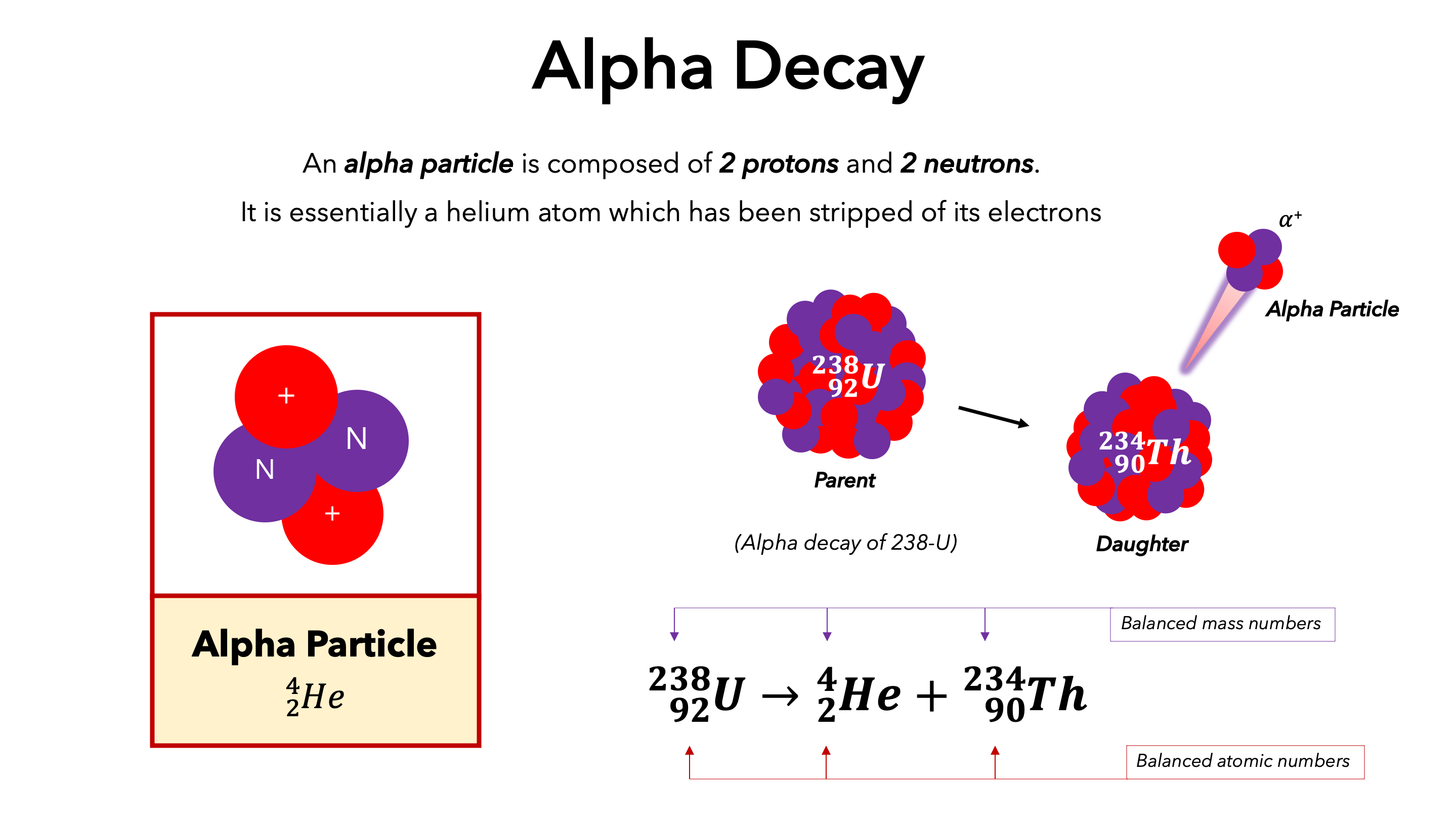
With this kind of decay, an unstable atomic nucleus will actually emit, or release an alpha particle and then transform into an entirely different element. You can think of the nuclei as being a parent nucleus and a daughter nucleus.
The Alpha particle that is ejected is composed of two protons and two neutrons and is known as a helium nucleus.
This process occurs most often when massive nuclei have too large of a proton to neutron ratio. When the atomic nucleus decays, the atomic mass number is reduced by four and the atomic number by two, bringing it to a much more stable and happy configuration.
Useful information about the Alpha particle is provided in the following table:
Atomic Mass NumberNumber of ProtonsNumber of NeutronsPenetration DepthPolarity of ChargeAverage Kinetic Energy422Generally low, a few cmPositiveapproximately 5MeV$
Now that we have a decent idea of what Alpha decay is, let's introduce the "math" that is involved with this idea.
Recall that the parent nucleus decays into a daughter nucleus, and in doing so, the mass number of the daughter is 4 less than the parent and the atomic number is decreased by 2. This process can be described using the Alpha Decay Equation, which is as follows:
ZAX⇒Z−2X−4Y+24He
- ZAX is the parent nucleus
- A is the total number of nucleons
- Z is the total number of protons
- Z−2X−4Y is the daughter nucleus
- 24He is the emitted alpha particle
Let's take a look at some examples!
Plutonium 239 will decay by alpha particle emission is the followjng way:
Pu94239⇒U92235+He24
Uranium 238 will decay to Thorium 234 with that helium nucleus being ejected:
Ur92238⇒Th90234+He24
Fun fact: Since an alpha particle is relatively more massive than other forms of decay, a simple sheet of paper is able to shield it and it is unable to penetrate the skin!
Other types of radioactive decay, or the breakdown of an atomic nucleus, include Beta Decay, where electrons are emitted, and Gamma Decay where high energy photons are emitted. Therefore, based on what is being emitted, you can determine what kind of decay that you are dealing with!