
Interactive · 2 questions
Besides the normal DNA double helix, there are many types of DNA structures.
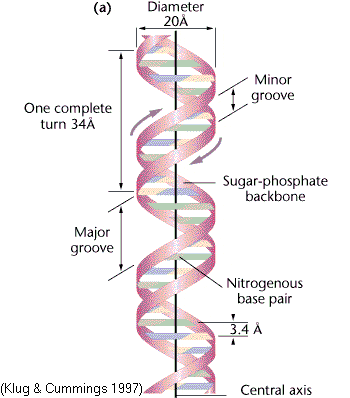
Looking at the image above, is normal DNA (B-DNA) left or right handed?
Yes, B-DNA is right handed. There are actually 3 different types of DNA helices: B-DNA, Z-DNA, and A-DNA.
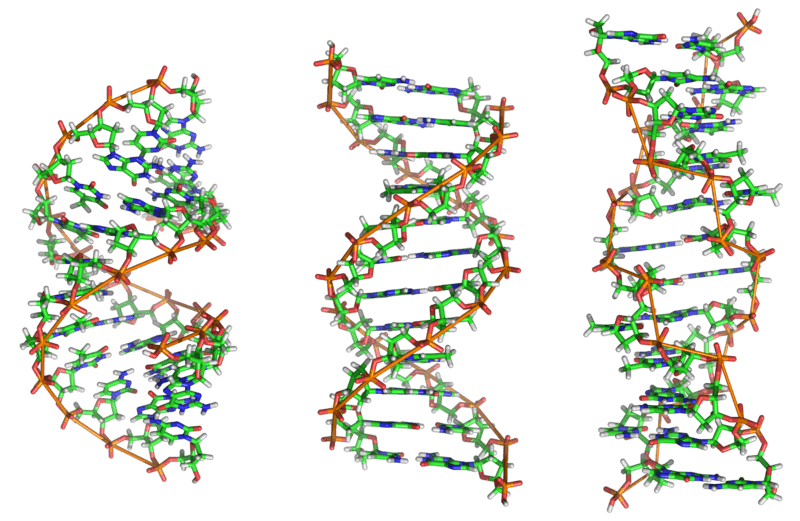
From left to right: A-DNA, B-DNA, and Z-DNA
B-DNA, the common structure, has 10.5 base pairs per turn and a diameter of about 30 Angstroms. A-DNA and Z-DNA have 11.0 base pairs per turn and 12.0 base pairs per turn respectively. Based off of X-ray crystallography, we have determined the diameter of A-DNA and Z-DNA to be 26 Angstroms and 18 Angstroms respectively. The sugar pucker also differs between the 3 forms, but that is too complicated to describe here. Major and minor groove shape and size also vary among the 3 helical structures.
A-DNA has been crystallized from various sequences, most commonly duplexes like and , at a low humidity. If you look at the picture above, you can see that the bases in A-DNA don't line up with the helical axis like B-DNA. Like B-DNA, A-DNA is right-handed. Since this crystalllography was done ex vivo, we don't know if this structure actually exists in vivo. However, some of the crystallized DNA-Protein complexes we have appear to have A-DNA in them (TATA-box binding protein and DNAse1).
Z-DNA is actually a left-handed double helix. When it was first crystallized, a lot of scientists were skeptical but have now accepted it. Z-form DNA was found using repeats of self-complementary oligos like and . They named it Z-DNA because the phosphate backbone appeared to zigzag as shown above. Z-DNA is normally found in DNA molecules with long alternating GC sequences and at high salt. We also don't know if this is found .
At a high salt concentration and high humidity what structures do you think GCGCGCGCGCGCGCGCGCGCGC could form?
Remember that any DNA sequence can form B-DNA when paired with its corresponding strand. It is at high humidity so A-DNA would not be found very often it at all. The sequence is self complimentary and full of Gs and Cs so it might form Z-DNA.
Suprisingly, DNA triplexes also exist! They form when another strand tries to interact with a DNA duplex like B-DNA. In H-DNA, one of the more uncommon forms of DNA, a dsDNA strand interacts with a a single stranded DNA to form a triple helix. Essentially, a strand made up of pyrimidines lies in the major groove of another strand of double stranded DNA and is stabilized by Hoogsteen base pairs. Hoogsteen base pairs are in the picture below. The symbol YR*Y just means that is composed of two pyrimidine strands and one purine strand. YR*R means that it is composed of one pyrimidine and two purine strands. Triplexes are interesting because they hae the potential to target a specific sequence of DNA.
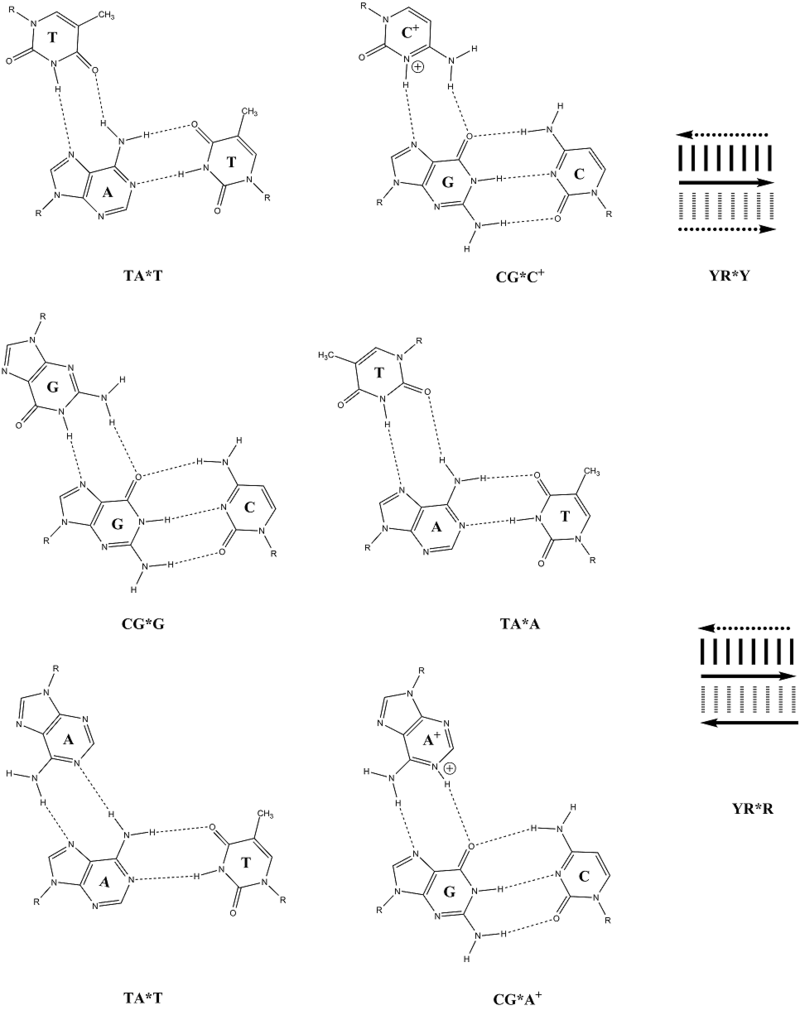
Hoogsteen Base Pairs
Holliday Junctions have also been shown to occur in cells. They are the result of homologous recombination, which is used for double-stranded break repair. To learn more about Holliday junctions, wait till the explanation for double-stranded break repair is written. One is shown below. They are also used in DNA nanotechnology to synthesize certain shapes.
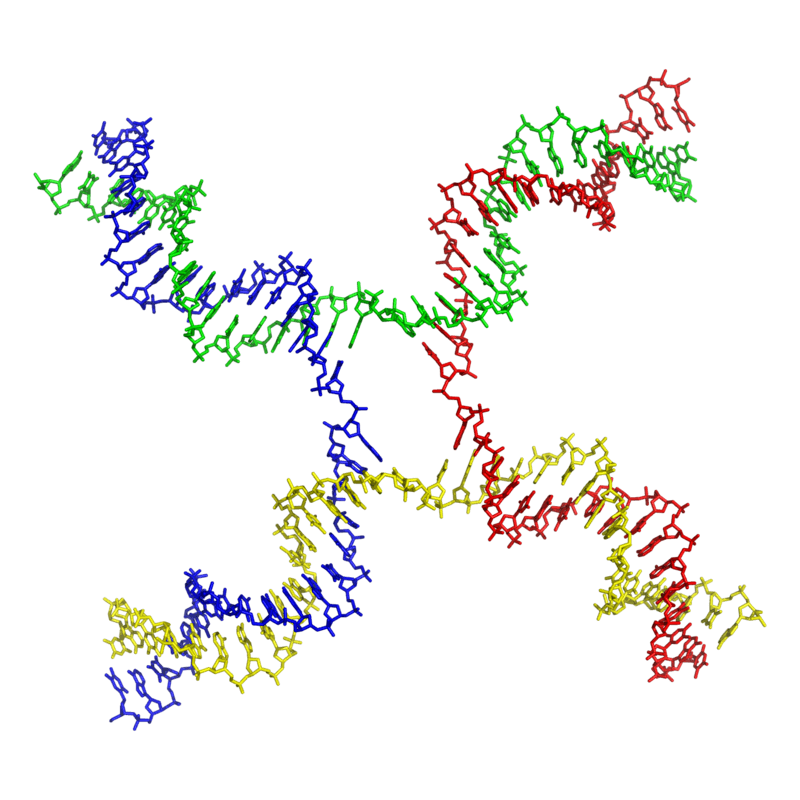
Holliday Junction
DNA cruciforms can also form. They are normally found in regions with sequences that base pair to their backwards sequence (called "inverted repeats" or "palindromes"). It is energetically unfavorable to form these structures in B-DNA but they can form in negatively supercoiled covalently closed circular DNA like a negatively-supercoiled plasmid in bacteria.
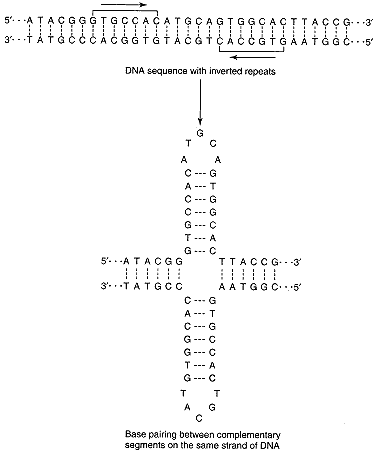
DNA cruciform
My personal favorite, DNA quadruplexes, form in DNA molecules with a long 3' single stranded Guanine-rich overhang. As shown below, the repeating Gs can associate into tetrads that can form parallel or antiparallel DNA quadruplexes. They are stabilized by hydrogen bonding and have a monovalent ion (K or Na) in the center of the quartet. C-rich DNA can form structures known as i-motifs and i-quadruplexes. In i-motifs and i-quadruplexes, two protonated C-rich duplexes intercalate or weave in and out of each other. Because they need to be protonated, i-motif and i-quadruplex formation is only favoured in low pH environments.
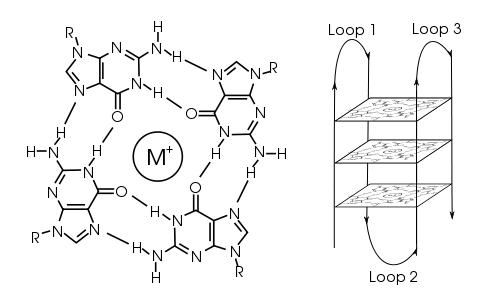
G Quadruplex
There are probably other undiscovered alternate DNA structures as well. Hopefully, we will be able to add more interesting DNA structures to this list.