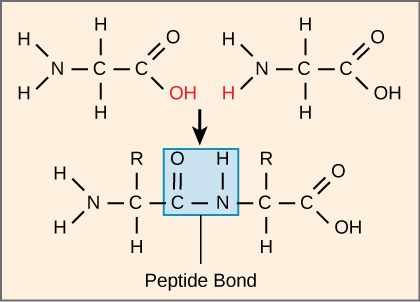
Proteins are formed from monomers called amino acids joined together by peptide bonds. A chain of these monomers can also be called a polypeptide.
There are 20 amino acids from which all proteins are made. Your body can produce 11 of them on its own. That means we have to get the other nine from the foods we eat.
The nine that we cannot synthesize (make) are called essential amino acids.
Some proteins contain just a few of these monomers in a chain, while other proteins consist of thousands of them. The largest known protein is titin; it's made of a chain of 33,000 amino acids.
Here are the 20 amino acids. Note that many (though not all) have names ending in -ine.
All amino acids have three identical parts: an amino group, a carboxyl group, and a hydrogen. They only differ in their fourth part, called a functional group, R group, or side chain.
In the table above, the functional groups are highlighted in blue. Note how every other part is always the same. The diversity of R groups makes proteins the most diverse of the biological macromolecules.
The Importance of Functional Groups
The functional groups of amino acids are necessary for the creation of all the different proteins our bodies require. Amino acids are usually characterized by their functional groups. Polarity, acidity, and chemical makeup are often used to predict how these functional groups will interact with each other. These interactions determine secondary and tertiary protein structures, which make up the shape of the protein.
Bonding and Polypeptide Chains
Sequences of amino acids, joined together by peptide bonds, form polypeptides. A peptide bond is a covalent bond between the amino group of one amino acid and the carboxyl group of another one. The formation of this bond releases a molecule of water.
The R group doesn't influence the bond formation. This is because peptide bonds only occur between the carboxyl and amino groups. This means that a peptide bond can form between any two amino acids. Their arrangement in a polypeptide is dictated by DNA.
These polypeptide chains are the primary structure of proteins. The interactions between R groups determine further structure.
Vocabulary Review:
Monomer : Any molecule that can react with other molecules of the same or different makeup to form a chain, or polymer
Polymer : A chain of monomers made of a specific type of compound
Macromolecule : A polymer that has a large (macro) molecular mass. There are four main types in organisms: carbohydrates, proteins, lipids, and nucleic acids
Amino Acids : Molecules with a carboxyl group (−COOH) and an amino group (−NH2). The building blocks of proteins
Polypeptide : A molecule made up of peptide bonds or covalent bonds that hold amino acids together
Protein : Complex polymer made of carbon, hydrogen, nitrogen, and oxygen. They are made of amino acids