
Illustrated · 1 min
Angle of Incidence
Angle of Incidence is the angle between the incident ray and the normal. (Normal is the line perpendicular to the surface.)
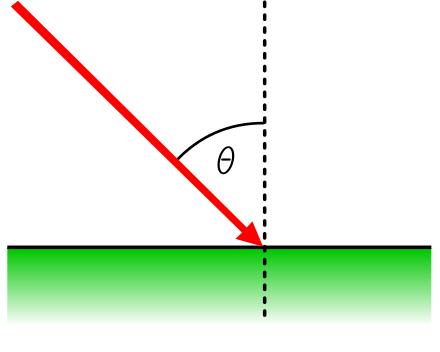
Image Credit: Wikipedia
Illustrated · 1 min
Angle of Incidence is the angle between the incident ray and the normal. (Normal is the line perpendicular to the surface.)
Image Credit: Wikipedia
Illustrated · 1 min
Angle of Reflection of a ray or beam is the angle measured from the reflected ray to the surface normal.
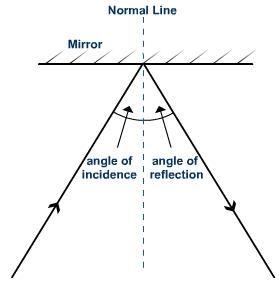
Image Credit: www.s-cool.co.uk
Read · 1 min
The angle of reflection is the angle formed between the normal and reflected ray. The angle of reflection = The angle of incidence The normal angle of reflection and angle of incidence lie in the same plane
Read · 1 min
Fermat's Principle of Least Time
This is an analogue of the well known Principle of Least Action in Mechanics. All the explanations above so far have been discussing about the angles of incidence and reflection, but how do we actually come up with the formula for the Law of Reflection??
Fermat's Principle of Least Time tells us that light will always take the path that can be traversed in the least time.
This is sufficient knowledge to derive the Law of Reflection.
Hint: Draw a mirror and label 2 points where the light has to travel from point A to point B and constrain the light to hit the mirror at least once during its travel.