Illustrated · 1 min
+7 contributors






Differences Between Animal and Plant Cells
There are many similarities between plant cells and animal cells, including the fact that both are eukaryotic (they have a nucleus). Plant and animal cells also have many membrane bound organelles in common.
However, there are a few key differences that can help you easily distinguish between plant and animal cells.
For one, lysosomes and centrioles are only found in animal cells, not plant cells. Here are some other differences:
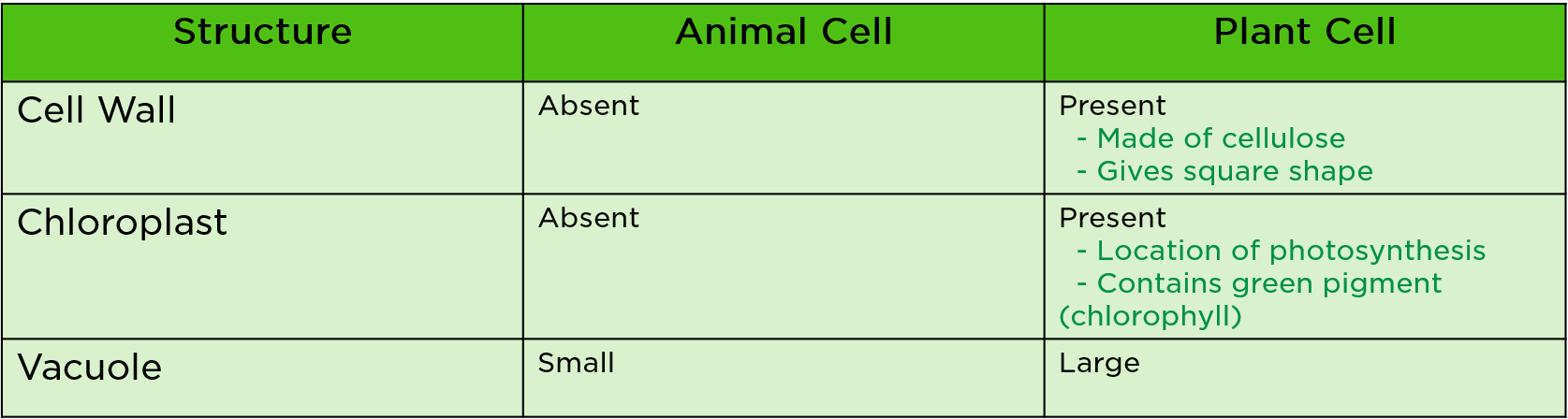
Image Source: by Hannah Bonville et al
Let's consider each of these differences, one at a time.
Cell Wall
Plant cells have cell walls made of cellulose, a polysaccharide (large sugar).
Just as the walls of your room give it straight sides, cell walls make plant cells rectangular and straight-sided. This is in contrast to the more circular, blobby shape of animal cells.

Image source: By Fran Barreto CC0, via pixabay.com Image source: By LadyofHats [Public domain], via Wikimedia Commons
Chloroplast
Another giveaway that a cell is from a plant is if it's green. This green color is caused by a pigment called chlorophyll, which is stored inside organelles called chloroplasts.
You will only find chloroplasts in plant cells. These are the organelles where photosynthesis takes place. Animal cells undergo cellular respiration instead of photosynthesis. Chloroplasts are types of plastids, which are organelles in plant and algae that create and store food or pigments and play an important role in photosynthesis.

Image source: By Kristian Peters -- Fabelfroh CC BY-SA 3.0, via Wikimedia Commons Image source: By CNX OpenStax CC BY 4.0, via Wikimedia Commons
Large Vacuole
The last major structural difference between plant and animal cells is that, while both types have vacuoles, the vacuoles present in plant cells are very large.

Image source: By MesserWoland and Szczepan1990 CC BY-SA 3.0, via Wikimedia Commons Image source: By LadyofHats [Public domain], via Wikimedia Commons
Key Vocabulary:
- Animal cell
- Plant cell
- Cell wall
- Cellulose
- Chloroplast
- Chlorophyll