Interactive · 1 question

Richter Scale: Magnitude and Intensity of Earthquakes

\\

Richter scale is a good way to talk about how strong an earthquake is. It is also easy to compare two earthquakes using the Richter scale.

Generally, earthquakes are estimated to be under 1010 on the Richter scale.

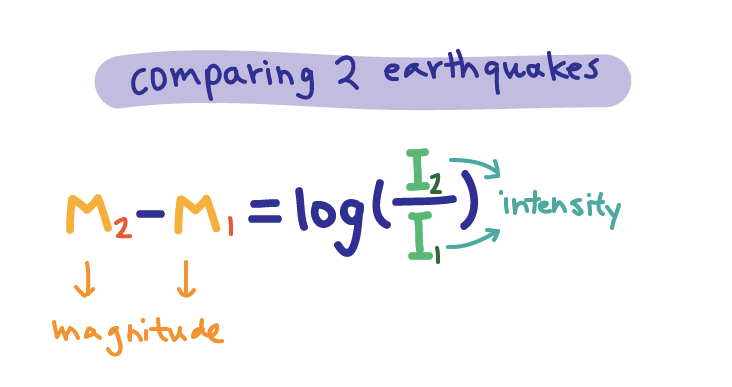
Below is the formula for comparing two earthquakes.

M2-M1=log(I2-I1)

Image source: by Christine

You can check out how this formula is derived.

Compute the magnitude of an earthquake \\

Given the intensity of two earthquakes and the magnitude of one of them, we can find the magnitude of the other earthquake. For example:

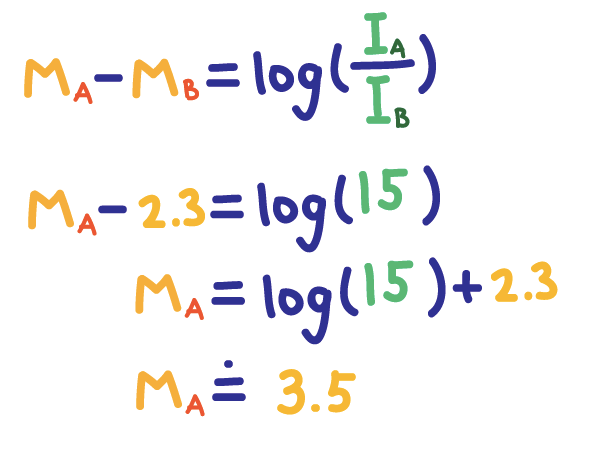
Earthquake AA is 1515 times stronger than earthquake BB. Earthquake BB is estimated to be 2.32.3 on the Richter scale. What is Earthquake AA on the Richter scale?

M_A-M_B=log(I_A/I_B)
M_A-2.3=log(15)
M_A=log(15)+3.5
M_A=3.5

Image source: by Christine

How much stronger is this earthquake comparing to that? \\

When given the magnitudes of 22 earthquakes, we can figure out how much stronger one earthquake is comparing to the other one. For example:

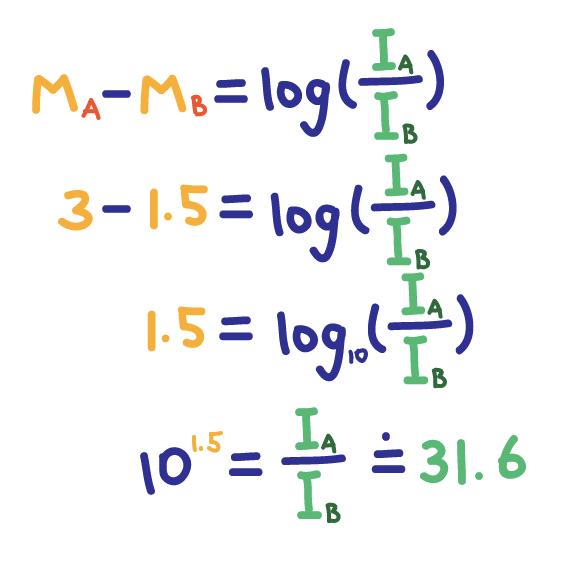
On the Richter scale, earthquake AA is estimated to be 33 and earthquake BB is estimated to be 1.51.5.

How much stronger is earthquake AA?

Choose one answer

Read · 2 min

The Richter Scale

The Richter scale is a logarithmic scale used to measure the "size" of an earthquake. It defines the magnitude of the earthquake to be the logarithm of the ratio of the the amplitude of the seismic wave to an arbitrary amplitude.

Wow that was a mouthful and I think I understand less about the Richter scale now. A simply formula might be easier to memorize!

We can calculate the magnitude of an earthquake using the following equation: M=log⁡(IIN)M=\log\left(\frac{I}{I_N}\right) Here the variables represent:

  • MM the magnitude of the earthquake
  • II the amplitude of the seismic wave or the intensity
  • INI_N the arbitrary amplitude or arbitrary intensity

Relating Two Earthquakes

Many problems will require you to relate information of two earthquakes or use the information of one to find another.

Suppose we have Earthquake 11 and Earthquake 22. Let's start by writing their equations. Earthquake 1:M1=log⁡(I1IN)Earthquake 2:M2=log⁡(I2IN)\begin{align} \text{Earthquake 1:}&\quad M_1=\log\left(\frac{I_1}{I_N}\right)\\ \text{Earthquake 2:}&\quad M_2=\log\left(\frac{I_2}{I_N}\right) \end{align}

Let's think about what they have in common. Well they both have the same INI_N! We can rewrite each equations in terms of INI_N and set them equal to one another. M=log⁡(IIN)M=log⁡(I)−log⁡(IN)log⁡(IN)+M=log⁡(I)log⁡(IN)=log⁡(I)−M10log⁡(IN)=10log⁡(I)−MIN=10log⁡(I)−M\begin{align} M&=\log\left(\frac{I}{I_N}\right)\\ M&=\log(I)-\log(I_N)\\ \log(I_N)+M&=\log(I)\\ \log(I_N)&=\log(I)-M\\ 10^{\log(I_N)}&=10^{\log(I)-M}\\ I_N&=10^{\log(I)-M} \end{align}

Using Earthquake 11 and 22 we get: Earthquake 1:IN=10log⁡(I1)−M1Earthquake 2:IN=10log⁡(I2)−M2\begin{align} \text{Earthquake 1:}&\quad I_N=10^{\log(I_1)-M_1}\\ \text{Earthquake 2:}&\quad I_N=10^{\log(I_2)-M_2} \end{align}

Now, set them equal to one another. 10log⁡(I1)−M1=10log⁡(I2)−M2log⁡(I1)−M1=log⁡(I2)−M2M2+log⁡(I1)−M1=log⁡(I2)M2−M1=log⁡(I2)−log⁡(I1)M2−M1=log⁡(I2I1)\begin{align} 10^{\log(I_1)-M_1}&=10^{\log(I_2)-M_2}\\ \log(I_1)-M_1&=\log(I_2)-M_2\\ M_2+\log(I_1)-M_1&=\log(I_2)\\ M_2-M_1&=\log(I_2)-\log(I_1)\\ M_2-M_1&=\log\left(\frac{I_2}{I_1}\right) \end{align}

Using this equation, we can answer pretty much any question an earthquake shakes at us!

Finding the Magnitude

The first style of problem you might encounter is finding the magnitude of an earthquake, given a second earthquakes intensity. For example:

Earthquake AA registered 7.07.0 on the Richter scale. Earthquake BB was 33 times stronger than Earthquake AA. What did Earthquake BB register on the Richter scale?

Let's fill in the information we know into the equation above. We know MA=7.0M_A=7.0. Also, we know IB=3IAI_B=3I_A because it was three times more intense. MB−MA=log⁡(IBIA)MB−7=log⁡(3IAIA)MB=log⁡(3)+7MB≈7.5\begin{align} M_B-M_A&=\log\left(\frac{I_B}{I_A}\right)\\ M_B-\color{#8925AE}{7}&=\log\left(\frac{\color{#8925AE}{3I_A}}{I_A}\right)\\ M_B&=\log(3)+7\\ M_B&\approx7.5 \end{align}

Earthquake BB will register around a 7.57.5 on the Richter scale.

How Much Larger...

The other kind of problem you might run into is finding out how much larger one earthquake is compared to another.

Earthquake AA measured a 7.07.0 on the Richter scale. Earthquake BB registered 6.06.0. How much more intense was Earthquake AA?

Let's fill in the information we know into the equation above. We know MA=7.0M_A=7.0 and MB=6.0M_B=6.0. MB−MA=log⁡(IBIA)6−7=log⁡(IBIA)−1=log⁡(IBIA)10−1=10log⁡(IBIA)110=IBIAIA=10IB\begin{align} M_B-M_A&=\log\left(\frac{I_B}{I_A}\right)\\ \color{#8925AE}{6}-\color{#8925AE}{7}&=\log\left(\frac{I_B}{I_A}\right)\\ -1&=\log\left(\frac{I_B}{I_A}\right)\\ 10^{-1}&=10^{\log\left(\frac{I_B}{I_A}\right)}\\ \frac{1}{10}&=\frac{I_B}{I_A}\\ I_A&=10I_B \end{align}

Earthquake AA is 1010 times more intense than Earthquake BB!

Video

(Video) Richter Scale Problem

by DrPhilClark

Here's a video by DrPhilClark showing you how to solve a common Richter scale problem.

Summary\large{\text{Summary}}

The Richter scale defines the magnitude of an earthquake to be R=log⁡(IcIn)R=\log\left(\frac{I_c}{I_n}\right) where IcI_c is the intensity of the earthquake and InI_n is the intensity of a standard earthquake. Therefore, you can write the difference of two magnitudes as R2−R1=log⁡(I2I1)R_2-R_1=\log\left(\frac{I_2}{I_1}\right).

Test Yourself: If one earthquake is 16 times larger than another, how much larger is its magnitude on the Richter scale?

Choose one answer

Video

(Video) Applications of Logarithms

by Bill Witte

Bill Witte has a great video explaining the practical applications of logarithms.

Video

(Video) Applications of Logs

by Richard Davies

Richard Davies has a great video explaining the applications of logarithmic equations with some examples.

Read · 1 min

Now that we've learned about logarithms and natural logs, our next step is to understand applications of logarithms. Logarithms are used in a variety of different places to model different aspects of our lives. We've already learned the basics of continuously compounded interest, and using that concept to solve compound interest problems.

We see logarithms a lot in measurements of things in the natural world. For example, the we use logarithms for the following measurements:

  • decibels (when measuring sounding)

  • the Richter scale (when measuring the size of an earthquake)

  • pH (when measuring acidity and basicity)

  • exponential growth and decay

  • estimating time of death using the temperature of the body and the temperature of the surroundings

  • cooling of an object, from initial temperature using rate of temperature loss

In our non-natural world, we use logarithms, as well:

Type a concept, like “slope” or “photosynthesis”.

↑ ↓ to choose · Enter to openSearch explanations and problems