Approaches to Studying Evolution — Methods & Examples

Before this, knowEvolution Basics

Illustrated · 2 min

How Do Scientists Study Evolution?

One way to learn more about how ancient species evolved is to use fossil evidence. Fossils are most often found in sedimentary rock. Sediments are sand or clay which settle at the bottom of a body of water. Over time, this layer of sediment is covered by new layers. As the layers get heavier, the sediment hardens into sedimentary rock.

Dead organisms can be buried under new layers of sediment and preserved in sedimentary rock. This process can create fossils.

Some examples of fossils include insects, shells, bones, and plants.

Here are some examples of the types of fossils scientists can find. Insects, shells, bones, and plants can all be found as fossils.

Image source: By Gabi Slizewska

So how does all of this help us learn about evolution?

Fossils are often only parts of organisms, like bones or teeth, but they help us compare structures of extinct species to similar modern ones. This way, we can see how certain structures have changed over time.

Scientists can also use fossils and sedimentary layers in a process called relative dating. Relative dating puts the different sedimentary layers in chronological order. The lower layers are older than the layers closer to the surface. This also allows scientists to place the fossils in those layers in chronological order. Unfortunately, this technique does not give us an exact age of the fossils. Instead, it shows us relative age in comparison to the fossils in other layers.

A diagram of how relative dating works. Upper layers (closer to the surface) are younger than the deeper, lower layers.

Relative dating works by comparing the fossils found in different layers of sedimentary rock.

Image source: By Gabi Slizewska

Another really cool technique is called radiometric dating. This technique relies on radioactive isotopes to determine the age of a fossil in years. This is possible because radioactive isotopes present in the body decay, or break down, at a steady rate. A half-life is the amount of time it takes for half of the radioactive isotopes in a sample to convert to nonradioactive isotopes. Knowing the half-life of a specific radioactive isotope lets scientists make precise estimates of a fossil's age.

One form of this technique is called carbon dating. It is used with fossils of living organisms because they contain the radioactive carbon-14. However, carbon-14 has a short half-life on the evolutionary scale, so it is only useful for relatively "young" fossils (up to 60,000 years old).

Other radioactive isotopes such as potassium-40 can be used to date older fossils. However, these isotopes are found in rock, not in fossils. Using these isotopes allows scientists to date layers of sedimentary rock, which also dates the fossils within them.

An example of radiometric dating. A sample of a rock begins with 20 molecules of radioactive uranium at 0 half-lives. After 1 half-life, half of the molecules of uranium turn into non-radioactive lead. This means that 10 of the 20 molecules are now lead. After 2 half-lives, half of the uranium molecules that are left after 1 half-life turn into lead. This means that 15 of the molecules are now lead.

An example of radiometric dating using radioactive uranium. The uranium decays into lead.

Image source: By Gabi Slizewska

Scientists used these methods to establish a geological time scale. This is a timeline of the Earth's history. It consists of eons, eras, and periods. These methods also let us determine the rate at which evolution takes place.

Below is an example of what the geological time scale looks like.
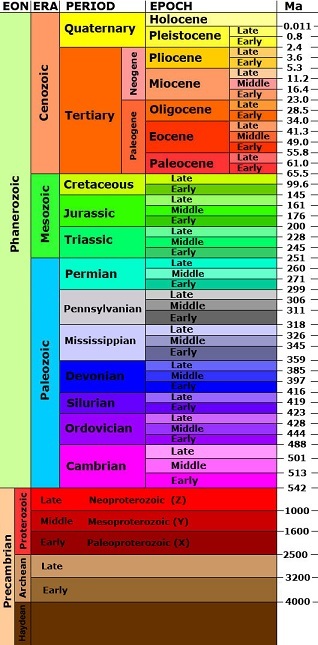
A diagram of the geological time scale

Image source: By United States Geological Survey [Public domain], via Wikimedia Commons

Illustrated · 1 min

Fossils are the remains of dead animals and plants, which have been naturally preserved for thousands of years. Fossils represent species that once existed on Earth, but may now be extinct. Their physical similarities to living species explain how modern species have come to exist. When we study fossils, it is also important to know how old they are. One way to find out is by relative dating. We can use this method because of how sedimentary layers form. Fossils found further down in the ground are older relative to those closer to those closer to the surface. A better way of dating fossils, radiometric dating, looks at the radioactive isotopes in biological samples. Each isotope has a specific half-life, the time it takes for half of the radioactive isotopes to become non-radioactive. All of the information gathered from fossils help us create evolutionary timelines or various species, as well as geological time scales.

Image source: By Gabi Slizewska

Video · + 1 min read

(Video) Evolution: It's a Thing

by CrashCourse

Scientists use many different techniques to study the evolutionary process. In the video above, Crash Course presents evidence of evolution.

Summary

The theory of evolution is based on many observations by scientists like Jean-Baptiste Lamarck and Charles Darwin. There are actually many types of evidence that support this theory.

Evolutionary biologists may choose to study fossils or anatomical similarities between species. They can study how two species that used to be the same became separate species. They can even study the behavior of organisms to see if there are any common themes.

Radioactive dating and carbon dating are two very common ways to study evolutionary history and the age of fossils. Relative dating is another method that is used to determine the age of fossils.

Comparative anatomy is a technique used to compare the similarities and differences between species. It allows scientists to determine which species share a common ancestor.

Vocabulary Review:\color{#8925AE}{\text{Vocabulary Review:}}

Radioactive Dating\color{#8925AE}{\text{Radioactive Dating}} : A technique for determining the age of an object by analyzing the amount of radioactive isotopes that are present within the object

Relative Dating\color{#8925AE}{\text{Relative Dating}} : A technique for determining the age of an object by studying the age of the rocks that surround it

Read · 2 min

Tracking Evolutionary Changes

There are many different approaches to studying evolutionary biology. Evolution as a whole can be defined as a change in the genetic composition of a genetic population over a period of time. This has lead to the diversity of life that we see today.

It's not always easy to look at two different species and tell how close or far apart they are on the tree of life. For example, if you were to look at a whale you might say that it's more closely related to sharks than to humans. However, through some more in-depth studying, we are able to see that a whale and a human are more closely related as they are both mammals.

Determining the Age of a Fossil

There are several different methods of looking back in time and seeing how closely related different species are. Many times scientists will look at the fossils they find in the ground to track the Earth's evolutionary past. Originally, the deeper into the earth you went the older the fossil supposedly was. Now we have a more exact way of dating these fossils through processes such as carbon dating and radiometric dating in which we are able to see how old a fossil is based on the chemicals within it.

Comparing Species

Scientists are then able to compare the physiological, or physical, features of these animals and track their evolutionary past. We are able to see this by comparing the fossils of animals to those animals which are currently alive in the region. The fossils typically have similarities to those animals which live in the same area in the present day.

A relatively new process of researching evolution is by using molecular biology to look at the genetic code of each species and using different mathematical models and computer simulations to determine how closely related two species are. Using genetic information (like protein amino acid sequences) is typically more accurate than studying fossils because while two species could look similar, their genetic code may tell a different story.

Type a concept, like “slope” or “photosynthesis”.

↑ ↓ to choose · Enter to openSearch explanations and problems


