Area of a Quadrilateral

Before this, knowPerimeter vs. Area

Interactive · 1 question

Area of a quadrilateral

A quadrilateral is a figure, or shape, with four sides. Rectangles and squares are both quadrilaterals.

The formula of area of rectangles and squares are rather straightforward--it is width times length. However, for squares, the width equals the length.

A=width×lengthA=\text{width}\times \text{length}
A rectangle and square with length and width labeled.  The length and width of a square are equal.  The area of any rectangle is the product of its length and width.

What about the area of a parallelogram?

Can we still use the length×width\text{length} \times \text{width} formula?

A parallelogram with its base and height labeled.

The answer is yes!

In fact, you can cut up any quadrilateral and rearrange the pieces to make a rectangle. Since you are using the pieces from the old quadrilateral, the new rectangle will has the same area. This way, the area formula of a rectangle applies to all quadrilaterals!

Try it!

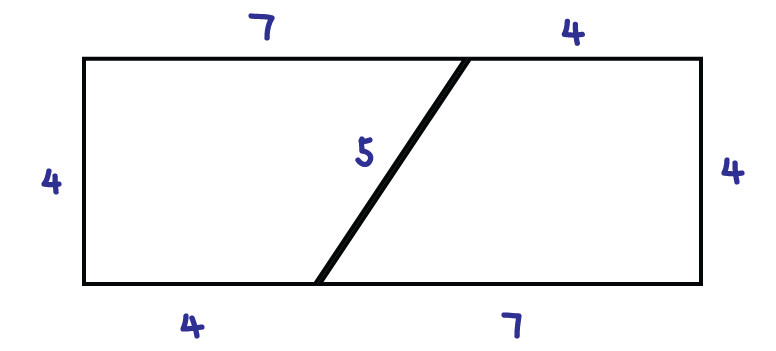
A right trapezoid with base 7, height 4, parallel side 4, and final side 5.

What is the area of the quadrilateral above?

Choose one answer

No recipe to follow

These problems have no steps to copy. You have to understand the idea well enough to bend it to a new purpose. These are real problems from the AMC 8, AMC 10, AMC 12 and AIME, the national math competitions for middle and high school students, each with a worked solution on LIVE by Po-Shen Loh.

Illustrated · 1 min

Areas of Different Quadrilaterals\textbf{Areas of Different Quadrilaterals}

Here are some graphics that show you the formulas to find the areas of different quadrilaterals: squares, rectangles, parallelograms, rhombi, trapezoids, and kites.

The area of a square with side lengths of x is represented by the following formula: A=x^2.

Image by Caroline Kulczycky

The area of a rectangle with base length b and height length h is represented by the following formula: A=bh.

Image by Caroline Kulczycky

The area of a parallelogram with base length b and height length h is represented by the following formula: A=bh.

Image by Caroline Kulczycky

The area of a rhombus with base length b and height length h is represented by the following formula: A=bh.

Image by Caroline Kulczycky

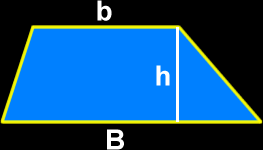
The area of a rhombus with one base length b1, second base length b2, and height length h is represented by the following formula: A=h(b1+b2)/2.

Image by Caroline Kulczycky

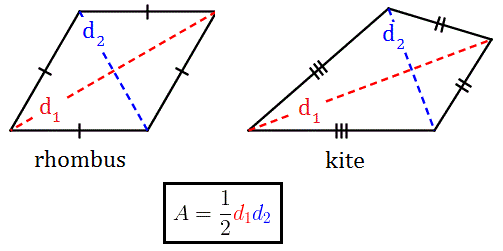
Area of a kite with one diagonal of length a and the other diagonal of length b is represented by the following formula: A=ab/2

Image by Caroline Kulczycky

Video · + 2 min read

(Video) Area of Quadrilaterals

by SmithMathAcademy

In this video, SmithMathAcademy goes over how to find the area of squares, rectangles, general parallelograms, and irregular polygons.

Summary\large{\text{Summary}}

Finding the Area of a Square

A square has four sides of equal lengths. Let's say each side has length s.s.

A square with side lengths s.

Then A,A, the area, is given by the following equation: A=s⋅sor A=s2\begin{align} A&=s \cdot s\\ \text{or } A&=s^2 \end{align}

Finding the Area of a Rectangle

Let's say a rectangle has a base of length bb and a height of length h.h. (Note: you can also say that the rectangle has length bb and width h.h.)

A rectangle with base b and height h.

Then A,A, the area, is given by the following equation: A=bhA=bh

Finding the Area of a Parallelogram

Say you're given a parallelogram with a base of length bb and a height of length h.h.

A parallelogram with base b and height h.

Then A,A, the area, is given by the following equation: A=bhA=bh

Finding the Area of Irregular Polygons

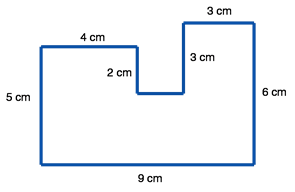
To find the area of an irregular polygon, simply break down the shape into smaller polygons, and find the area of those. Let's look at an example where we find the area of the following polygon from the video:

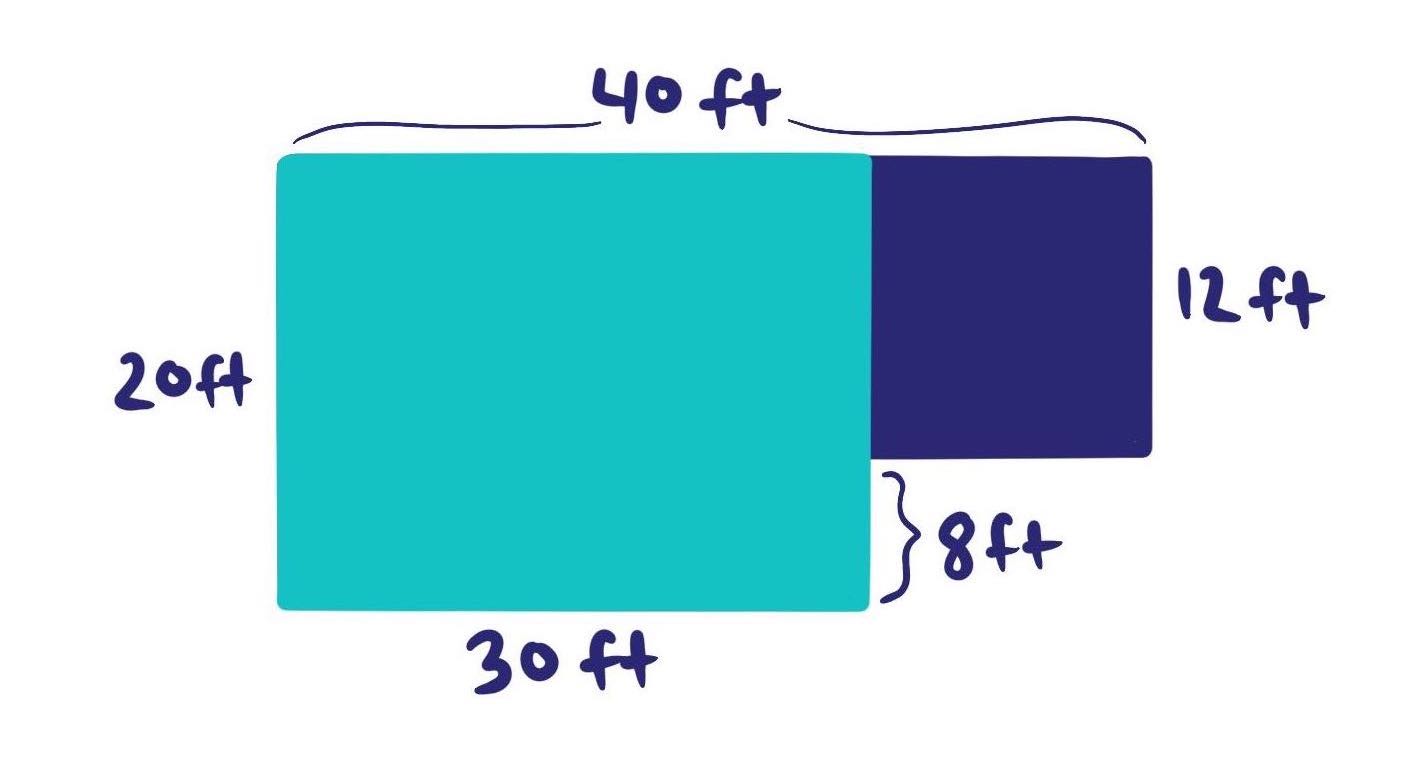
An irregular polygon with the top side of length 40 ft, the left side of length 20 ft, the bottom side of length 30 ft, the right side of length 12 ft.

There are multiple ways of breaking this irregular polygon down into smaller quadrilaterals. Here's one way from the video:

The same irregular polygon as before, except it's demonstrated how it's composed of a smaller blue rectangle and purple rectangle. The blue rectangle is 30ft x 20ft and the purple rectangle is 10ft x 12ft.

We have broken the irregular polygon into two rectangles: a blue one and a purple one. To find the area of the big irregular polygon, we simply add the areas of these smaller rectangles.

The blue rectangle has a base of 30ft30\text{ft} and a height of 20ft.20\text{ft}. Using our area formula for rectangles, we can find the area of the blue rectangle: A=bh=30 ft×20 ft=600 ft2\begin{align} A&=bh\\ &=30\text{ ft} \times 20\text{ ft}\\ &=600 \text{ ft}^2 \end{align} Notice how the top side of the big irregular polygon is 40 ft40\text{ ft} and the bottom side is 30 ft.30\text{ ft}. What happened to the remaining 10 ft?10\text{ ft}?

The remaining 10 ft10\text{ ft} is actually the length of the base of the purple rectangle! This rectangle also has a height of 12 ft.12\text{ ft}. Using our area formula for rectangles, we can find the area of the purple rectangle:

A=bh=10 ft×12 ft=120 ft2\begin{align} A&=bh\\ &=10\text{ ft} \times 12\text{ ft}\\ &=120 \text{ ft}^2 \end{align}

The area of the big irregular polygon, A,A, is equal to the sum of the areas of the blue and purple rectangles. Thus:

A=600 ft2+120 ft2=720 ft2\begin{align} A&=600 \text{ ft}^2+120 \text{ ft}^2\\ &=720 \text{ ft}^2 \end{align}

The irregular polygon has an area of 720 ft2.720 \text{ ft}^2.

Illustrated · 1 min

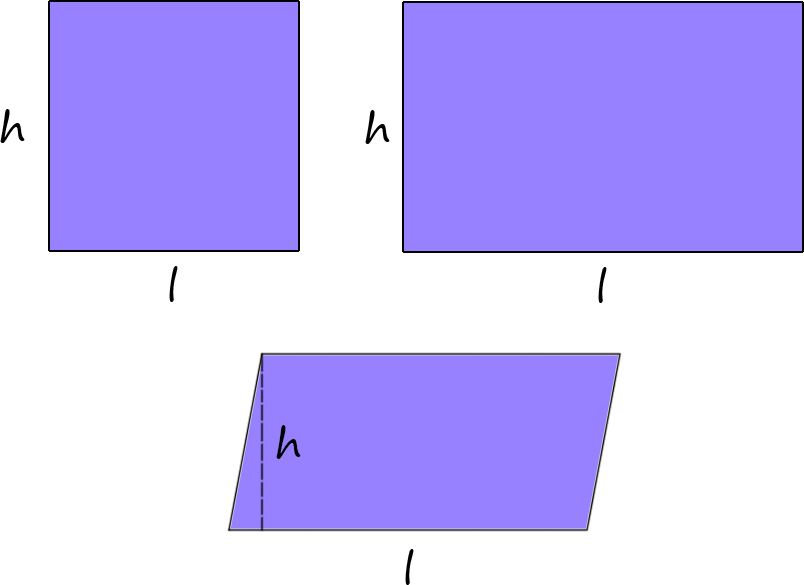
The area of any quadrilateral is its length times its height. A=lhA=lh

An image of a square, rectangle, and parallelogram with length (base) and width (height) labeled.

Illustrated · 1 min

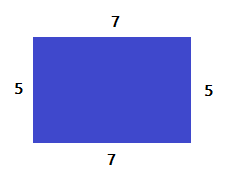
The definition for the area of a shape can be found here. The formula for finding the area of a quadrilateral is: A=b⋅h\color{blue}{A}=b\cdot h Where b=baseb=\text{base} and h=heighth=\text{height}. \\ This formula can be used to find the area of the rectangle below:

A rectangle with sides 5, 7, 5, 7.
A=7 units×5 unitsA=35 units2\color{blue}{A}=7\text{ units}\times 5\text{ units} \\ \color{blue}{A}=35\text{ units}^2

Video · + 3 min read

Area of quadrilaterals including irregular shapes

This image is of the 7 types of quadrilaterals. This includes the following shapes: parallelogram, Isosceles trapezoid, rectangle, square, trapezoid, rhombus, and kite.

These seven shapes are all quadrilaterals which create a sort of hierarchy. Kite -- a quadrilateral with symmetric sides. Parallelogram -- a quadrilateral with opposite sides which are parallel and opposite angles which are equal. Trapezoid -- a quadrilateral with one pair of parallel opposite sides and one pair of non-parallel sides; this shape looks like a square with an extra right triangle on the side. Isosceles trapezoid -- a quadrilateral with symmetric sides; however, this differs from a kite because the angles are different measures. Rhombus -- a quadrilateral with all sides equal and parallel as well as opposite angles; this differs from a square because the angles are not all equal. Rectangle -- a quadrilateral with opposite parallel sides and all angles are 90 degrees. Square -- a quadrilateral with all sides parallel and equal length as well as all angles that are 90 degrees.

It is important to know the types of quadrilaterals to understand when you can use the following formulas to find the areas of these shapes. It is also important to know that all quadrilaterals are polygons. A polygon is a closed figure formed using only straight lines. A quadrilateral is a polygon with exactly four sides.

Which of the following is not a polygon?

Choose one answer

Illustrated · 2 min

Area: An Origin Story

So we know that the area of a parallelogram is the product of its base and height: A□=bhA_{\square}=bh But where does this formula come from?

Rectangles

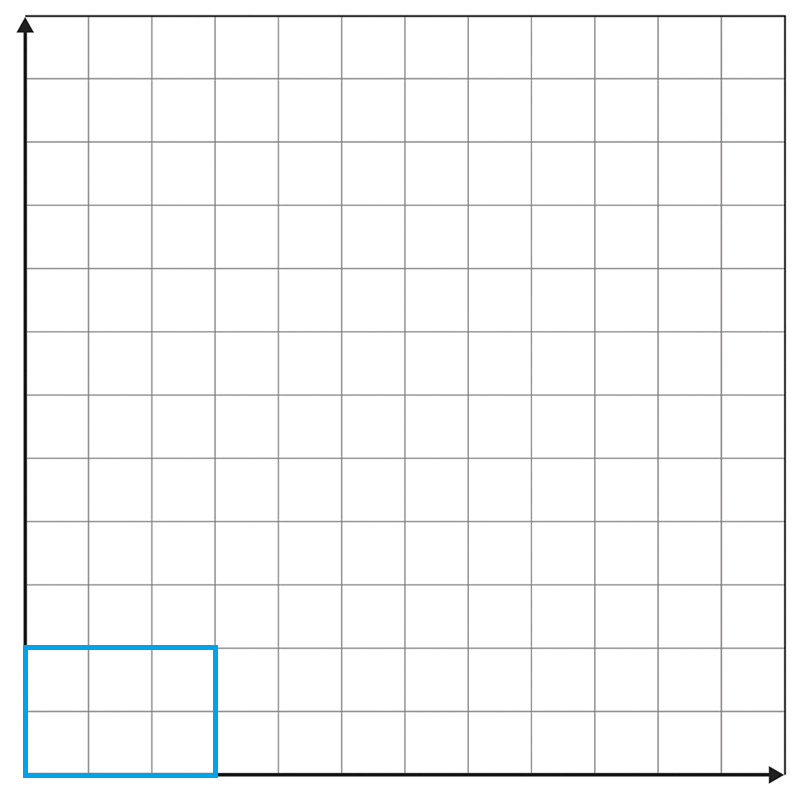
Let's start with thinking about rectangles on a coordinate grid. We can visualize the formula for a rectangle area (bhbh) by looking at how many units are in the length of each side:

A coordinate grid with a 3 by 2 rectangle at the origin.

In the picture above, the rectangle has a base of 33 units and a height of 22 units; by our formula, the area is 66, which we can confirm by counting how many units are contained within the perimeter of the rectangle.

But what else does bhbh tell us? We can think of the rectangle above as two rows of three units or three columns of two units. This means that the base and height encode even more information: how many units per row and column, and how many rows and columns total!

Parallelograms

Now, let's take a look at parallelograms. Parallelograms are quadrilaterals with two pairs of parallel sides; this category actually includes all rectangles (and squares as well)!

Parallelograms also have area bhbh - the same as rectangles. But parallelograms don't look like rectangles most of the time, so what's going on?

A coordinate grid with a 2 by 3 parallelogram.

In the picture above, we see a parallelogram with base 22 and height 33, so we know it has area 2⋅3=62\cdot 3=6, the same as a rectangle with the same dimensions! Here's an illustration of this relationship:

A graphic showing that the area of a parallelogram is preserved when it is transformed into a rectangle.

This is exactly why the bhbh formula works! We can "chop off" a triangle from the end of the parallelogram and stick it on the other end to create a rectangle with the same base and height!

Trapezoids

Trapezoids are a little weird, but we can take advantage of their weirdness to derive their area. Recall that a trapezoid must have a pair of parallel lines. What else has parallel lines? A parallelogram!

In fact, any trapezoid can be made into a parallelogram by taking a copy of that trapezoid and sticking the two trapezoids together in a way that preserves the original height of that trapezoid.

Image depicting the transformation of a trapezoid to a parallelogram while preserving the height.

This means we have a parallelogram with the same height as our trapezoid and a base equal to the sum of the trapezoid's bases. Moreover, the parallelogram is exactly twice as large as our trapezoid. Since we know the area of a parallelogram (bhbh), we can simply plug in the new base and divide this area by two to get the area of our trapezoid!

Thus, the area of a trapezoid is h(b1+b2)2\frac{h(b_1+b_2)}{2}.

Type a concept, like “slope” or “photosynthesis”.

↑ ↓ to choose · Enter to openSearch explanations and problems