Illustrated · 2 min
+2 contributors

There are three main states of matter:
- Solid
- Liquid
- Gas
There is also a fourth state of matter known as plasma. In the three main states of matter the molecules or particles have different arrangements.

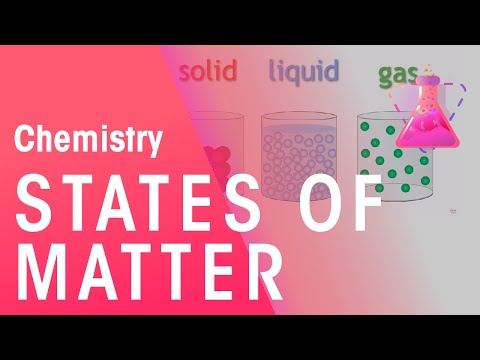
Th particles in the three states of matter are arranged differently.
Image source: By Cassie Gates
Particle Arrangement in Solids
Solids, have closely packed particles. The closely packed arrangement is what causes solids to have defined shapes. The solid-state of matter has the lowest energy compared to the same substance in the other two states. To melt a solid, you have to add heat.
Remember, there are a few types of solids. Crystalline solids have highly ordered structures. They include ionic, metallic, and network covalent compounds. In each case, the bonds create a repeating crystal lattice. In contrast, it's Van der Waal's forces that create molecular solids. Their particles are held together by dispersion forces, dipole-dipole interactions, or hydrogen bonding. Finally, we also have amorphous solids. Most often, they're made of massive molecules or polymer chains. The particles don't stack in an ordered fashion. So, they have unique physical properties. For example, they are often soft, malleable, and have lower melting points.
Particle Arrangement in Liquids
In liquids, the particles are near each other, but not tightly packed. The particles in a liquid are able to slide past each other. This allows for the movement of particles throughout the liquid. The looser arrangement of particles is what allows liquids to take on the shape of their container. The intermolecular forces between particles in liquid determine properties like viscosity and surface tension. Particles in a liquid are higher in energy than the solid state. So, to freeze them, you need to remove heat. But they have less energy than the gas state. So, to vaporize them, you add heat.
Particle Arrangements in Gases
Gases have particles that are very far away from each other. The arrangement of particles in a gas is why gases will expand to fill whatever space they occupy. Compared to solids and liquids, gases have the most kinetic energy and the weakest intermolecular interactions. If you continue adding heat, the particles will ionize. This results in plasma. If you remove heat, you can condense a gas into a liquid.