Associative Property — Definition & Examples

Before this, knowCommutative Property — Definition & Examples

Illustrated · 1 min

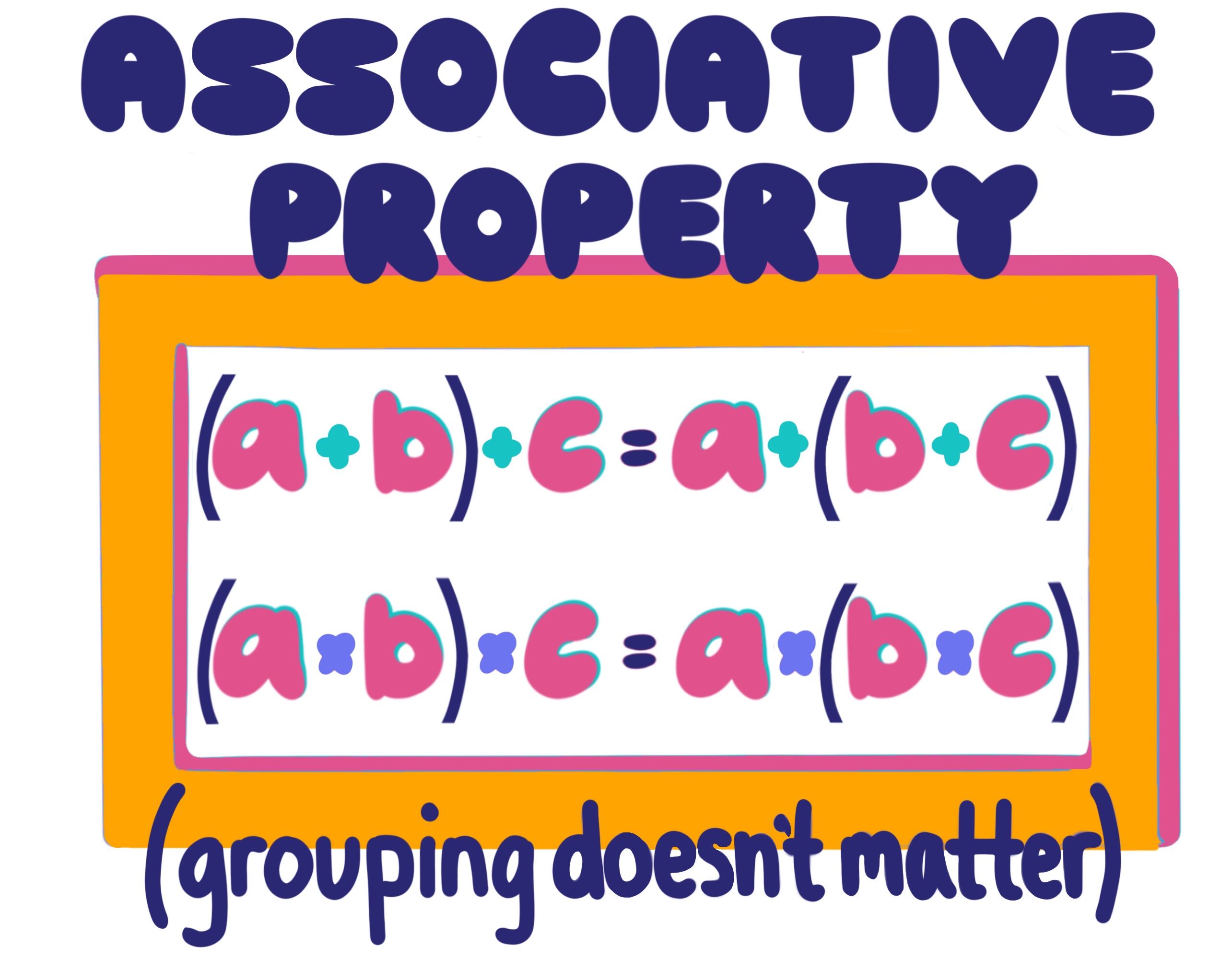
Associative Property

Associative Property: (a+b)+c=a+(b+c) and (ab)c=a(bc). Grouping doesn't matter.

Image Source: Caroline Kulczycky

Here are some examples. Notice these properties work with either numbers or variables.

Associative Property of Addition

(2+4)+6=2+(4+6)=12(x+y)+z=x+(y+z)=x+y+z(2+4)+6 =2+(4+6)=12\\ (x+y)+z=x+(y+z)=x+y+z

Associative Property of Multiplication

(2⋅4)⋅6=2⋅(4⋅6)=48(x⋅y)⋅z=x⋅(y⋅z)=xyz(2\cdot 4) \cdot 6 =2 \cdot (4 \cdot 6)=48\\ (x\cdot y)\cdot z=x\cdot (y\cdot z)=xyz

These equations are often confused with the commutative property. The difference is that this property talks about how to move around parentheses. The commutative property talks about how to move around the numbers. Both statements are true in part because of the order of operations.

Bonus

Interested in mathematical properties? Check out some other cool properties, like the reflexive, symmetric, and transitive properties!

Video

(Video) Properties of Multiplication

by mathman1024

Here's a video by mathman1024 showing you some more properties with multiplication.

Summary\large{\text{Summary}}

The second property is the Associative Property of Multiplication which states: (a⋅b)⋅c=a⋅(b⋅c)(a\cdot b)\cdot c=a\cdot (b\cdot c) This also tells us that it doesn't matter in what order we multiply numbers. Both of these properties state this. Thus the goal is usually to choose an order that is easier. It may take some practice to recognize which order is the easiest.

For example, let's look at the problem: 2(−7)(−4)2(-7)(-4). We can multiply the smaller numbers together first. 2(−7)(−4)=2(−4)(−7)=(−8)(−7)=56\begin{align} &2(-7)(-4)\\ &=2(-4)(-7)\\ &=(-8)(-7)\\ &=56 \end{align}

We could also multiply the two negative numbers together first. This choice has the approach of getting rid of the negative signs quickly. However, you likely find 8×78 \times 7 easier than 2×282 \times 28.

2(−7)(−4)=2(28)=56\begin{align} &2(-7)(-4)\\ &=2(28)\\ &=56 \end{align}

Try this one on your own and then watch the video to see the answer.

  1. 5(767)(2)5(767)(2)

Interactive · 2 questions

Let's say that it's the end of a busy week, and you walk up to a register at your local convenience store with a microwave dinner, a box of popcorn and a container of milk in hand. The cashier rings up each of these items: "three dollars plus five dollars is eight dollars...plus four dollars...and that brings your total to 1212 dollars."

Now, you might describe the arithmetic (and more specifically, the addition) that the cashier just used like so: 3+5+4=123 + 5 + 4 = 12

However, notice how the cashier found the sum of the first two items' costs before adding in the final cost. This means that the cashier's use of addition can more accurately be described by inserting a pair of parentheses into the equation above: (3+5)+4=12(3 + 5) + 4 = 12

If the cashier had decided to add up the costs of your popcorn and milk first instead, would the result of the addition be the same?

Choose one answer

Type a concept, like “slope” or “photosynthesis”.

↑ ↓ to choose · Enter to openSearch explanations and problems