Interactive · 1 question

+1 contributors

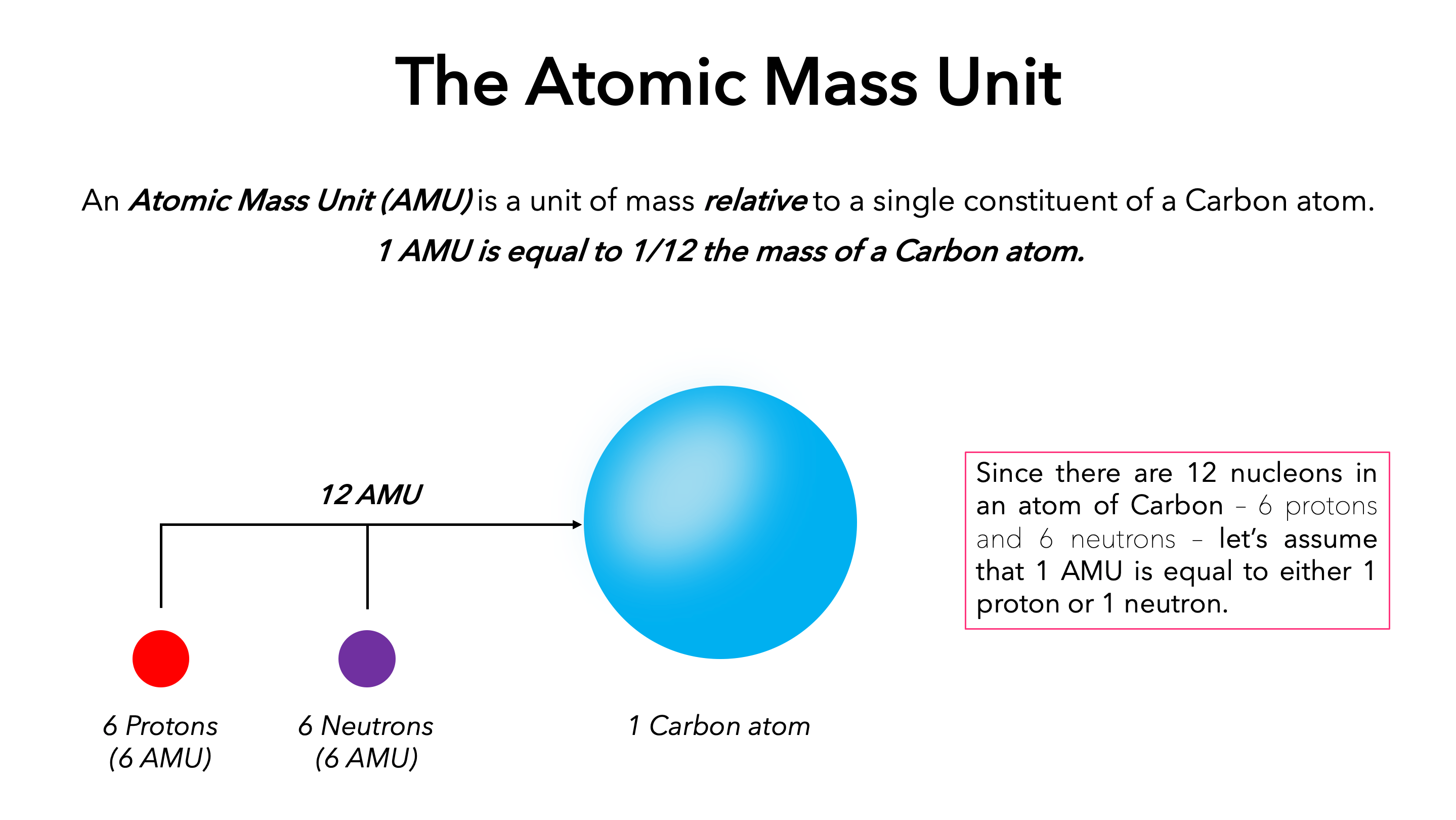
Atomic mass is typically measured in atomic mass units (AMU). AMU is the mass of a carbon-12 atom, and is approximately the mass of 1 proton, or 1 neutron. If you go to another source you may be confused by the use of unified atomic mass units (u) and daltons (Da). These, in essence, are all the same thing. The name has just changed slightly and diverged over time as the unit has been redefined. AMU may be converted into grams by multiplying by Avogadro's number. That is to say, AMU .
In order to determine the atomic mass of an atom, simply count the number of protons and neutrons. Since the mass of protons and neutrons are both 1 AMU, the mass of the atom expressed in AMU is the number of protons plus the number of neutrons. Electrons are much smaller than protons and neutrons, having a mass of approximately AMU, so their effect on the mass of the atom is negligible.
Since elements exist in different isotopes (the number of neutrons is variable), atomic mass is typically not expressed as an integer. For example, periodic tables will list carbon as having a mass of AMU, rather than just . This is because there is a small amount of carbon atoms that have masses of or AMU. This results in the average mass of carbon being just over AMU.
An atom is found to have 13 protons, 15 neutrons, and 14 electrons. What is the mass in AMU?
Protons and neutrons actually have slightly different masses, and due to relativistic affects, their masses are both slightly more than AMU. These differences are minor, and should not be considered in your study of chemistry.