ATP (Adenosine Triphosphate) — Structure & Function

Before this, knowWhat Is Bioenergetics? — Definition & Overview

Illustrated · 2 min

What Is ATP?

ATP stands for adenosine triphosphate. It's in the nucleotide family of molecules. It stores short-term chemical energy within living cells.

ATP Structure

To be specific, energy is stored in the chemical bonds between atoms of the molecule. Let's take a quick look at the structure:

ATP is made of carbon, hydrogen, oxygen, phosphorus, and nitrogen.

Molecular structure of adenosine triphosphate.

Image source: By NEUROtiker [Public domain], via Wikimedia Commons

Take a close look at the structure above. Believe me, I understand the urge to scan it quickly and move on. But in this case, the structure and bonds help explain why this molecule can store energy.

The basic structure is an adenine connected to three phosphate groups by a ribose sugar.

Let's consider the name adenosine tri-phosphate. Adenine connected to ribose creates adenosine. Tri means three. So to translate, "adenosine triphosphate" means "adenosine with three phosphates".

Find the three phosphates (shown as P) in the structure below:

ATP has three phosphate groups.

Image source: By NEUROtiker (modified by expii) [Public domain], via Wikimedia Commons

Energy is stored in the bonds between the phosphates. In order for this energy to be released, the bonds need to be broken. Think of it like popping one of the phosphates off. This releases chemical energy.

The bond holding the last phosphate, the one at the end of the little tail, holds the most energy. This is the phosphate that gets kicked off and, when it does, a bunch of energy gets released.

When one of the phosphates is removed, adenosine triphosphate (ATP) becomes adenosine diphosphate (ADP):

When cells go from ATP to ADP, it releases energy.

Image source: By NEUROtiker (modified by expii) [Public domain], via Wikimedia Commons \\ Image source: By NEUROtiker (modified by expii) [Public domain], via Wikimedia Commons

Working backwards, our cells can also reform ATP by combining ADP and phosphate.

Think of ATP as energy currency. In bioenergetics, we measure energy in units of it.

Our body makes these molecules through the process of cellular respiration. This process takes sugar molecules, called glucose, and turns them into ATP molecules that the cell can use to do just about anything in the body.

Without these energy molecules, the human body would not be able to carry out most of the chemical reactions that keep us alive.

Energy moves in and around cells in the form of ATP.

It's Energy-Man.
I know it looks silly, but this is seriously how I think about adenosine triphosphate. It's like a punch of energy and it's super important.

Image source: By OpenClipart-Vectors CC0, via pixabay.com

Video

(Video) ATP (Adenosine Triphosphate)

by RichochetScience

This video looks at how the molecule adenosine triphosphate carries energy.

Illustrated · 1 min

ATP and Energy Metabolism

Adenosine triphosphate is a nucleotide that is used to transfer chemical energy. Any cellular process that requires energy uses the chemical energy stored in this molecule. It is often called the "molecular unit of currency" for intracellular processes (intra- meaning within). This means that any process that occurs inside of a cell and requires free energy must use ATP.

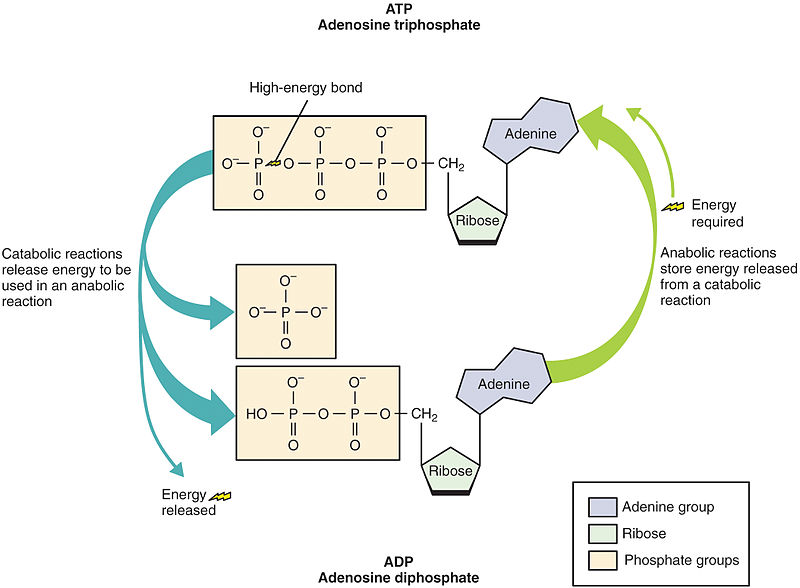
ATP is composed of a five-carbon ribose sugar, an adenosine group, and three phosphate groups.

Image source: By OpenStax College CC BY 3.0, via Wikimedia Commons

ATP is made during a complicated process called oxidative phosphorylation by an enzyme called ATP synthase. ATP itself is made of a five-carbon ribose sugar, an adenine group, and three phosphate groups. The phosphate groups are where the energy is stored.

The bonds that connect the three phosphates have very high energy, meaning that they do not want to be together. When the last phosphate on the tail is transferred to another molecule, energy is released. This energizes the molecule that receives the phosphate. After the release of a phosphate group, the molecule is called adenosine diphosphate (ADP). Di- means two, so two phosphates. This molecule still has some energy, but not enough to really energize any reactions.

Interactive · 2 questions

How Do Cells Get Energy?

Adenosine triphosphate (ATP) is one of the coolest and most important molecules in our bodies. It's the energy source used by cells. It is like the electricity powering this computer. You can also think of it like money. It is exchanged and traded throughout your cells.

It is made of the nitrogenous base adenine, the five-carbon sugar ribose, and three phosphate groups. It's important to know that the phosphate groups have very high energy and do not want to be near each other. Like, not at all.

ATP is made of the nucleic acid adenine, the five-carbon sugar ribose, and three phosphate groups.

Image source: By OpenStax College CC BY 3.0, via Wikimedia Commons

What does the P in ATP stand for?

Choose one answer

Video

(Video) ATP and Respiration

by CrashCourse

In this video, Hank Green explains how cellular respiration gives us ATP. This is our molecular cheerleader that gives us the energy to run marathons or pump out push-ups at the gym.

Adenosine triphosphate releases energy and becomes adenosine diphosphate.

Image source: By Valeri Natole

Type a concept, like “slope” or “photosynthesis”.

↑ ↓ to choose · Enter to openSearch explanations and problems