
Illustrated · 1 min

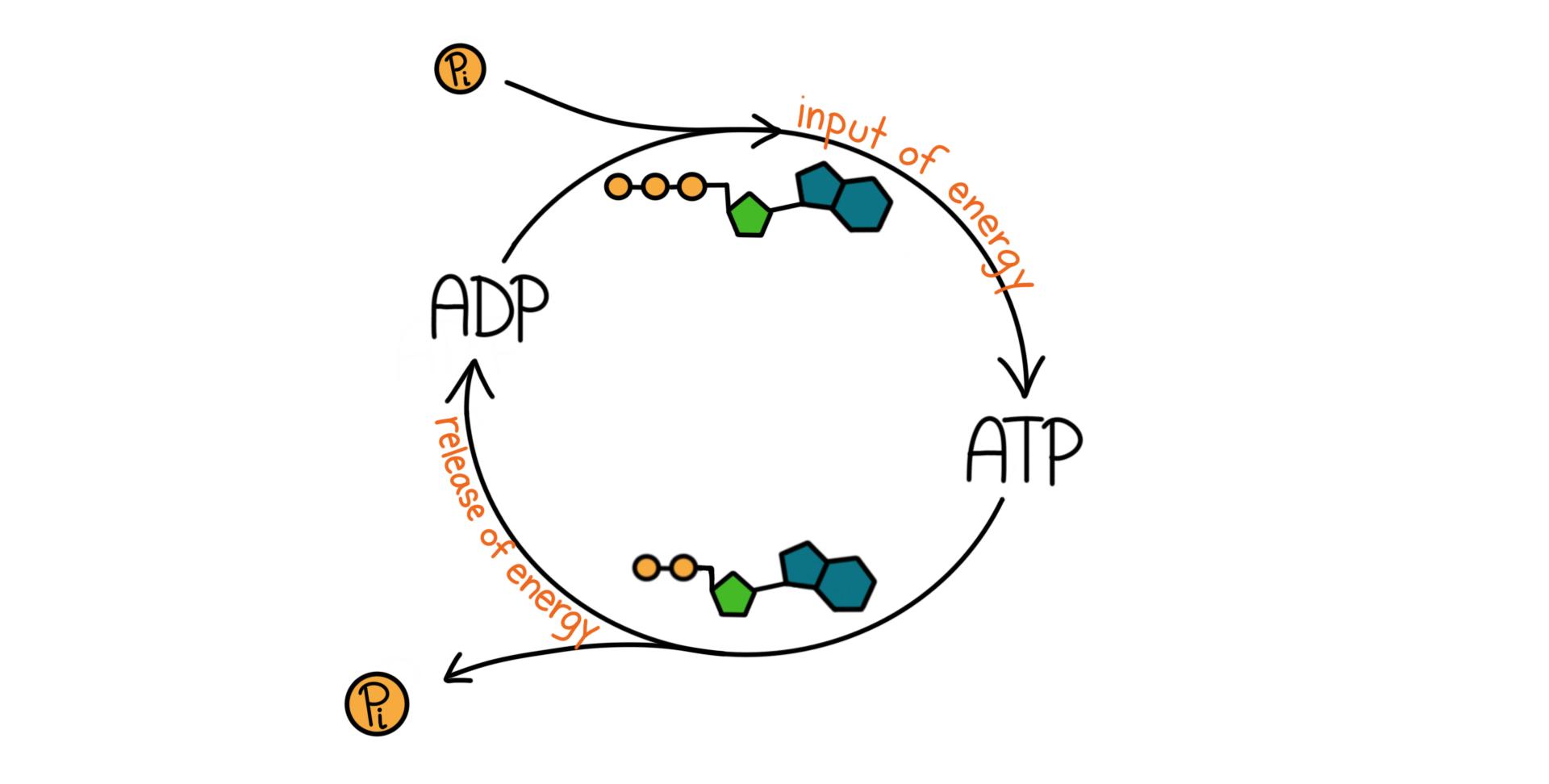
Hydrolysis
In order for cells to use ATP as an energy source for different reactions, the molecule has to undergo hydrolysis.
A hydrolysis reaction uses water to break off the terminal phosphate group of ATP. The lone, inorganic phosphate (sometimes written as P) leaves, and ATP becomes ADP (adenosine diphosphate).
ATP + HO ADP + P
This reaction is exergonic, meaning it releases energy.
The G, or change in free energy, is -7.3 kcal/mol (-30.5 kJ/mol) under standard conditions. However, cellular conditions are much different, and increase the energy output to about 13 kcal per mole of ATP. This energy can then be harnessed by different components of the cell to perform work.
Where does the energy come from?
The terminal phosphate bond in ATP is often called a high-energy bond. However, the bond is actually not very strong. The energy comes from water and ATP. ATP contains 3 negatively charged phosphate groups. The negative charges repel each other, making ATP unstable. Getting rid of one of these charges is very favorable. When the high-energy reactants form low energy products, ADP and P, lots of energy is released.
Phosphorylation
ADP can be recycled and used to regenerate ATP.
A phosphorylation reaction is used to add a phosphate group to a molecule of ADP to make ATP.
ADP + P ATP + H2O
This process requires an input of energy, which means that it's an endergonic reaction. This energy comes from various catabolic reactions in the cell, such as cellular respiration.
The G is +7.3 kcal/mol (+30.5 kJ/mol) under standard conditions.

