
Video · + 2 min read
What does it mean to "Balance"
Balancing an object can range from being really easy to being really hard depending on the object's shape, weight distribution, and several other factors. For example, a rigid object would be more difficult to balance compared to a flat, smooth object. Furthermore, a ball is harder to balance than a flat rock.
However, the most important thing to take into consideration is adjusting to the object's center of mass. In other words, it is important to find the point at which the object's weight does not place any torque on its support.
Review: What is torque? (Check all that apply)
Where is the Center of Mass?
A question you should be thinking of is "where is the center of mass for an object?" Well in actuality, technically anywhere can be a center of mass (henceforth balance point) for an object, as long as how you place the object makes it so that its weight does not place any torque on the supporting object/point. Can't believe it? Well try checking out the video below.

Usage in Life
You'll find that all of this is quite prominent in everyday life. For example, if you're a waiter or waitress, it's obvious that you want to make sure nothing breaks as you are moving things around. The best way to ensure this is that the object is as stable as possible, or in other words balanced. Furthermore, waiters/waitresses sometimes even have to use their arms which aren't quite as nice of a support as their hands to carry objects. Luckily, they are trained to do this so most of the time nothing breaks. It's quite awe-inspiring, some of the physics that you can find in the most unlikely of places!
Furthermore, let's take an even more fundamental approach by asking why we prefer to hold objects exactly on, or near, their balance point. Refer to the diagram below.
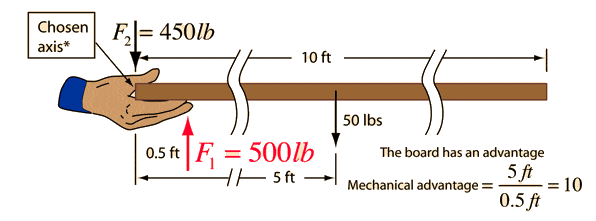
Example of why we prefer the balance point (Image source: Hyperphysics)
Suppose we decided to hold this 50 lbs wooden plank on one of its ends. To do so, we actually need to use 500lbs of force to lift it up evenly or "balance" it. The reason is because of the difference in the length between your hand that is grabbing onto the board and the board itself (we call your hand and wrist the shorter lever arm and the board the longer lever arm. This difference causes for a mechanical disadvantage on your part and so lifting the board is much harder.