Balancing Redox Reactions in Basic Solutions — Overview

Before this, knowOxidation Number Change Method — Balancing Redox Reactions

Read · 3 min

We're continuing to study balancing redox reactions. We started with two methodologies: oxidation change and half-reaction. Both methods worked well for neutral solutions. But, when our pH became acidic, we relied on an augmented half-reaction method. So, what happens when our solution is alkaline?

Steps for Balancing Basic Redox Reactions

Alkaline solutions build on our previous studies. They use an expanded method of balancing acidic redox reactions. So, the first six steps are the same. But then, we use hydroxide to cancel the hydrogen ions. Our final equation will have hydroxide as a reactant.

  1. Write the half-reactions.
  2. Balance all the elements besides hydrogen and oxygen. It's like stoichiometry. You just change the mole ratios.
  3. Add H2OH_{2}O to balance oxygens.
  4. Add H+H^{+} ions to balance hydrogens.
  5. Balance the charges by adding electrons. We write electrons as e−e^{-}.
  6. Add the two half-reactions. It's like a reaction mechanism! What if the electrons don't cancel? Multiply the half-reactions by the lowest common denominator.
  7. Cancel any H+H^{+} ions by adding OH−OH^{-}. The OH−OH^{-} adds to both sides of the equation.
  8. Combine the H+H^{+} and OH−OH^{-} into H2OH_{2}O.
  9. Combine any water molecules that are on the same side. Then, cancel any water molecules on both sides of the reaction. Now you have a balanced equation!

Examples

In a strong Arrhenius base, nitrogen dioxide becomes nitrate and nitrite anions. Balance the redox reaction.

Step 1. In this question, nitrogen dioxide is both oxidized and reduced. So, we only have one half-reaction.

NO2→NO3−+NO2−NO_{2} \rightarrow NO_{3}^{-} + NO_{2}^{-}

Step 2. We have to balance the nitrogen atoms.

2NO2→NO3−+NO2−2NO_{2} \rightarrow NO_{3}^{-} + NO_{2}^{-}

Step 3. At this point, we could split the reaction into two half-reactions. But, we can solve this problem as one equation. So, balance the oxygen atoms by adding water as a reactant.

2NO2+H2O→NO3−+NO2−2NO_{2} + H_{2}O \rightarrow NO_{3}^{-} + NO_{2}^{-}

Step 4. Balance the hydrogen atoms by hydrogen ions to the products.

2NO2+H2O→NO3−+NO2−+2H+2NO_{2} + H_{2}O \rightarrow NO_{3}^{-} + NO_{2}^{-} + 2 H^{+}

Step 5. The charges are already balanced! Both sides of the equation are neutral.

2NO2+H2O→NO3−+NO2−+2H+2NO_{2} + H_{2}O \rightarrow NO_{3}^{-} + NO_{2}^{-} + 2 H^{+}

Step 6. We only started with one reaction. So, there is nothing to add together.

2NO2+H2O→NO3−+NO2−+2H+2NO_{2} + H_{2}O \rightarrow NO_{3}^{-} + NO_{2}^{-} + 2 H^{+}

Step 7. Balance the hydrogen ions by adding hydroxide ions.

2NO2+H2O+2OH−→NO3−+NO2−+2H++2OH−2NO_{2} + H_{2}O + 2OH^{-} \rightarrow NO_{3}^{-} + NO_{2}^{-} + 2 H^{+} +2 OH^{-}

Step 8. Convert hydrogen and hydroxide ions into water.

2NO2+H2O+2OH−→NO3−+NO2−+2H2O2NO_{2} + H_{2}O + 2OH^{-} \rightarrow NO_{3}^{-} + NO_{2}^{-} + 2H_{2}O

Step 9. Cancel any water molecules that are on both sides of the equation.

2NO2+H2O+2OH−→NO3−+NO2−+2H2O2NO_{2} + \cancel{H_{2}O} + 2OH^{-} \rightarrow NO_{3}^{-} + NO_{2}^{-} + \cancel{2}H_{2}O

Answer

2NO2+2OH−→NO3−+NO2−+H2O2NO_{2} + 2OH^{-} \rightarrow NO_{3}^{-} + NO_{2}^{-} + H_{2}O

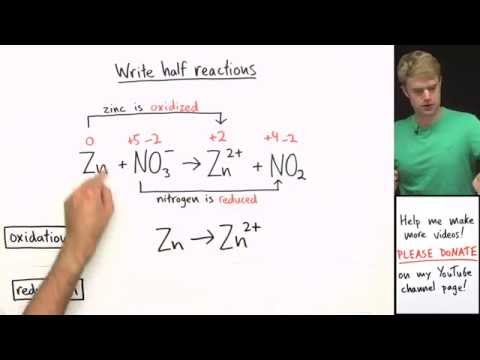
In alkaline conditions, the transition metal zinc reacts with nitrate ions. The products are the zinc (II) tetrahydroxide complex, Zn(OH)42−Zn(OH)_{4}^{2-}, and ammonia. Balance the equation.

Step 1.

Zn→Zn(OH)42−Zn \rightarrow Zn(OH)_{4}^{2-}

NO3−→NH3NO_{3}^{-} \rightarrow NH_{3}

Step 2. All the elements are balanced besides oxygen and hydrogen.

Zn→Zn(OH)42−Zn \rightarrow Zn(OH)_{4}^{2-}

NO3−→NH3NO_{3}^{-} \rightarrow NH_{3}

Step 3. Balance the oxygens in both reactions.

Zn+4H2O→Zn(OH)42−Zn + 4H_{2}O \rightarrow Zn(OH)_{4}^{2-}

NO3−→NH3+3H2ONO_{3}^{-} \rightarrow NH_{3} + 3H_{2}O

Step 4. Balance the hydrogens in both reactions.

Zn+4H2O→Zn(OH)42−+4H+Zn + 4H_{2}O \rightarrow Zn(OH)_{4}^{2-} +4H^{+}

9H++NO3−→NH3+3H2O9H^{+} + NO_{3}^{-} \rightarrow NH_{3} + 3H_{2}O

Step 5. Balance the charges in both reactions.

Zn+4H2O→Zn(OH)42−+4H++2e−Zn + 4H_{2}O \rightarrow Zn(OH)_{4}^{2-} +4H^{+} + 2e^{-}

9H++NO3−+8e−→NH3+3H2O9H^{+} + NO_{3}^{-} + 8e^{-} \rightarrow NH_{3} + 3H_{2}O

Step 6. To cancel the electrons, multiply the top equation by four. Then add the two reactions.

4Zn+16H2O+9H++NO3−+8e−→4Zn(OH)42−+16H++8e−+NH3+3H2O4Zn + 16H_{2}O+9H^{+} + NO_{3}^{-} + \cancel{8e^{-}} \rightarrow 4Zn(OH)_{4}^{2-} +16H^{+} + \cancel{8e^{-}} +NH_{3} + 3H_{2}O

Step 7. Balance hydrogen ions to water by adding hydroxide.

4Zn+16H2O+NO3−+9H++16OH−→4Zn(OH)42−+NH3+3H2O+16H++16OH−4Zn + 16H_{2}O + NO_{3}^{-} + 9H^{+} + 16OH^{-} \rightarrow 4Zn(OH)_{4}^{2-} +NH_{3} + 3H_{2}O + 16H^{+} + 16 OH^{-}

Step 8. Tally the water molecules produced from the previous step.

4Zn+25H2O+NO3−+7OH−→4Zn(OH)42−+NH3+19H2O4Zn + 25H_{2}O + NO_{3}^{-} +7OH^{-} \rightarrow 4Zn(OH)_{4}^{2-} +NH_{3} +19H_{2}O

Step 9. Cancel the water molecules that are on both sides of the equation.

4Zn+25H2O+NO3−+7OH−→4Zn(OH)42−+NH3+19H2O4Zn + \cancel{25}H_{2}O + NO_{3}^{-} +7OH^{-} \rightarrow 4Zn(OH)_{4}^{2-} +NH_{3} +\cancel{19H_{2}O}

Answer

4Zn+6H2O+NO3−+7OH−→4Zn(OH)42−+NH34Zn + 6H_{2}O + NO_{3}^{-} +7OH^{-} \rightarrow 4Zn(OH)_{4}^{2-} + NH_{3}

In an alkaline solution, chlorine gas converts into chlorate and chloride ions. Balance the formula. Remember, chlorine is a diatomic halogen, so chlorine gas has an oxidation state of 0.

Step 1. This problem is unique. Each chlorine atom changes its oxidation number. So, we need to split Cl2Cl_{2} into Cl for each half-reaction.

Cl→ClO−Cl \rightarrow ClO^{-}

Cl→Cl−Cl \rightarrow Cl^{-}

Step 2. The chlorines are balanced in both half-reactions.

Cl→ClO3−Cl \rightarrow ClO_{3}^{-}

Cl→Cl−Cl \rightarrow Cl^{-}

Step 3. We need to balance the oxygen in the top half-reaction.

Cl+3H2O→ClO3−Cl + 3H_{2}O \rightarrow ClO_{3}^{-}

Cl→Cl−Cl \rightarrow Cl^{-}

Step 4. We need to balance the hydrogen in the top half-reaction.

Cl+3H2O→ClO3−+6H+Cl + 3H_{2}O \rightarrow ClO_{3}^{-} +6 H^{+}

Cl→Cl−Cl \rightarrow Cl^{-}

Step 5. We need to balance the charges in both half-reactions.

Cl+3H2O→ClO3−+6H++5e−Cl + 3H_{2}O \rightarrow ClO_{3}^{-} +6 H^{+} + 5e^{-}

Cl+1e−→Cl−Cl + 1e^{-} \rightarrow Cl^{-}

Step 6. When we add the reactions, we need to cancel the electrons. So, we need to multiply the bottom equation by 5.

6Cl+3H2O+5e−→ClO3−+6H++5e−+5Cl−6Cl + 3H_{2}O+ \cancel{5e^{-}} \rightarrow ClO_{3}^{-} +6 H^{+} + \cancel{5e^{-}} + 5Cl^{-}

Step 7. We need to cancel the hydrogen ion in the products.

6Cl+3H2O+6OH−→ClO3−+6H++6OH−+5Cl−6Cl + 3H_{2}O +6OH^{-} \rightarrow ClO_{3}^{-} +6 H^{+} +6OH^{-} + 5Cl^{-}

Step 8. Now, combine the hydrogen and hydroxide ions in the products.

6Cl+3H2O+6OH−→ClO3−+6H2O+5Cl−6Cl + 3H_{2}O+6OH^{-} \rightarrow ClO_{3}^{-} +6H_{2}O + 5Cl^{-}

Step 9: Cancel the water molecules from both sides of the equation. We can also convert 6Cl→3Cl26Cl\rightarrow 3Cl_{2}.

3Cl2+3H2O+6OH−→ClO3−+6H2O+5Cl−3Cl_{2} + \cancel{3H_{2}O}+6OH^{-} \rightarrow ClO_{3}^{-} +\cancel{6}H_{2}O + 5Cl^{-}

Answer

3Cl2+6OH−→ClO3−+3H2O+5Cl−3Cl_{2}+6OH^{-} \rightarrow ClO_{3}^{-} +3H_{2}O + 5Cl^{-}

Video

(Video) How to Balance Redox Equations in Basic Solution

by Tyler DeWitt

In this video, Tyler DeWitt explains how to balance redox equations in basic solutions. He illustrates an example problem step-by-step. If you already understand balancing redox equations in acidic solutions, you can skip to the 13-minute mark. At that point, he shows you how to convert acidic conditions to basic conditions. This is an excellent video for helping you to understand balancing redox equations!

Type a concept, like “slope” or “photosynthesis”.

↑ ↓ to choose · Enter to openSearch explanations and problems