Interactive · 2 questions

+1 contributors

Hexadecimal
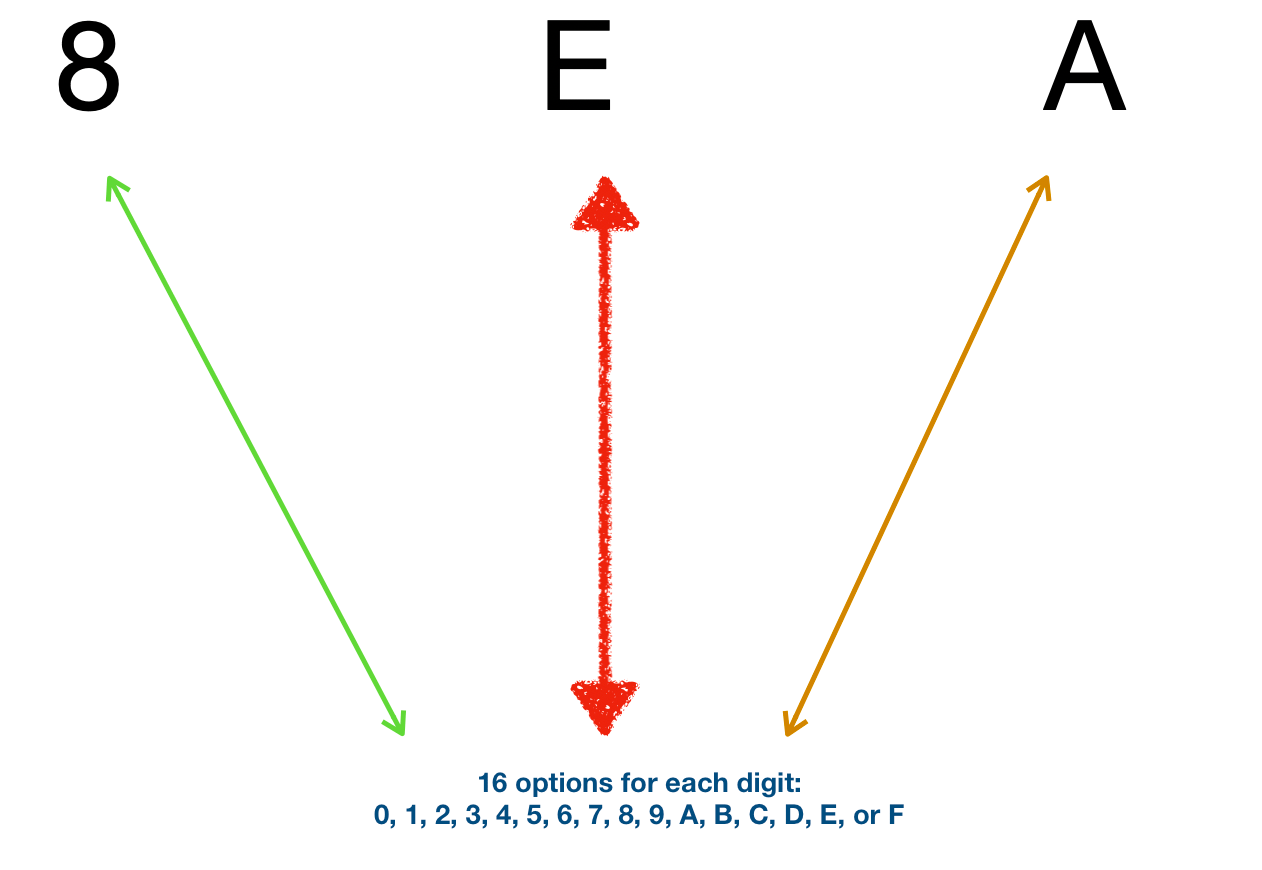
Hexadecimal is regarded as base- Each place value in the number is some power of The hexadecimal values are: The letters through represent through respectively.
From Decimal to Hexadecimal
Get ready, this method can be a pain to use. Just like with ternary, we want to focus on the remainder.
Let's work through an example to see how it's done. Let's convert to hexadecimal.
The first step is to divide our number by taking the remainder.

We get a remainder of Remember that hexadecimal uses the letter to represent this. So the "ones place" of our hexadecimal number is .
Next, we take the non remainder portion, , and divide it again by

We get as our non remainder part so we know we're done. The remainder is so this will be the "tens place" of our hexadecimal number.
From Hexadecimal to Decimal
Just like with binary and ternary, to get to decimal you want to take the sum of each digit multiplied by the powers of the base you're in. Since we're in base- we multiply by powers of
Let's convert to a decimal number. Starting with multiply by to the zero power, then gets multiplied by to the first power, and gets multiplied by to the second power. Remember that represents the number
So,
Practice
Try some on your own!
What is in base-16?
Solution
Because I'm lazy, I'm not going to make a diagram for the long division. Regardless, the first step is dividing by Since we get a remainder of the "ones place" of our hexadecimal number is
Next, divide the non remainder portion by Since we got a we end here. The remainder, corresponds to the letter . This will be the "tens place" of our hexadecimal number.
So,

What is in base-