Interactive · 1 question

+4 contributors




Basic Solutions

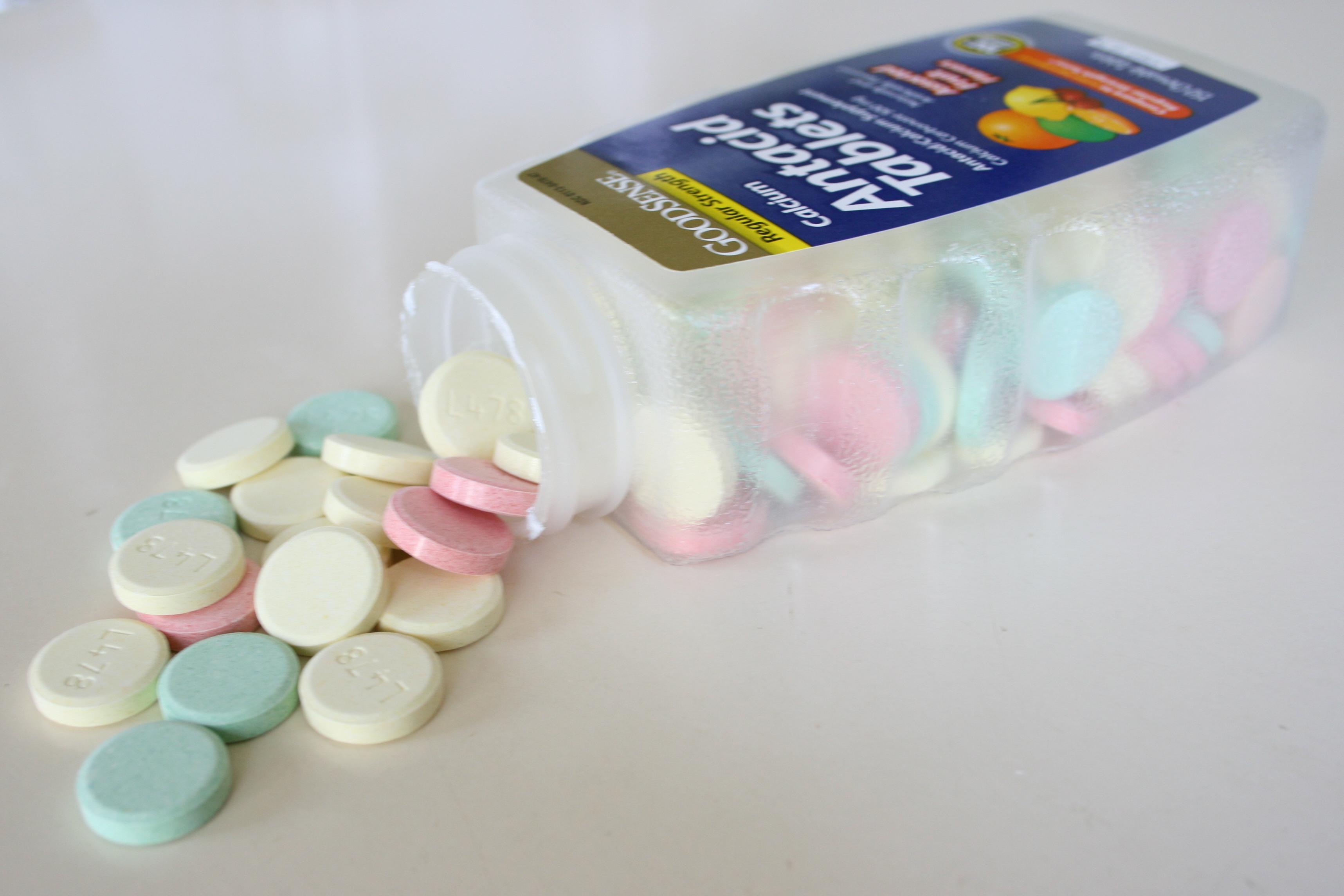
Image source: By James Petts from London, England CC BY-SA 2.0, via Wikimedia Commons
Have you ever wondered what makes a cake rise in the oven and get that round top? The answer is bases, specifically a common, household, weak base called baking soda, or .
Typically, a bases is defined as any compound that releases ions in a solution and has a pH of more than seven. (Another way of looking at this is that bases have an unshared pair of electrons that can bond with a proton.) As we explained in the section on acids, ions are important because, along with the ions released by acids, they form water.
Bases in Action
When reacts with the released by an acid, it forms water by releasing an and becomes and . This is commonly demonstrated in baking soda volcanoes, where the acid used is vinegar. The gas produced is the cause of the bubbling "lava" created and also the reason why cakes rise when baked.
So what makes a weak base? It's not its pH, which varies with concentration. It's the simple fact that when added to water, doesn't completely break apart into , and . A small amount of it breaks down, but most of it stays as a dissolved version of . Therefore, the concentration of in the solution is lower than the concentration of baking soda.
What Is a Strong Acid and Base?
Strong acids and bases are ones that are water-soluble (dissolve completely in water). Recall that forming bonds reduces energy, so breaking bonds takes energy. Strong acids and bases are compounds with bonds that are so polar (or ionic) that the dipoles of water are able to split them apart without added energy.
The strong bases are all ionic. They are combinations of alkali and alkali earth metals, or elements in the first two columns of the periodic table, with OH ions. They are . There is no need to memorize them. You can just look at a periodic table and check whether the element bonded to is an alkali metal (in the first column) or an alkali earth metal below (in the second column).
The strong acids are a little bit harder to remember, but there are only seven. They are .
Again, how acidic or basic a substance is is determined by its pH, not its strength. Any of these strong acids or bases can be put in a very dilute concentration and have a relatively neutral pH. A solution of a weak acid or base could be more concentrated and therefore more acidic or basic. The only difference between the two is that strong acids and bases ionize completely in water while weak ones do not.
Which of the following is a strong base?
Ammonia, , is also considered a base, despite the fact that it does not contain any ions. This is because Ammonium, , is a weak acid and doesn't dissolve completely in water. Therefore, when ammonia is added to water, it pulls some ions out of the water molecules to form , leaving excess ions in the solution.
Because they are two versions of the same molecule as a base and an acid, ammonia and ammonium are called conjugates of each other. Ammonia is the conjugate base of ammonium, and ammonium is the conjugate acid of ammonia.