Bases — Definition & Overview

Before this, knowWhat Is pH? — Definition & Overview

Interactive · 1 question

Basic Solutions

A chocolate cake that is visibly rounded on top.

Image source: By James Petts from London, England CC BY-SA 2.0, via Wikimedia Commons

Have you ever wondered what makes a cake rise in the oven and get that round top? The answer is bases, specifically a common, household, weak base called baking soda, or NaHCO3NaHCO_{3}.

Typically, a bases is defined as any compound that releases OH−OH^{-} ions in a solution and has a pH of more than seven. (Another way of looking at this is that bases have an unshared pair of electrons that can bond with a proton.) As we explained in the section on acids, OH−OH^{-} ions are important because, along with the H+H^{+} ions released by acids, they form water.

Bases in Action

When NaHCO3NaHCO_{3} reacts with the H+H^{+} released by an acid, it forms water by releasing an OH−OH^{-} and becomes Na+Na^{+} and CO2CO_{2}. This is commonly demonstrated in baking soda volcanoes, where the acid used is vinegar. The CO2CO_{2} gas produced is the cause of the bubbling "lava" created and also the reason why cakes rise when baked.

So what makes NaHCO3NaHCO_{3} a weak base? It's not its pH, which varies with concentration. It's the simple fact that when added to water, NaHCO3NaHCO_{3} doesn't completely break apart into OH−OH^{-}, Na+Na^{+} and CO2CO_{2}. A small amount of it breaks down, but most of it stays as a dissolved version of NaHCO3NaHCO_{3}. Therefore, the concentration of OH−OH^{-} in the solution is lower than the concentration of baking soda.

What Is a Strong Acid and Base?

Strong acids and bases are ones that are water-soluble (dissolve completely in water). Recall that forming bonds reduces energy, so breaking bonds takes energy. Strong acids and bases are compounds with bonds that are so polar (or ionic) that the dipoles of water are able to split them apart without added energy.

The strong bases are all ionic. They are combinations of alkali and alkali earth metals, or elements in the first two columns of the periodic table, with OH ions. They are LiOH,NaOH,KOH,RbOH,CsOH,Ca(OH)2,Sr(OH)2 and Ba(OH)2\color{#3DB917}{LiOH, NaOH, KOH, RbOH, CsOH, Ca(OH)_{2}, Sr(OH)_{2}\, and \,Ba(OH)2}. There is no need to memorize them. You can just look at a periodic table and check whether the element bonded to OHOH is an alkali metal (in the first column) or an alkali earth metal below CaCa (in the second column).

The strong acids are a little bit harder to remember, but there are only seven. They are HCl,HNO3,H2SO4,HBr,HI,HClO3,and HClO4\color{#3DB917}{HCl, HNO_{3}, H_{2}SO_{4}, HBr, HI, HClO_{3}, and \,HClO_{4}}.

Again, how acidic or basic a substance is is determined by its pH, not its strength. Any of these strong acids or bases can be put in a very dilute concentration and have a relatively neutral pH. A solution of a weak acid or base could be more concentrated and therefore more acidic or basic. The only difference between the two is that strong acids and bases ionize completely in water while weak ones do not.

Which of the following is a strong base?

Choose one answer

Illustrated · 1 min

This is an infographic cartoon explaining what a base is. The image shows personified water molecules (H2O), Sodium ions (Na+), and hydroxide ions (OH-) floating around. The image text reads: Basic solutions have high pHs and high concentrations of hydroxide ions (OH-). Bases donate hydroxide ions (OH-), and/or accept hydrogen ions (H+) from water, meaning basic solutions have low concentrations of H+ and high concentrations of OH-.

Image source: By Sylvia Freeman

Substances with high pH (from 8 to 14) are bases. Examples you can find around the house include things like bleach and baking soda. These chemical compounds are bitter-tasting (though we don't recommend tasting them) and will turn red litmus paper blue.

Video · + 1 min read

(Video) The Strengths and Weaknesses of Acids and Bases

by George Zaidan and Charles Morton on TED-Ed

A base produces hydroxide ions (OH−OH^-) in solution, whereas an acid produces hydrogen ions (H+H^+). When mixed together, bases will react with acids to form salts and water.

Basic solutions are often called alkaline solutions. They have fewer H+H^+ ions than acids. Instead, they have a large number of OH−OH^- ions.

Basic solutions have a pH greater than 7. Strong bases have a pH from 11 to 14. An example of a strong base is lye, also known as NaOHNaOH or sodium hydroxide. It is used in making soap. The hydroxide ion is even in its name.

Vocabulary Review:\color{#8925AE}{\text{Vocabulary Review:}}

pH\color{#8925AE}{\text{pH}} : A measure of how basic or acidic a solution is

Basic\color{#8925AE}{\text{Basic}} : A solution with a high number of hydroxide ions and a low number of hydrogen ions

Neutral\color{#8925AE}{\text{Neutral}} : A solution with an equal number of hydroxide and hydrogen ions

Acidic\color{#8925AE}{\text{Acidic}} : A solution with a low number of hydroxide ions and a high number of hydrogen ions

Buffer\color{#8925AE}{\text{Buffer}} : A solution that resists changes in pH

Illustrated · 1 min

What Is a Base?

A base is any substance that produces hydroxide ions (OH−OH^-) in a solution. Water is composed of two hydrogens and an oxygen. When a base is placed in water, it will take a proton from water leaving behind one oxygen and one hydrogen (OH−OH^-). Bases have low concentrations of H+H^+ ions and therefore have high pH values.

Think of bases as hydrogen thieves. When one is placed in water, it will steal hydrogen from the water. The stronger the base, the more hydrogen it can steal.

When an acid is placed in water, it will leave behind hydrogen ions. When a base is placed in water, it will leave behind hydroxide ions.

Image source: By OpenStax College CC BY 3.0, via Wikimedia Commons

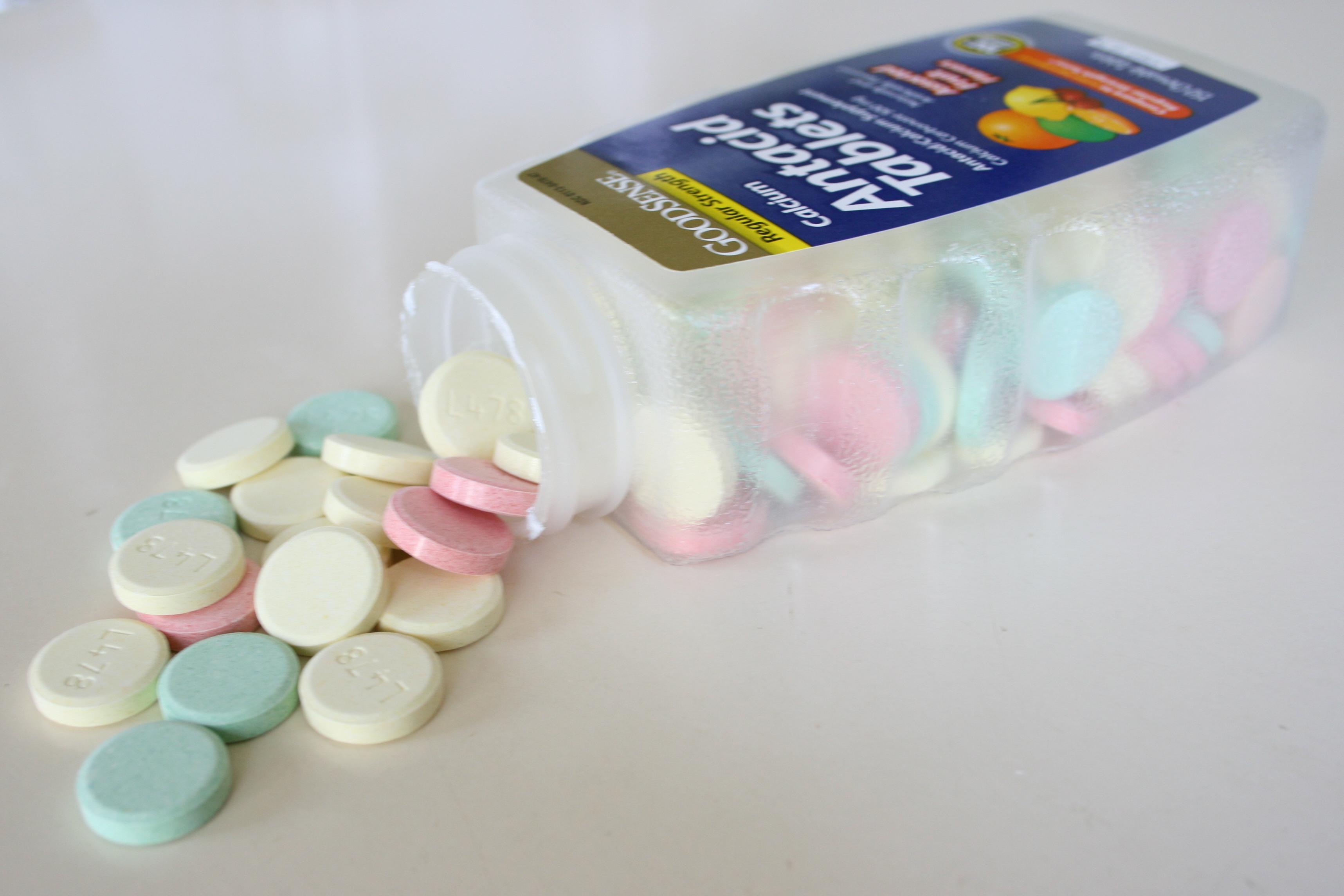
Antacids contain bases. Stomach acid is a corrosive substance that breaks down our food. Sometimes if we eat acidic food, it can give us a burning feeling in our stomach because there is too much acid. When this happens, we can take an antacid which will absorb the excess (H+^+) ions in our stomach and hopefully make us feel better.

Antacids are a common medicine used to counteract the effects of excess acid in the stomach.

Antacids have a basic pH.

Image source: By Midnightcomm CC BY-SA 3.0, via Wikimedia Commons

Type a concept, like “slope” or “photosynthesis”.

↑ ↓ to choose · Enter to openSearch explanations and problems