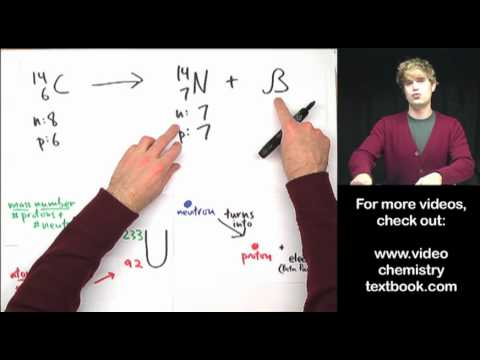
We have been learning that there are a couple of different types of radioactive decay or ways that an element can spontaneously transform into another element. One of these types is known as Beta Decay.
Beta-decay is the creation and emission of either electrons or positrons that results in the transformation of a proton into a neutron (or vice versa) inside the atomic nucleus of the radioactive sample.
If we think back, the purpose of alpha decay was to optimize the neutron/ proton ratio which is achieved by losing four neutrons and two protons. Well, the goal is the same with beta decay, only it is done a bit differently.
When there are too many neutrons or too many protons in the atomic nucleus, the atoms will emit beta particles in the beta decay process.
There are two types of beta decay, positive and negative. Let's take a look at each type.
1) Positive Beta Decay
-
positively charged beta particles, either positrons or neutrinos are released
-
proton in the nucleus disintegrates to yield a neutron
-
decrease in atom's atomic number
-
less common (can only happen if the daughter nucleus is more stable than the parent nucleus)
-
the change in atomic configuration is:
ZAX⇒Z+1AY+e++v
- AZX is the parent nucleus
- A is the total number of nucleons
- Z is the total number of protons
- Z+1AY is the daughter nucleus
- e++v is the emitted positrons and neutrinos
2) Negative Beta Decay
-
negatively charged beta particles, either electrons or antineutrinos are released
-
neutron is converted into a proton
-
increase in atom's atomic number
-
far more common
-
the change in atomic configuration is:
ZAX⇒Z+1AY+e−+v
- AZX is the parent nucleus
- A is the total number of nucleons
- Z is the total number of protons
- Z+1AY is the daughter nucleus
- e−+v is the emitted electrons and neutrinos
Throughout both processes, the atomic mass number remains the same.
Now there you have it!
Let's take some look at examples:
Beta decay of carbon-14: 614C⇒714N+−10e−
- Neutron of carbon is converted into a proton
Beta decay of carbon-10: 610C⇒510B++10e+
- Proton of carbon is converted into a neutron