Interactive · 1 question

Bernoulli Trials

A Bernoulli Trial is a random experiment that repeats a single action identically over and over again. It has exactly two possible outcomes: "success" and "failure". The probability of success is the same every time the action is repeated.

Note: In Bernoulli Trials the repeated actions must be independent. Independent events are events that are not affected by other events. Let A and B represent events, A and B are independent if and only if P(A∣B)=P(A)P(A\mid B) = P(A)

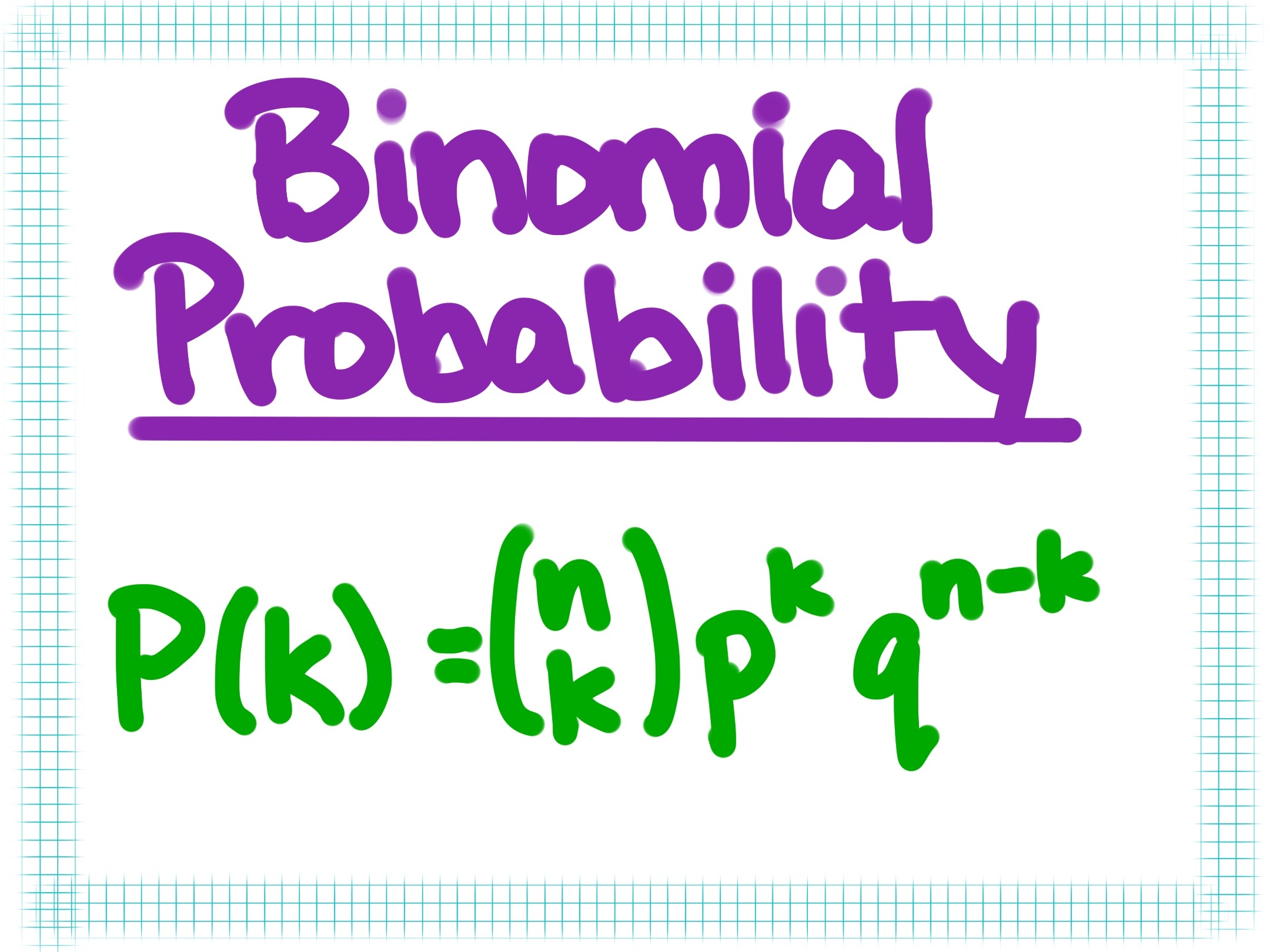
The Binomial Probability Formula is used to find the probabilities for Bernoulli Trials:

P(k)=(nk)pkqn−kP(k) = \binom{n}{k}p^kq^{n-k}

where, P(k)P(k) = the probability of the Bernoulli Trial, nn = number of trials, kk = number of successes in nn trials, n−kn-k = number of failures, pp = probability of success in one trial and q=1−pq=1-p = probability of failure in one trial

Example: Flipping a Coin

We toss a coin 20 times what is the probability of coin landing on heads exactly 15 times.

We know that, nn = 20, kk = 15, n−kn-k = 5, pp = 0.5 = probability of the coin landing on heads and qq = 0.5 = probability of the coin landing on tails.

Therefore, the probability the coin lands on heads exactly 15 times is...

P(15)=(2015)(0.5)15(0.5)5≈0.01478P(15) = \binom{20}{15}(0.5)^{15}(0.5)^{5} \approx 0.01478

Test Yourself!

You are taking a 10 question multiple choice test; each question has 4 choices. You didn't study so you decide to guess on all the questions. What is the probability that you get exactly 6 questions correct?

Choose one answer

Learn a clever approach

Every problem comes with a worked solution, so even one you cannot crack shows you a new way to think. These are real problems from the AMC 8, AMC 12 and AIME, the national math competitions for middle and high school students, each with a worked solution on LIVE by Po-Shen Loh.

Illustrated · 1 min

Binomial Probability

There is a simple formula using a combination.

Binomial Probability

Image source: by Anusha Rahman

Imagine you are doing a series of experiments. Each experiment has several trials. Each trial has only two possible outcomes, usually called success or failure. This group of trials is called a Bernoulli process. Each trial is independent, which means one result does not affect the next result.

In these trials, we are interested in a certain event. For example, imagine flipping a coin and looking for heads. Each coin flip is one trial in our Bernoulli process. We can use a random variable to represent the result. We give it a value of 11 for a success, such as heads. We give it a value of 00 for a failure, such as tails.

Now, let's say we complete a fixed number of trials, called nn trials. We want to know how many times our desired event happens. This number of successes is called a binomial random variable. In other words, we are counting the successes in a fixed number of independent Bernoulli trials. This variable follows a binomial distribution.

This setup helps us study the results of these experiments. We can use it to calculate the probability of getting a certain number of successes.

Video

(Video) Bernoulli Trials

by Wrath of Math

In this video by Wrath of Math, you will learn about Bernoulli Trials.

Type a concept, like “slope” or “photosynthesis”.

↑ ↓ to choose · Enter to openSearch explanations and problems
