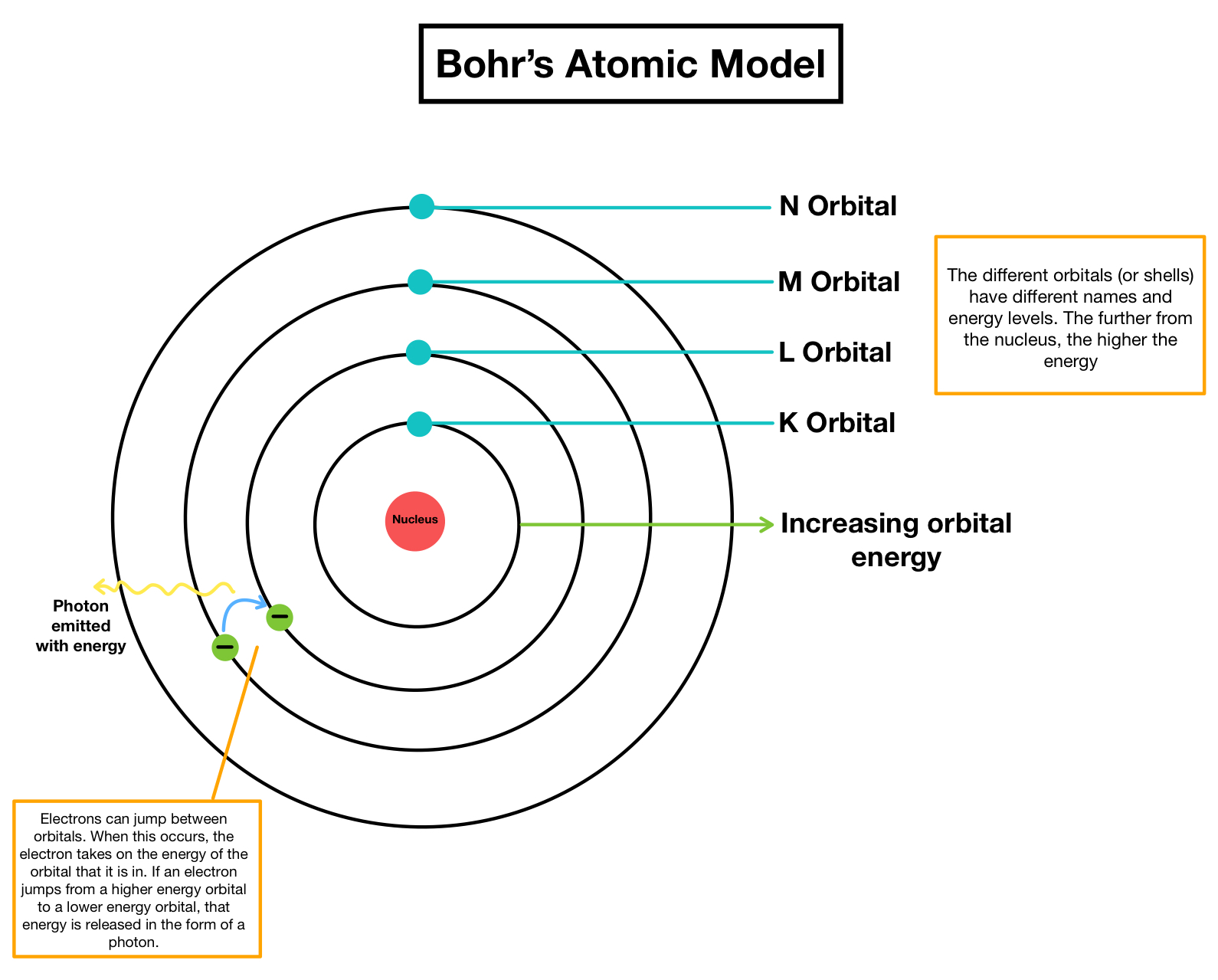
We've been studying the history of chemistry. We're slowly building to the development of the quantum mechanical model of the atom. So far, we've been exploring how our perspective shifted away from classical physics. We started by looking at Planck's quantum theory. Then we saw Einstein solve the challenge of the photoelectric effect. We were beginning to understand that energy and matter behave differently at the atomic scale. This led to the development of the wave-particle duality. But, within chemistry, the central questions still revolved around the atom. We had various ideas like the plum pudding model and the nuclear model. But none of them truly fit the experimental data.
One of our remaining problems was atomic spectra. When we put energy into an atom, they emit different colors. But, various elements produced unique spectra. Could we develop a model that theoretically predicted these emission spectra? Thankfully, Niels Bohr had a unique insight into the structure of the atom. It didn't solve all the problems. But, it was a foundational first step.
Deriving the Bohr Model from Classical Physics
Let's study how Bohr derived his atomic model. He essentially only used classical physics. But, he made a momentous connection to quantum mechanics.
First, let's imagine a hydrogen atom. At its center is a positive charge. Remember, we didn't know about neutrons at the time. So, we thought the nucleus was just a proton. Hydrogen only has one electron. We'll imagine it orbiting the nucleus via circular motion.
Now, what is the total energy of the electron? The electron is moving. So, it has kinetic energy. But, there is also a potential energy component. It comes from the electrostatic attraction to the proton.
Do you remember the kinetic energy and Coulomb potential formulas from classical physics?
K.E=21mv2.
P.E=RKQ1Q2.
- K is Coulomb's constant. It equals 8.99×10⁹C2Nm2. The units are Newtons-square meters over square Coulombs.
- Q is the charge in Coulombs. In this case, the charge of a proton and electron are equal but opposite. So, Q1Q2→e2. e is 1.602×10⁻¹⁹C.
So, what's the total energy of the electron?
ET=K.E+P.E=21mv2−RKe2
The negative sign comes from the electron's negative charge.
In our model, the electron is moving in a circular trajectory. The circular motion gets generated by the Coulomb force. It's like how gravity creates planetary orbits. That means the centripetal force (the force of circular motion) equals Coulomb's force. Remember, these are the force equations. So, they look different than the energy equations.
Rmv2=R2Ke2
If we solve for mv2 we get mv2=RKe2
Let's plug that back into our energy equation.
ET=K.E+P.E=21mv2−RKe2→2RKe2−RKe2→2R−Ke2
So, what are we left with? We have the energy in terms of the electron's charge and the distance between the proton and the electron. But how do we determine the distance within an atom? It's at this point that Bohr had his central insight. What if the electron's angular momentum is quantized? Remember, momentum is mass in motion. So, anything moving has momentum. Our electron is moving around the proton in a circular orbit. So, it has an orbital angular momentum. If angular momentum is quantized, we can relate it to multiples of Planck's constant.
L=mvR=2πhn where n=1,2,3...
- The n and h we saw in our study of black body radiation. All quantization is a multiple of Planck's constant. But what about the 2π. It occurs because the electron is moving in a circle. A full circle is two-pi radians.
The trick here is to square the angular momentum.
L2=m2v2R2=4π2h2n2 where n=1,2,3...
Now, we can solve for mv2.
mv2=4π2mR2h2n2 where n=1,2,3...
But we already had a relationship for mv2! So, let's set them equal to each other.
4π2mR2h2n2=RKe2 where n=1,2,3...
What happens when we solve for R?
R=4π2mKe2h2n2 where n=1,2,3...
But wait, h, π, m, K, and e are all constants! So, let's simplify.
R=5.31×10⁻¹¹n2 where n=1,2,3...
Now we can plug R into our energy equation.
ET=2R−Ke2=2×5.31×10−11n2−Ke2=n2−2.17×10⁻¹⁸J where n=1,2,3...
To make the units easier, we can convert joules to electronvolts.
n2−2.17×10−18J×1J6.242×1018eV=n2−13.6eV where n=1,2,3...
What did Bohr's Model Accomplish?
We just derived the equation that Bohr proposed in 1913. But what does it actually tell us? It's the energy for each orbit of the hydrogen atom. Remember, at the time, we didn't know about orbitals. But it turns out that Bohr's model is a good prediction. How did we experimentally confirm Bohr's model? It theoretically predicted the atomic spectra of hydrogen! At the same time, other chemists were working on the modern periodic table. The Bohr model qualitatively fits some of the periodic trends. For example, it helped explain the octet rule, ionization energy, and atomic radius trends. Bohr's model was also the first step toward understanding valence electrons and covalent bonding. He proposed that molecules form between the outer orbit electrons of two atoms.
Imperfections of the Bohr Model
As you might guess, the Bohr model has some flaws. Why? There are a couple of reasons. The model does not account for electron-electron repulsion. The repulsion impacts the electron's energy. So, the energy levels are not the same for multiple electron systems. It also cannot describe the atomic spectra of heavier elements. Again the electron repulsion influences the wavelength of light emitted. Finally, it does not consider the wave-particle duality, the de Broglie equation, or the uncertainty principle. All of these would come within the next decade. They would transform the Bohr model into the quantum mechanical model!