Buffers — Definition & Overview

Before this, knowWhat Is pH? — Definition & Overview

Illustrated · 1 min

What Are Buffers?

This is a cartoon illustration explaining what a buffer is. The text reads: Weak acids exist in an equilibrium. A solution of a weak acid (HA) and its conjugate base (A-) is called a buffer. The image shows a burly, buff, green, personified buffer molecule as the weak acid (HA) in equilibrium with its conjugate base (A-). Weak acids can dissociate into a proton and their conjugate base, existing in equilibrium.
This is a cartoon illustration explaining what a buffer is. The text reads: buffer solutions resist changes in pH. The image shows burly, buff, green, personified buffer molecules fighting hydrogen molecules.

Image source: By Sylvia Freeman

A buffer is a solution that resists changes in pH when small amounts of acids or bases are added to it.

Remember that organisms function in strict pH ranges. Big changes in pH, caused by the addition of an acid or base, can kill an organism and its cells, or (in the best case scenario) prevent a major process (like digestion) from occurring properly.

Here's an example: your blood maintains a pH of about 7.4. Let's look at what would happen if that changed:

  • Blood pH of 7.7 = muscle spasms, convulsion
  • Blood pH of 6.9 = coma, death

The functional pH range for blood and many of your body systems is very narrow. Major changes mean major problems.

The message here: pH levels in the body (and in specific cells) need to stay relatively constant. Maintaining constant pH is an example of homeostasis.

Here's where buffers come in.

Buffer solutions are made from a weak acid and its conjugate (partner) base, or a weak base and its conjugate acid.

These solutions resist changes in pH when acids or bases are added. Organisms and their cells produce them to keep pH steady. If an acid or base is added, the buffer neutralizes it. They act like a cellular cotton ball, soaking up added acids and bases and prevent them from damaging the cell.


Illustrated · 1 min

How Do Cells Control pH Levels?

A buffer is a substance that reacts with a strong acid or base to prevent significant changes in pH.

This word is sometimes used casually, like "he was trying to buffer their argument", to describe someone keeping the peace during a conflict. The idea of preventing conflicts is actually a great way to remember what chemical buffers do. They keep the pH from rising (or falling) and prevent drastic changes, which is pretty similar to the casual use of the word.

Acid base reaction

Image source: By OpenStax CC BY 4.0, via Wikimedia Commons

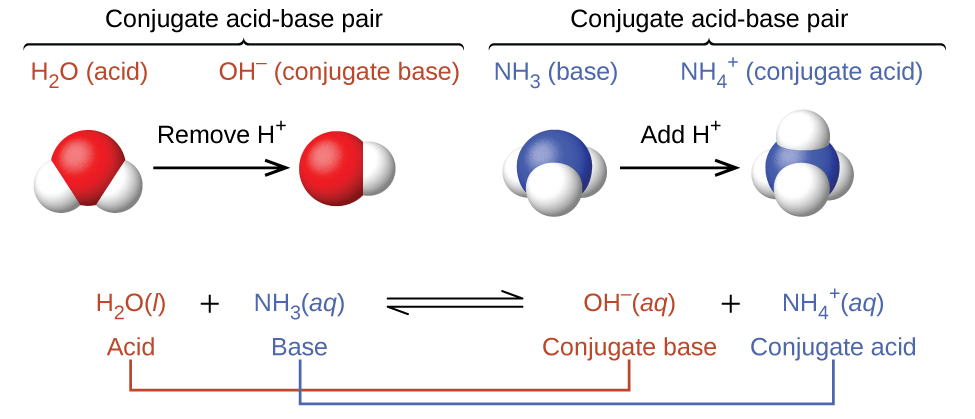
They are often mixtures of a weak acid with its salt or a weak base and its salt. These pairs are known as conjugate acid-base pairs. They are forms of the same molecule, just one is acidic and the other is basic.

Acid base reaction

Conjugate acid-base pairs

Image source: By OpenStax CC BY 4.0, via Wikimedia Commons

Adding acid to an unbuffered solution causes a sharp drop in pH. Adding acid to a buffer solution, however, will only cause a slight lowering of the pH.

This really helps biological systems maintain steady pH levels. You really don't want your blood to have a sudden spike in acidity. Luckily blood contains biological buffers like bicarbonate ions. These solutions also help keep stomach acid in the right range to dissolve food but not dissolve the stomach lining.

Vocabulary Review:\color{#8925AE}{\text{Vocabulary Review:}}

pH\color{#8925AE}{\text{pH}} : A measure of how basic or acidic a solution is

Basic\color{#8925AE}{\text{Basic}} : A solution with a high number of hydroxide ions and a low number of hydrogen ions

Neutral\color{#8925AE}{\text{Neutral}} : A solution with an equal number of hydroxide and hydrogen ions

Acidic\color{#8925AE}{\text{Acidic}} : A solution with a low number of hydroxide ions and a high number of hydrogen ions

Buffer\color{#8925AE}{\text{Buffer}} : A solution that resists changes in pH

Illustrated · 2 min

Resisting Changes in pH

A buffer is a solution that resists changes in pH. They are most commonly formed by the addition of a weak base or weak acid to water. Weak bases and acids must be used (as opposed to strong bases and acids) since they exist in equilibrium. This means that the conjugate pairs of both the acid and base exist in the solution.

The equilibrium between ammonia and water with conjugate pairs. Acids and bases are labeled.

Image source: By Jasper Brown

But how exactly does equilibrium allow a system to buffer? The answer lies in Le Chatelier's principle. In short, Le Chatelier's principle states that a system in equilibrium will resist changes to that equilibrium. Using the reaction above as an example, if we were to add water (H2OH_2O) to the system, it would drive the reaction to the right. Likewise, if we add ammonia (NH3NH_3), we go to the right. If we add hydroxide (OH−OH^-) or ammonium (NH4+NH_4^+), we drive to the left.

Resisting pH Change

Bringing this back to pH buffers, lets examine how the ammonia reaction will resist a pH change. Let's say we added NaOHNaOH to the system. This will break apart into Na+Na^{+} and OH−OH^{-}, and thus we are adding hydroxide to the system. At first glance you might think that it will just skyrocket the pH since we are increasing the amount of hydroxide, but because of Le Chatelier's principle, the reaction is driven to the left and hydroxide is consumed. While the pH does still rise, it rises less than it would have had the same amount of NaOHNaOH been added to water.

In a similar vein, if an acid was added, then ammonia would snatch it up. This would increase the amount of ammonium and drive the reaction to the left. Since there would then be less hydroxide, the pH lowers.

Review:\color{#8925AE}{\text{Review:}}

Conjugate pair\color{#8925AE}{\text{Conjugate pair}} : Two chemicals that differ only by the addition or subtraction of a proton \\ Equilibrium\color{#8925AE}{\text{Equilibrium}} : A system that proceeds in the forward direction at the same rate that it proceeds in the reverse direction \\ Le Chatelier’s principle\color{#8925AE}{\text{Le Chatelier's principle}} : A system in equilibrium resists changes acted upon it \\

Video

(Video) Buffers, the Acid Rain Slayer

by CrashCourse

The video above explains what a buffer is.

It is a solution that prevents drastic pH changes when an acid or base is added to it.

Type a concept, like “slope” or “photosynthesis”.

↑ ↓ to choose · Enter to openSearch explanations and problems