Calculating Areas Bounded by Curves

Interactive · 2 questions

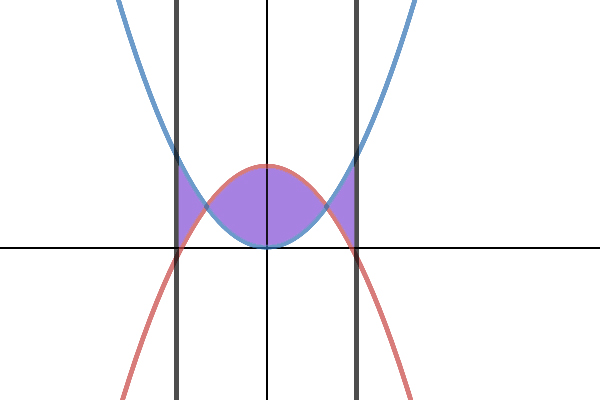
We all know that integrals give areas; i.e. definite integrals given areas under curves over a particular interval. Now, let us ask a different question. If we had two curves and we took the region bounded between those two curves, what would be the area? Let us start with an example.

Let us say we want to find the bounded area between the graphs of y=x2y = x^2 and y=xy = \sqrt {x}. We can clearly see the lemon-shaped region below.

The easiest way to think about it is the following. Let's say we wanted to define R\mathcal{R} to be the entire region in the first quadrant above the graph y=x2y=x^2. Now define the entire region below the graph of y=xy=\sqrt{x} to be S\mathcal{S}. It is clear that the region R∩S\mathcal{R} \cap \mathcal{S} is equal to the area in the first quadrant below y=xy = \sqrt {x} minus the area under the curve y=x2y = x^2. Try to see why this is and once you are done, click Continue.

Now that we have understood what type of problem we are solving, we can begin converting to math; namely, integrals. Note that the area we are interested in runs between the two intersections of the curves.

Over what xx-values does the area run?

Choose one answer

Interactive · 1 question

We already know that an integral is an area under a curve. An area bounded by two curves is the area under the smaller curve subtracted from the area under the larger curve. This will get you the difference, or the area between the two curves.

What is the first step in order to find the area between the two curves f(x)=xf(x)=x and f(x)=x2f(x)=x^2 from x=0x=0 to x=1x=1?

Choose one answer

Video · + 1 min read

(Video) Finding Areas Between Curves

by PatrickJMT

Here's a video by patrickJMT where he shows you how to find any area that's between two curves.

For example, suppose you had some function f(x)f(x).

And another function below it, g(x)g(x), and both functions are defined from aa to bb.

How would you find the area that is between them? Well, we can use integrals! We set the integral from aa to bb and then integrate the top curve minus the bottom curve. ∫ab[f(x)−g(x)]dx\int_a^b\left[f(x)-g(x)\right]dx

Let's look at some examples. In the first, the curves are given to us.

We want to calculate the area between the two curves from (0,0)(0,0) to (6,12)(6,12).

We start by integrating from the smallest xx-coordinate to the largest xx-coordinate, i.e. from 0 to 6. ∫06\int_0^6

Next, we want to take the top curve and subtract the bottom curve. On our interval the line y=2xy=2x is our top curve (because it's higher up) and x2−4xx^2-4x is our bottom curve. ∫06[2x−(x2−4x)]dx\int_0^6\left[2x-(x^2-4x)\right]dx

Now that we set the problem up, we solve. ∫06[2x−(x2−4x)]dx ∫06[2x−x2+4x]dx ∫06[6x−x2]dx ∫066x dx−∫06x2 dx 6∫06x dx−∫06x2 dx 6[12x2]06−[13x3]06 3[x2]06−13[x3]06 3[(6)2−(0)2]−13[(6)3−(0)3] 3[36−0]−13[216−0] 3(36)−2163 36\begin{aligned} &\int_0^6\left[2x-(x^2-4x)\right]dx\\\ &\int_0^6\left[2x-x^2+4x\right]dx\\\ &\int_0^6\left[6x-x^2\right]dx\\\ &\int_0^6 6x\text{ }dx-\int_0^6 x^2\text{ }dx\\\ &6\int_0^6 x\text{ }dx-\int_0^6 x^2\text{ }dx\\\ &6\left[\frac12x^2\right]_0^6-\left[\frac13x^3\right]_0^6\\\ &3\left[x^2\right]_0^6-\frac13\left[x^3\right]_0^6\\\ &3\left[(6)^2-(0)^2\right]-\frac13\left[(6)^3-(0)^3\right]\\\ &3\left[36-0\right]-\frac13\left[216-0\right]\\\ &3(36)-\frac{216}{3}\\\ &\boxed{36} \end{aligned}

In this second example we're given the equations and have to determine which is the top curve and which is the bottom curve.

y=8−x2y=8-x^2, y=x2y=x^2, x=−3x=-3, x=3x=3

Start by graphing each curve.

We can set the two curves equal to each other to find their points of intersection. 8−x2=x28=2x24=x2±2=x\begin{aligned} 8-x^2&=x^2\\ 8&=2x^2\\ 4&=x^2\\ \pm2&=x \end{aligned}

From left to right the three sections of integrals are from −3-3 to −2-2, −2-2 to 22, and 22 to 33. ∫−3−2[x2−(8−x2)]dx+∫−22[(8−x2)−x2]dx+∫23[x2−(8−x2)]dx\int_{-3}^{-2}\left[x^2-(8-x^2)\right]dx+\int_{-2}^{2}\left[(8-x^2)-x^2\right]dx+\int_{2}^{3}\left[x^2-(8-x^2)\right]dx

Now that the equation is set up we can solve the integrals. Let's start with the first. ∫−3−2[x2−(8−x2)]dx ∫−3−2[x2−8+x2]dx ∫−3−2[2x2−8]dx ∫−3−22x2 dx−∫−3−28 dx 2∫−3−2x2 dx−8∫−3−2 dx 2[13x3]−3−2−8[x]−3−2 23[x3]−3−2−8[x]−3−2 23[(−2)3−(−3)3]−8[(−2)−(−3)] 23(19)−8(1) 143\begin{aligned} &\int_{-3}^{-2}\left[x^2-(8-x^2)\right]dx\\\ &\int_{-3}^{-2}\left[x^2-8+x^2\right]dx\\\ &\int_{-3}^{-2}\left[2x^2-8\right]dx\\\ &\int_{-3}^{-2} 2x^2\text{ }dx-\int_{-3}^{-2} 8\text{ }dx\\\ &2\int_{-3}^{-2} x^2\text{ }dx-8\int_{-3}^{-2} \text{ }dx\\\ &2\left[\frac13x^3\right]_{-3}^{-2}-8\left[x\right]_{-3}^{-2}\\\ &\frac23\left[x^3\right]_{-3}^{-2}-8\left[x\right]_{-3}^{-2}\\\ &\frac23\left[(-2)^3-(-3)^3\right]-8\left[(-2)-(-3)\right]\\\ &\frac23(19)-8(1)\\\ &\frac{14}3 \end{aligned}

Next, the second. ∫−22[(8−x2)−x2]dx ∫−22[8−x2−x2]dx ∫−22[8−2x2]dx ∫−228 dx−∫−222x2 dx 8∫−22dx−2∫−22x2 dx 8[x]−22−2[13x3]−22 8[x]−22−23[x3]−22 8[(2)−(−2)]−23[(2)3−(−2)3] 8(4)−23(16) 643\begin{aligned} &\int_{-2}^2\left[(8-x^2)-x^2\right]dx\\\ &\int_{-2}^2\left[8-x^2-x^2\right]dx\\\ &\int_{-2}^2\left[8-2x^2\right]dx\\\ &\int_{-2}^2 8\text{ }dx-\int_{-2}^2 2x^2\text{ }dx\\\ &8\int_{-2}^2 dx-2\int_{-2}^2 x^2\text{ }dx\\\ &8\left[x\right]_{-2}^2-2\left[\frac13x^3\right]_{-2}^2\\\ &8\left[x\right]_{-2}^2-\frac23\left[x^3\right]_{-2}^2\\\ &8\left[(2)-(-2)\right]-\frac23\left[(2)^3-(-2)^3\right]\\\ &8(4)-\frac23(16)\\\ &\frac{64}3 \end{aligned}

Finally, the last integral. ∫23[x2−(8−x2)]dx ∫23[x2−8+x2]dx ∫23[2x2−8]dx ∫232x2 dx−∫−3−28 dx 2∫23x2 dx−8∫−3−2 dx 2[13x3]23−8[x]23 23[x3]23−8[x]23 23[(3)3−(2)3]−8[(3)−(2)] 23(19)−8(1) 143\begin{aligned} &\int_{2}^{3}\left[x^2-(8-x^2)\right]dx\\\ &\int_{2}^{3}\left[x^2-8+x^2\right]dx\\\ &\int_{2}^{3}\left[2x^2-8\right]dx\\\ &\int_{2}^{3} 2x^2\text{ }dx-\int_{-3}^{-2} 8\text{ }dx\\\ &2\int_{2}^{3} x^2\text{ }dx-8\int_{-3}^{-2} \text{ }dx\\\ &2\left[\frac13x^3\right]_{2}^{3}-8\left[x\right]_{2}^{3}\\\ &\frac23\left[x^3\right]_{2}^{3}-8\left[x\right]_{2}^{3}\\\ &\frac23\left[(3)^3-(2)^3\right]-8\left[(3)-(2)\right]\\\ &\frac23(19)-8(1)\\\ &\frac{14}3 \end{aligned}

Combining these three we get: 143+643+143=923\frac{14}3+\frac{64}3+\frac{14}3=\frac{92}3

Video · + 1 min read

(Videos) Area Between Curves with Respect to yy

by PatrickJMT

In these videos by patrickJMT he shows you how to find the area between curves by taking the integral with respect to yy. Previously it was with respect to xx. It will be roughly the same process. The integral bounds will be the min and max of the yy-axis as opposed to the xx-axis.

Suppose you have two functions f(y)f(y) and g(y)g(y) and want to find the area between the two curves.

We want to find the yy-coordinates of their points of intersection, i.e. cc and dd. Then you take the integral of the right most function minus the left most function. ∫cd[f(y)−g(y)]dy\int_c^d\left[f(y)-g(y)\right]dy

The example he looks at is finding the area between the curves x=y3−yx=y^3-y and x=1−y4x=1-y^4.

The first step is to graph the curves.

Now set the curves equal to each other in order to see where they intersect. y3−y=1−y4y4+y3−y−1=0(y4+y3)−(y+1)=0y3(y+1)−(y+1)=0(y3−1)(y+1)=0y=±1\begin{aligned} y^3-y&=1-y^4\\ y^4+y^3-y-1&=0\\ (y^4+y^3)-(y+1)&=0\\ y^3(y+1)-(y+1)&=0\\ (y^3-1)(y+1)&=0\\ y&=\pm1 \end{aligned}

We need to integrate from -1 to 1 and integrate the right most curve, 1−y41-y^4, minus the left most curve, y3−yy^3-y. ∫−11[(1−y4)−(y3−y)]dy\int_{-1}^1\left[(1-y^4)-(y^3-y)\right]dy

Finally, integrate. ∫−11[(1−y4)−(y3−y)]dy ∫−11[1−y4−y3+y]dy ∫−111 dy−∫−11y4 dy−∫−11y3 dy+∫−11y dy [y]−11−[15y5]−11−[14y4]−11+[12y2]−11 [y]−11−15[y5]−11−14[y4]−11+12[y2]−11 [1−(−1)]−15[(1)5−(−1)5]−14[(1)4−(−1)4]+12[(1)2−(−1)2] 2−25−0+0 85\begin{aligned} &\int_{-1}^1\left[(1-y^4)-(y^3-y)\right]dy\\\ &\int_{-1}^1\left[1-y^4-y^3+y\right]dy\\\ &\int_{-1}^11\text{ }dy-\int_{-1}^1y^4\text{ }dy-\int_{-1}^1y^3\text{ }dy+\int_{-1}^1y\text{ }dy\\\ &\left[y\right]_{-1}^1-\left[\frac15y^5\right]_{-1}^1-\left[\frac14y^4\right]_{-1}^1+\left[\frac12y^2\right]_{-1}^1\\\ &\left[y\right]_{-1}^1-\frac15\left[y^5\right]_{-1}^1-\frac14\left[y^4\right]_{-1}^1+\frac12\left[y^2\right]_{-1}^1\\\ &\left[1-(-1)\right]-\frac15\left[(1)^5-(-1)^5\right]-\frac14\left[(1)^4-(-1)^4\right]+\frac12\left[(1)^2-(-1)^2\right]\\\ &2-\frac25-0+0\\\ &\boxed{\frac85} \end{aligned}

Type a concept, like “slope” or “photosynthesis”.

↑ ↓ to choose · Enter to openSearch explanations and problems