Read · 4 min
We finally made it through all those gas laws! They finished on a high note with the ideal gas law. It's a powerful tool that helps us understand gas behavior. We also saw that we can use it to calculate a gas's molar mass. But, it can help us even more. Today it will help us determine a gas's density!
Why do Gases have Variable Densities?
Remember that a substance's density is its mass divided by its volume, in other words its mass per unit volume. Gases do not have a fixed density. Why not? Let's think about the physical properties of gases. We learned that gases are expandable and compressible. Their volumes can change. So, they have shifting densities. Anything that alters a gas's volume affects its density. But, solids and liquids have constant volumes. We learned about this when we compared the volumes of the phases of matter. So, we can give a fixed value for the density of a solid or liquid. But, for a gas's density, we have to state the temperature and pressure. Most often, we give the density at standard temperature and pressure. For example, chlorine, a halogen, has a density of 3.17 at STP.
Deriving Density from the Ideal Gas Law
The first thing we need to do is derive a formula for a gas's density. We can do it from the ideal gas law.
-
Start with the ideal gas law: .
-
Solve the density equation for volume: .
-
Insert volume into the ideal gas law: .
-
Solve for density: .
-
Simplify by converting moles to molar mass (): .
-
Simplify by multiplying the top and bottom by : .
-
Finally, finish simplifying: .
Why Does Density Depend on Temperature, Pressure, and Molar Mass?
In the final form of our equation, we see that a gas's density depends on the temperature, pressure, and molar mass. Remember, density is defined as a gas's mass divided by volume. So anything that affects its volume impacts the density. To understand why we need to think about the gas laws.
Charles' law tells us that volume and temperature are directly related. Adding heat raises the kinetic energy. So, there will be more space between the molecules. They have a larger volume. The same mass is taking up more space. So, their density decreased.
Boyle's law connected the pressure and volume. They have an indirect relationship. Imagine we have a movable piston. When the gas molecules collide with the piston, they exert a force. If the system's volume increases, there will be fewer collisions. Again, we have the same mass but with more space. So, the density changes.
What about the molar mass? Let's imagine one mole of hydrogen gas and one mole of the noble gas, neon. Neon has a much larger molar mass. From Avogadro's law, we know there is the same number of particles. But, they have different masses. So, their densities are different.
Steps for Solving Gas Density Problems
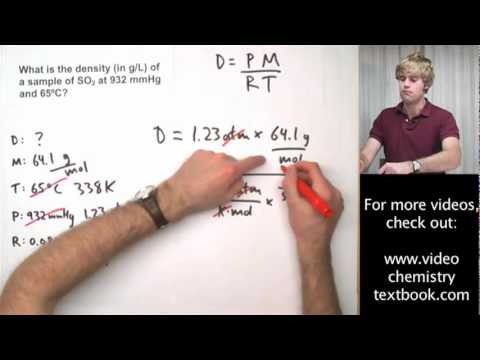
Your teacher will ask you to use the gas density formula. Most often, you'll want to find a gas's density or its molar mass. In both cases, you can use the same equation. There are three steps for solving gas density problems.
-
List what you know.
-
Convert the units based on the universal gas constant. I recommend using .
-
Plug everything into the density equation.
Gas Density Example Problems
What we're learning has practical applications in environmental chemistry. For our example problems, we'll look at some gases in our atmosphere.
- The troposphere is the lowest layer of our atmosphere. It varies in height from 4 kilometers to 12 kilometers. At its highest point, the temperature is about -60.0 . The air pressure at the top is about 100.0 millibar. Let's calculate the density of carbon dioxide gas in the troposphere.
Start by listing what we know.
-
P= 100.0 millibar
-
T= -60.0
-
R= 0.0821
-
M= 44.0
-
Next, convert your units to match the ideal gas constant.
-
P=100.0 millibar .098 atm
-
T= -60.0 213.15 K
-
R= 0.0821
-
M= 44.0
Plug everything into the density equation.
- What changes would we need to make if we wanted to calculate the density of methane?
-
The only thing we need to change for a new greenhouse gas is molar mass.
-
- If we know the density, we can also solve for the molar mass. Let's say we have an unknown gas at standard temperature and pressure. Let's find its molar mass given a density of .
Let's write what we know.
-
-
P= 1.0 atm
-
K= 273.15 K
-
-
M=?
All the units are correct. So, we plug everything into the density formula.
-
-
The gas is diatomic nitrogen!
There is a second way to solve this problem.
-
At STP, we know that one mole of gas has a volume of 22.4 L. Let's multiply the density by the molar volume.
-
(THIS ONLY WORKS AT STP!!!!)