Interactive · 4 questions
+2 contributors

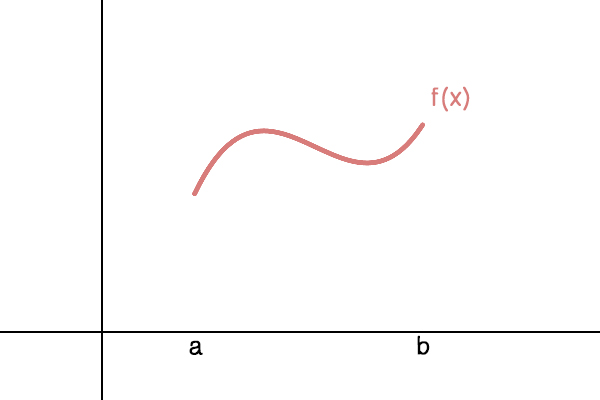
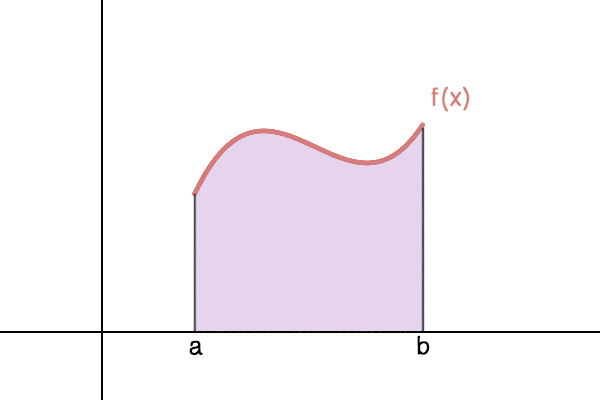
To find the area under a given curve, we've previously seen that one can consider a series of rectangles with constant width inscribed under a curve, and consider their total area as this common width becomes arbitrarily small. These sums were known as Riemann sums.
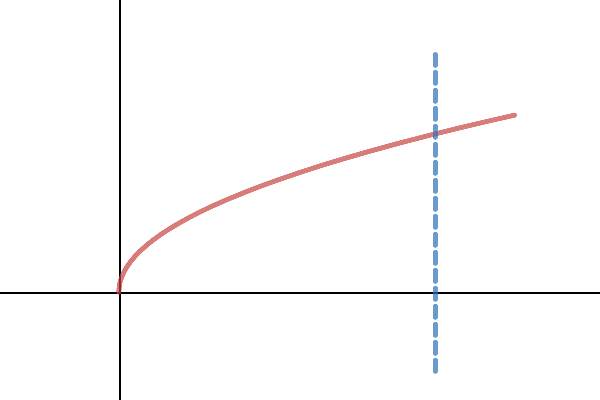
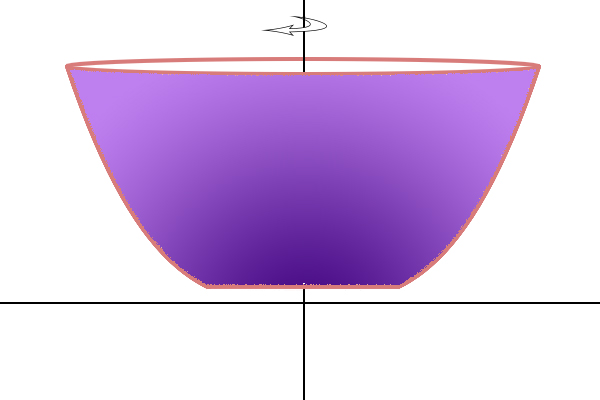
A similar trick works when we wish to find the volume of a region rotated around an axis of revolution. In particular, the Disk and Washer Methods are useful when the bounding lines are perpendicular to the axis of revolution (Shell Method works well when these are parallel). Let's first assume that the -axis is the axis of revolution. When each rectangle is rotated around this axis, a cylinder is formed.
What is the volume of each resulting cylinder, if we wish to revolve a function about the axis?
Note that each "sideways" cylinder will have a height and a radius , so the volume of each cylinder is .
Therefore, summing along an interval gives the following: The volume resulting when the function from is revolved around the axis is
An example:
What is the volume of the resulting solid when from to is revolved around the -axis?
The volume is .
What's the volume of the graph , from to , rotated around the axis?
The volume is . Note that this is recognizable as the volume of a sphere with radius , and this is indeed the solid in question here.
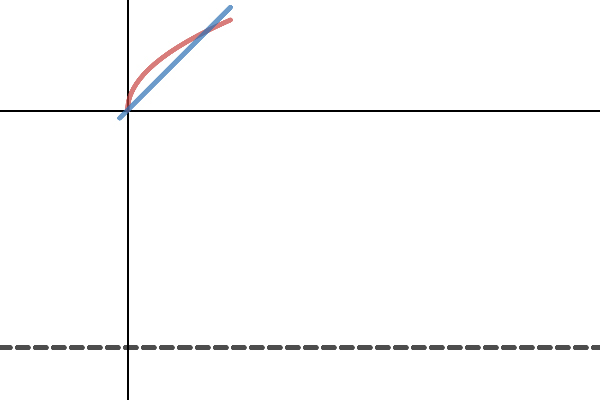
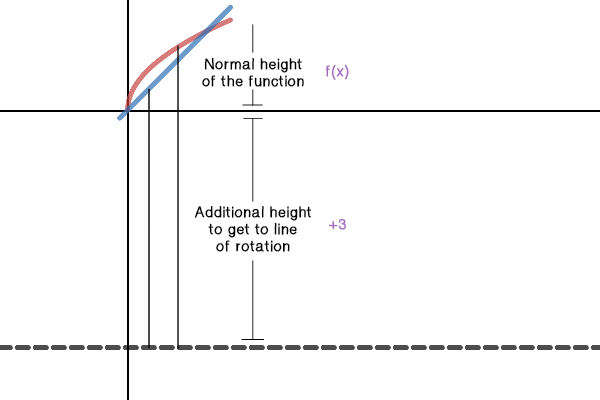
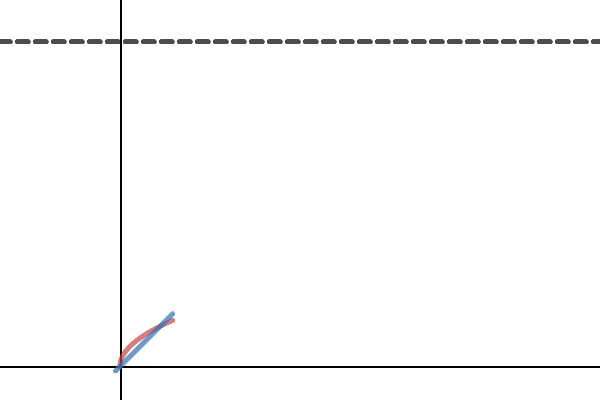
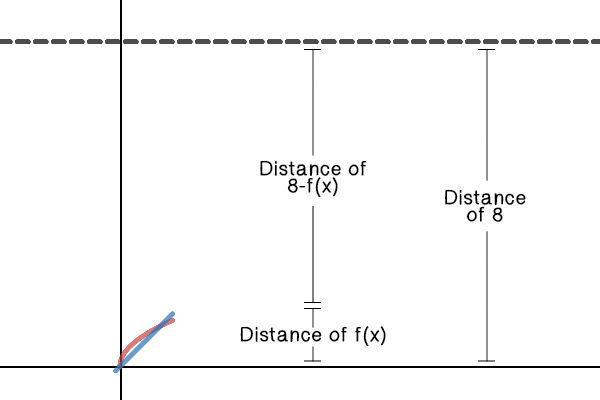
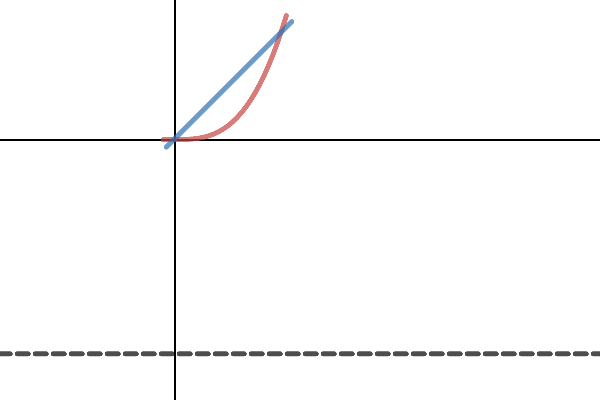
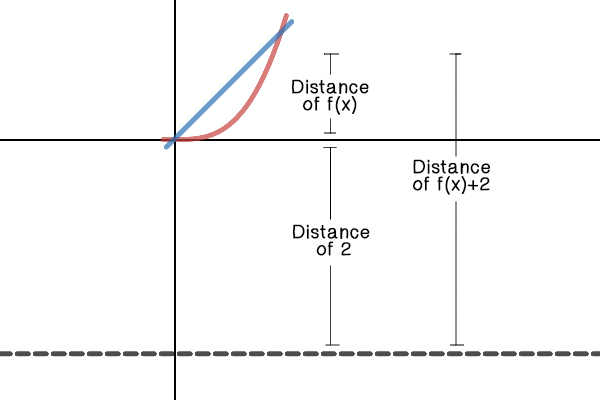
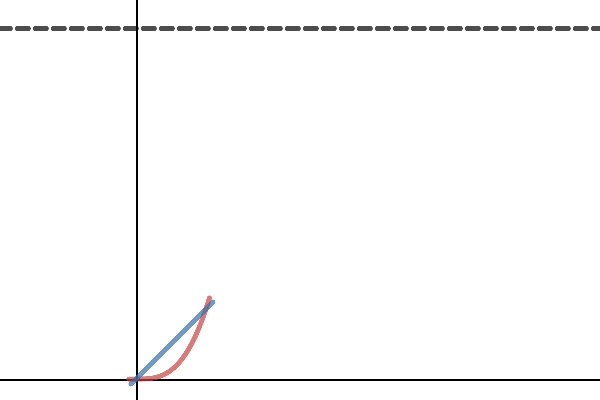
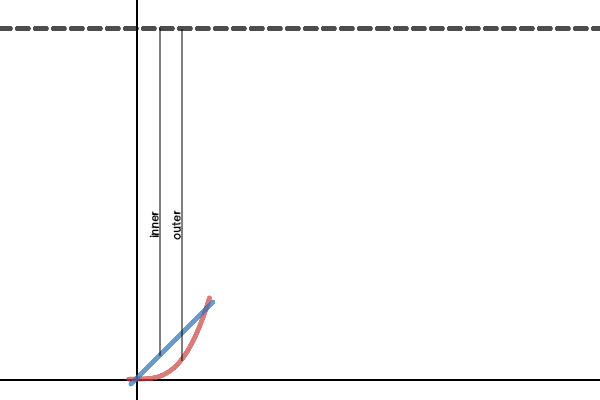
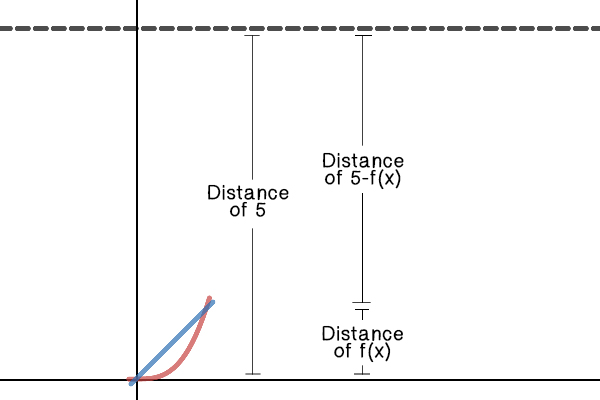
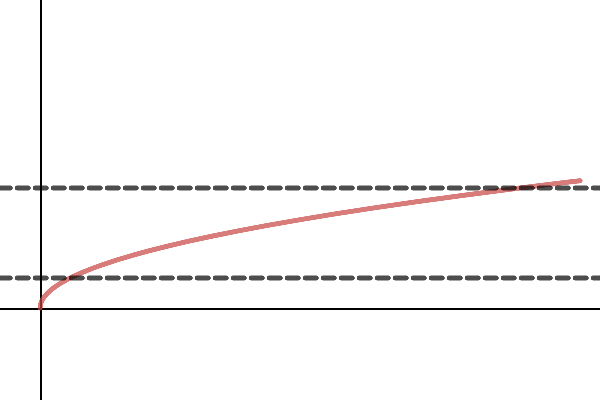
So what about other axes of revolution? If the axis is still horizontal, then a similar idea works. Let's say that we wished to revolve on the interval around the line . In this case, the new radius of each cylinder becomes , and the resulting total volume is
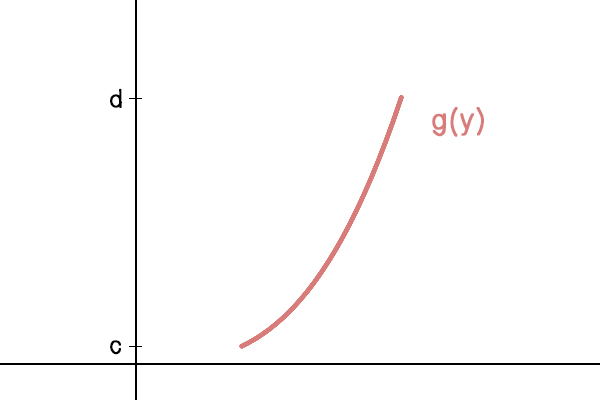
If the axis is vertical, then a change of variables is required. Let's say that we wanted to revolve an invertible function around the from to . Then each cylinder will have height and radius , so that the volume is given by:
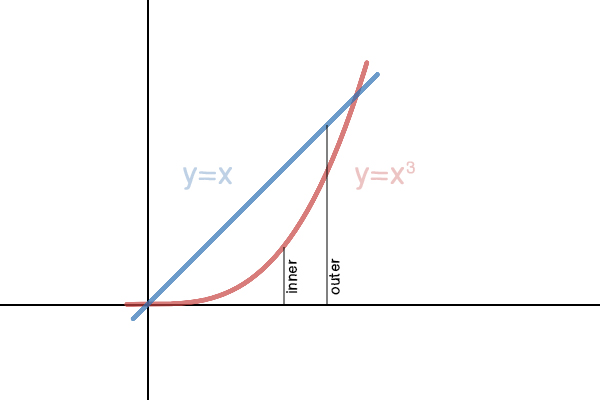
So far, these computations have all fallen under the Disk Method, since the 2-dimensional area which we wish to revolve has been bounded on one side by the axis of revolution. This has resulted in non-hollow solids. The Washer Method is necessary when we want to revolve an area which does not touch the axis of revolution. It seems natural to approach this problem as simply a difference of a larger and a smaller "disk" problem, but some care should be taken.
Here's a fallacious attempt to define Washer's Method: If and are two functions such that for each in the interval , then the volume of the area between and rotated around the axis is given by:
Think for a moment where the above formula could go wrong.
If and are on opposite sides of the axis of revolution at some point (say ), then the rotated region will overlap itself, and so the volume is miscounted. Hence an extra condition should be added: If and are two functions such that or for each in the interval , then the volume of the area between and rotated around the axis between is given by:
This added condition ensures that no overlap occurs in the course of the revolution. Here's an example:
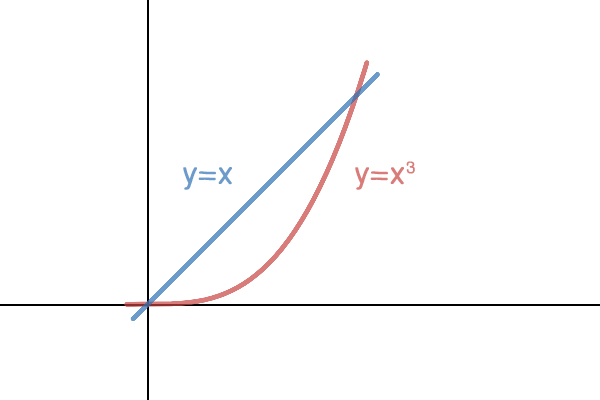
What is the volume which results when the region between the graphs and from to is revolved around the -axis?
These functions satisfy the necessary criteria, so the volume is
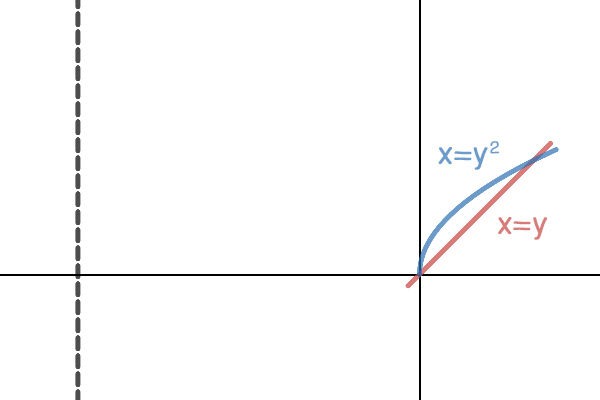
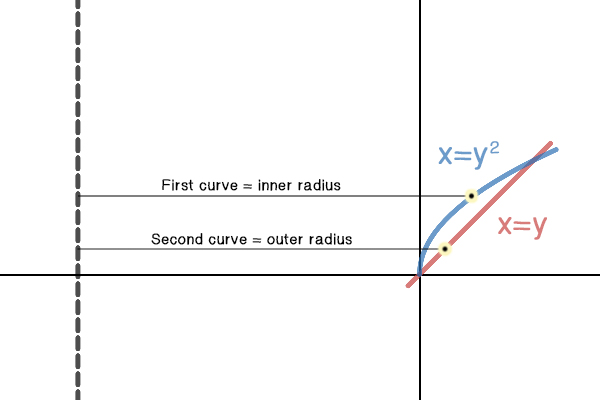
The Washer Method can be similarly adjusted for vertical axes of revolution: If and are two invertible functions such that or for each in the interval , then the volume of the area between and rotated around the axis between is given by:
These methods are useful when determining the volume of a solid of revolution, where each cross section perpendicular to the axis of revolution is a circle. These cross sections can be a variety of other shapes as well; dealing with this will be discussed in the next section, Volumes via other types of "Slices"
(Sidenote: By applying a linear transformation on , one can work with any linear axis of revolution. Horizontal and vertical axes are generally the most common.)