Calvin Cycle (Dark Reaction) — Equation & Steps

Before this, knowSunlight in Photosynthesis — Role & Importance

Illustrated · 2 min

How Cells Make Glucose

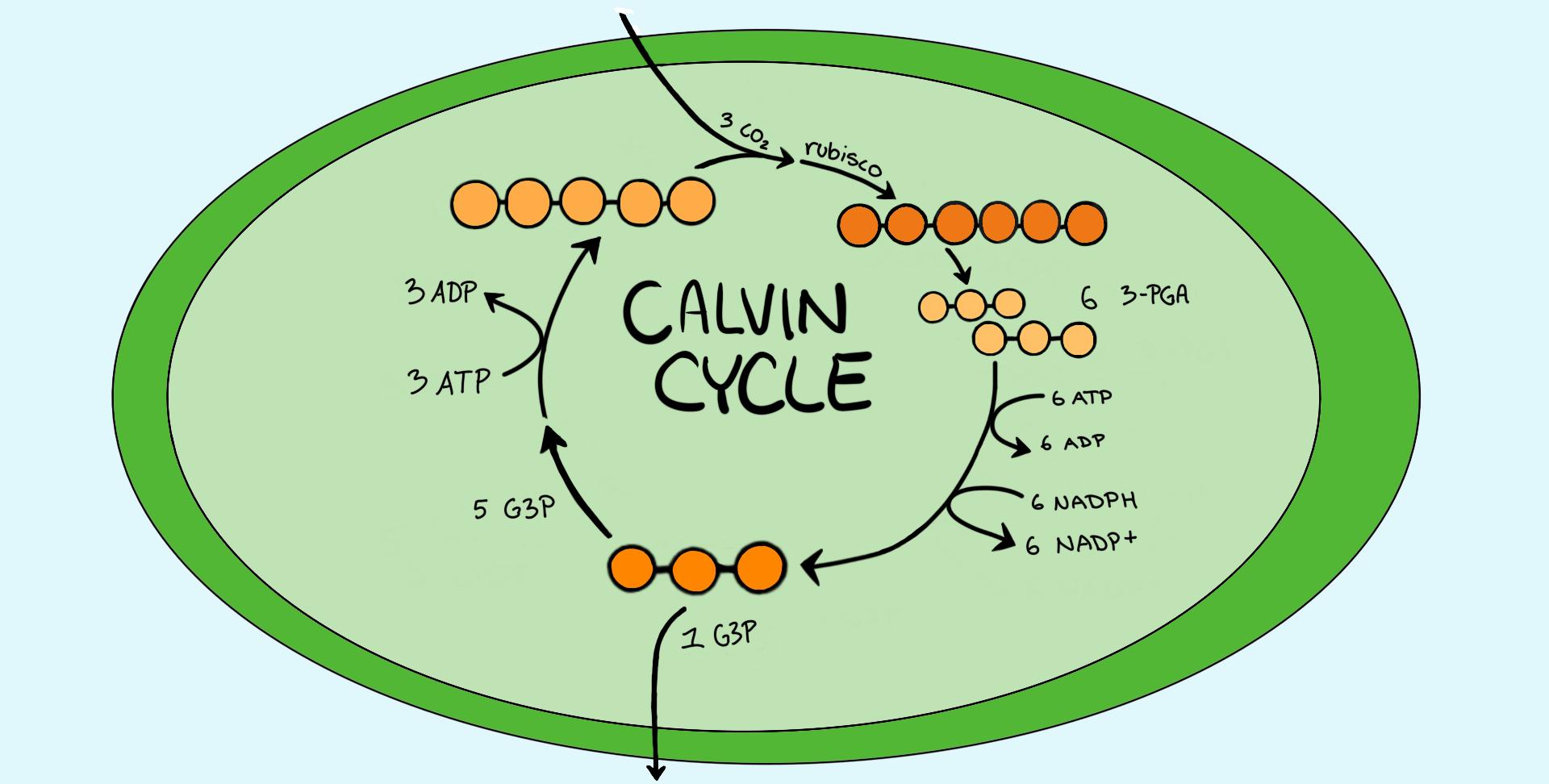
A diagram of the Calvin cycle, as described in the explanation below.

This diagram shows the reactants and products after three turns of the Calvin cycle. \\ Image source: By Gabi Slizewska

Photosynthesis consists of two parts. The first requires sunlight and the second does not.

The Calvin cycle is also called the dark reactions or light-independent reactions because it is the part that doesn't need energy from the sun to happen.

The Calvin cycle takes place within the stroma of the chloroplast. This is where plants make sugar molecules that they can use to make other essential components, and that all other organisms can use for energy.

The cycle uses ATP and NADPH synthesized in the light-dependent reactions to drive its reactions forward. So although the cycle itself doesn't use light energy, it does depend on the light reactions to provide it with the ATP and NADPH.

Reactions in the Cycle

The cycle begins when carbon dioxide (CO2CO_{2}) from the atmosphere enters plant cells. An enzyme called rubisco catalyzes the first reaction, where CO2CO_{2} binds to a specific 5-carbon molecule called ribulose-1,5-bisphosphate (RuBP). This reaction creates a 6-carbon molecule which then splits into two 3-carbon molecules. This part of the cycle is called carbon fixation. This just means that inorganic carbon is converted to organic molecules, like sugar.

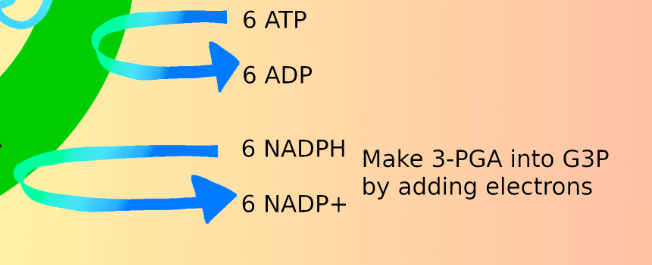
The high-energy products from the light reactions are used in the next reaction. ATP and NADH donate electrons to the 3-carbon molecules, which are converted into a 3-carbon sugar called glyceraldehyde-3-phosphate (G3P).

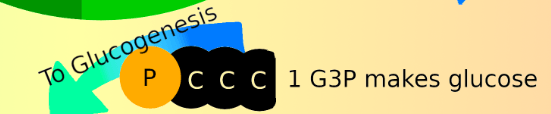
Some of these G3P molecules leave the cycle to form glucose molecules. These will be used by the plant during cellular respiration. Three turns of the cycle are needed for one G3P molecule to exit the cycle. Glucose is made of six carbons, so two G3P molecules are needed to make one glucose molecule.

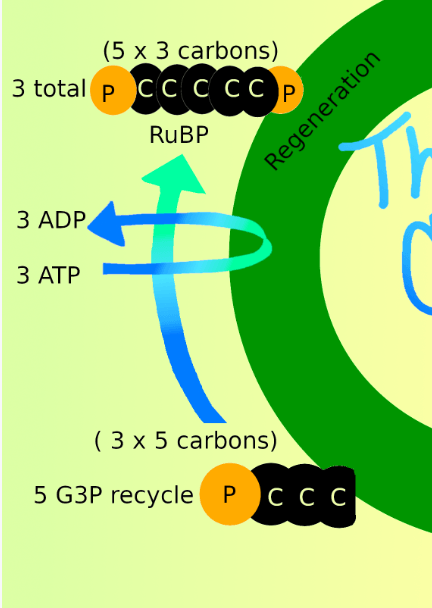
After three turns of the cycle, this leaves five more G3P molecules which are recycled. This allows the cycle to continue. ATP is used to convert the leftover G3P into the molecules that can bind incoming carbon dioxide and restart the cycle.

Illustrated · 1 min

Light-Independent Reactions

The light-independent reactions make up the second part of photosynthesis.

You should note that the name "light-independent reactions" is a little misleading. These reactions do not directly require light, but they can't occur without the NADPH and ATP molecules produced in the light-dependent reactions. There are a few exceptions such as desert plants, who only open their pores at night to get carbon dioxide in order to avoid losing water during the day.

The light-independent reactions are also called the Calvin cycle (or the Calvin-Benson cycle) and occur in the stroma (fluid interior) of the chloroplast.

Diagram showing the structure of a chloroplast

Image source: By Ollin, Smartse (modified by Expii) [Public domain], via Wikimedia Commons

In the light-independent reactions, the plant uses carbon dioxide (CO2CO_2) and the ATP and NADPH from the light-dependent reactions to produce a sugar called glucose.

Glucose (C6H12O6C_6H_{12}O_6) can then be converted by the plant into other molecules that the cell needs. It can also be used in cellular respiration.

Light-dependent and light-independent reactions

In the light-independent reactions, carbon dioxide, ATP, and NADPH are used to produce glucose. \\ Image source: By Hannah Bonville

Notice how the ATP and NADPH are recycled by the light-independent reactions. They return to the light-dependent reactions to be used again.

Key Vocabulary:

  1. Photosynthesis
  2. Chloroplast
  3. Stroma
  4. Glucose

Interactive · 6 questions

What Is the Calvin Cycle?

This image arranges the multiple steps of the Calvin cycle into a circle. The descriptions of each step of the circle can be found below. The steps include carbon fixation, reduction, and regeneration.

Image source: By Sarah Morgan

After a plant traps sunlight energy in the light-dependent reactions, it needs to use the ATP and NADH it created to make long-term energy storage molecules like glucose. The Calvin cycle is used to do this. Since the cycle does not involve sunlight in any of its reactions, it is considered a dark reaction. You can also refer to dark reactions as light-independent reactions.

What Are the Steps of the Cycle?

The Calvin cycle has three main steps: carbon fixation, reduction, and regeneration.

What Happens During Carbon Fixation?

The image is a cropped portion of the first diagram showing the steps of carbon fixation.

Image source: By Sarah Morgan

Carbon dioxide molecules from the environment are absorbed by plants through holes in their leaves called stomata. Stomata pores allow gases to go in and out of the leaves. The carbon dioxide makes its way to mesophyll cells and then diffuses into the stroma of their chloroplasts.

When carbon dioxide enters the cycle, it is joined together with ribulose bisphosphate, or RuBP. Carbon dioxide has one carbon while RuBP has five. Together, they create a 6-carbon molecule that is split into two 3-carbon molecules called 3-phosphoglyceric acid, or 3-PGA.

When carbon dioxide binds to the RuBP, the carbon in the CO2CO_2 is fixed because it is no longer loose in the atmosphere as a gas.

What Is Rubisco?

The important thing to remember about carbon fixation is that it uses the enzyme Rubisco. Rubisco is what causes the carbon dioxide to bind to the RuBP and then split into 3-PGA. Rubisco is the most abundant protein on Earth since nearly all photosynthesizing organisms use it.

What does carbon dioxide do during carbon fixation?

Choose one answer

Illustrated · 1 min

Producing Glucose

At the end of the light reactions, we have generated NADPH, ATP, and oxygen. Oxygen is a waste product of the electron transport chain, while ATP and NDPH move onto the Calvin cycle. The equation for photosynthesis is 6CO2 + 6H20 yields glucose + 6C02. The CO2 is the input of the Calvin cycle. The H20 is the input of the light dependent reactions. Glucose is the product of the Calvin cycle and O2 is the waste product of the light-dependent reactions. The Calvin cycle is split into three parts: Carbon Fixation (1), Reduction and Sugar Production (2), and Regeneration (3). Carbon fixation is when carbon from the atmosphere interacts with the Rubisco enzyme, which turns the carbon into an organic molecule that can be utilized by the cells. This is what it means to "fix" carbon: to turn it into a usable state. CO2 and the RuBP molecule form a 6-carbon molecule with two phosphates that is immediately broken down into two 3-carbon, 1-phosphate molecules called PGA. Six CO2 molecules generate 12 G3P molecules. In the second step, the cell utilizes the high-energy molecules generated in the light-dependent reactions, including ATP and NADPH. By using these high-energy molecules, the cells reduce 3PG to create a slightly different molecule, G3P. Two G3P then leave the cycle and go on to make glucose. This is how the cell produces the glucose seen in the photosynthesis equation. The cyclic nature of the Calvin cycle becomes apparent in the last step of the cycle, regeneration. Here, the 10 G3P that remained in the cycle are regenerated to RuBp. This process also utilizes the high energy ATP made during the light reactions. The RuBP molecule formed then goes on to interact with more CO2 brought in from the atmosphere to generate more PGA. In this way, the cycle is able to continue.

Image source: By Alana Karras

Video

(Video) Nature's Smallest Factory: The Calvin Cycle

by Cathy Symington on TED-Ed

Have you read about the Calvin cycle but are having trouble visualizing it? If so, check out this video by TED-Ed to see how chloroplasts work like a factory to produce glucose and recycle materials.

Type a concept, like “slope” or “photosynthesis”.

↑ ↓ to choose · Enter to openSearch explanations and problems