Video · + 1 min read

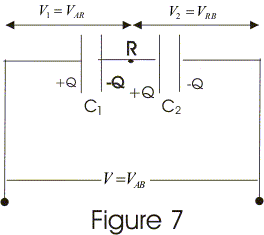
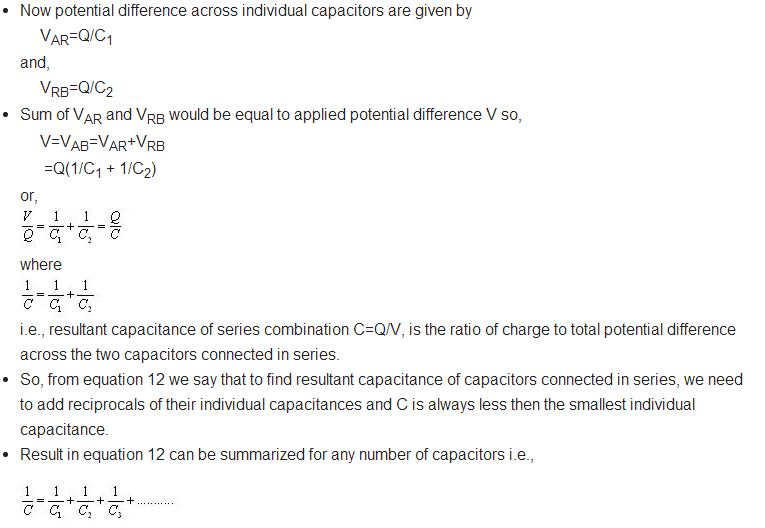
When you are given multiple capacitors in series, it is sometimes easier to work with them if we can combine these individual capacitors into a single capacitor that will function the same. This single capacitor is called the equivalent capacitor. Combining capacitors in series is not intuitive but, with some simple concepts and definitions, it is easy to figure out. Let's go through how to derive that. Since our goal is to find an equivalent capacitance, it would help to define what capacitance is. Capacitance, , is equal to the charge stored on the capacitor, , divided by the potential difference across the plates, : Suppose we have multiple capacitors in series with capacitances . These capacitors each have a potential difference across them of . Capacitors connected in series all have the same charge stored ; the video does a good job of explaining why. If we want to find a capacitor that will work the same as the capacitors in series, then the potential difference across the equivalent capacitor, needs to be equal to the potential difference across all the capacitors. If we solve for and apply our definition of capacitance, we can substitute this into the above equation: Now we divide the sides by Q, and the left hand side becomes . This is equal to one over the equivalent capacitance. Therefore, the relation between a number of capacitors in series and the equivalent capacitance is: There are a few things to note. First of all, when you solve for this equation, you have to remember that this produces the inverse of the equivalent capacitance; don’t let that screw you up. Secondly, the equivalent capacitance is going to be smaller than any of the individual capacitances. If it is larger than any of them, check your calculations.