Carbohydrates — Overview & Importance in Biology

Before this, knowMonomers and Polymers — Role & Importance

Interactive · 1 question

What Are Carbohydrates Made Of?

Carbohydrates are made up of one or more simple sugars. More commonly known as starches, they are the main source of energy for most living things.

You're probably wondering, "Well, what is a simple sugar?"

Simple sugars are small sugar molecules, which are also called monosaccharides. This literally translates to "one sugar". You've probably heard of a few kinds of simple sugars before, such as glucose and fructose.

A simple carbohydrate (monosaccharide) is made of carbon, hydrogen, and oxygen atoms in a 1:2:1 ratio. These carbohydrates can be drawn in a couple of different ways, but they all represent the same thing. Four types of drawings are shown below for a simple sugar.

Monosaccharide structure

Four ways to represent the structure of a monosaccharide. Notice that this sugar has 6 carbon, 12 hydrogen, and 6 oxygen atoms. This follows the 1:2:1 ratio mentioned above.

Image source: By Yikrazuul [Public domain], via Wikimedia Commons

Simple sugars can bond together to form long chains, called complex sugars or complex carbohydrates.

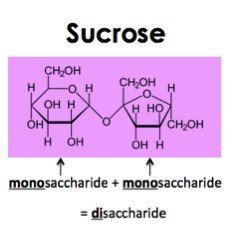
When the complex sugar is made of two monosaccharides, it's called a disaccharide. (Note that di- means two, so this translates to "two sugars".)

Regular table sugar, sucrose, is a compound made of both glucose and fructose.

Formation of a disaccharide

Two simple sugars come together to form a disaccharide, losing a water molecule in the process.

Image source: By CNX OpenStax CC BY 4.0, via Wikimedia Commons

Polysaccharides are macromolecules formed from monosaccharides. Poly- means "many".

Animals use a polysaccharide called glycogen (sometimes called animal starch) to store excess sugar. If your blood sugar ever gets too low, glycogen will be broken down into glucose for more energy.

Plants also use polysaccharides (starch) for storing excess sugars. They use the complex carbohydrate called cellulose for structural strength. Large amounts of cellulose are present in wood and paper.
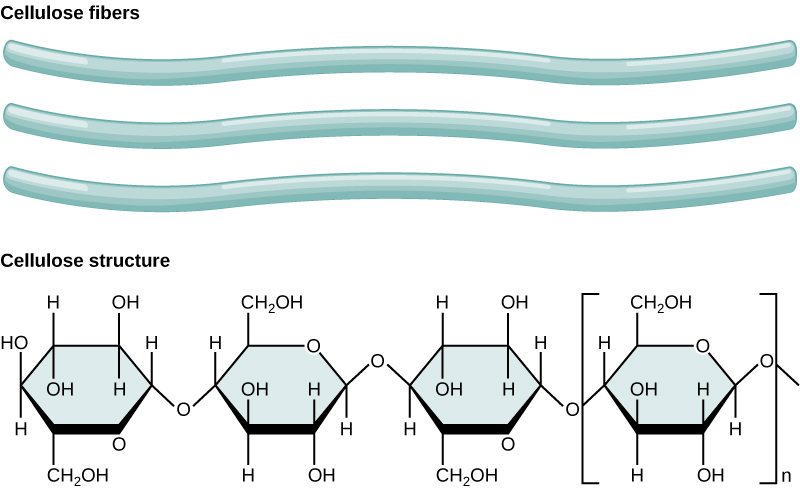
Cellulose structure

Cellulose is a polysaccharide used by plants. Humans can't digest it.

Image source: By CNX OpenStax CC BY 4.0, via Wikimedia Commons

What is the polysaccharide that plants use for energy storage?

Choose one answer

Illustrated · 2 min

What Are Carbohydrates?

Carbohydrates are sugars. They are the primary energy storage molecule for life on Earth.

Structure of Carbohydrates

Carbohydrates are made of carbons, hydrogens, and oxygens. The hydrogen bonds between the hydrogens and oxygens in carbohydrates typically make them dissolve easily in water. These hydrogen bonds also make hydrolysis reactions possible. Hydrolysis reactions are where the carbohydrates react with water to break down into smaller molecules. This allows them to be used as a source of energy.

Carbohydrate monomers have a simple chemical formula with a ratio of 1 carbon atom to 2 hydrogen atoms to 1 oxygen atom. These bond with other monosaccharides to make polysaccharides, which are polymers. Glucose is the most important monosaccharide. It is used by organisms in cellular respiration to produce usable energy for the body.

Where Do Carbohydrates Come From?

Plants perform photosynthesis to make carbohydrates using energy from the sun, water, and CO2CO_2 (carbon dioxide). Animals eat and break down the very same carbohydrates to make energy in the form of ATP. This process is called cellular respiration.

Chemical formula of glucose

Image source: By NEUROtiker [Public domain], via Wikimedia commons

Simple sugar examples

These are all examples of monosaccharides—single, little sugars. They are monomers (building blocks) used to make bigger sugars when they're chained together. If something ends in -ose, it's a sugar (carbohydrate).

Image source: By OpenStax College CC BY 3.0, via Wikimedia Commons

Disaccharides

When two monosaccharides are bonded together, they are called disaccharides. (It helps to remember that di means two and mono means one.) Examples of disaccharides include sucrose and lactose. These are easily broken down by animals and bacteria to get glucose, which is then used for cell functions.

Sucrose, a disaccharide

Sucrose is just one example of the several types of disaccharides.

Image source: By NEUROtiker [Public domain], via Wikimedia Commons

Polysaccharides

Large strings or clusters of monosaccharides are called polysaccharides (poly- means "many"). They are also called complex carbohydrates. Polysaccharides are used either as energy storage molecules or as structural molecules.

Examples include glycogen, cellulose, starch, and chitin. Glycogen stores energy in humans (in the liver), while starch performs the same function in plants. Cellulose makes up plant cell walls, giving them their square shape. Finally, chitin is what makes up the hard exoskeletons of insects.

Polysaccharide molecules

Polysaccharides like starch, glycogen, and cellulose are big molecules. Each little blue hexagon in this picture represents a single monosaccharide (like glucose). Tons of these simple sugars get bonded together to make polysaccharides.

Image source: By OpenStax College CC BY 3.0, via Wikimedia Commons

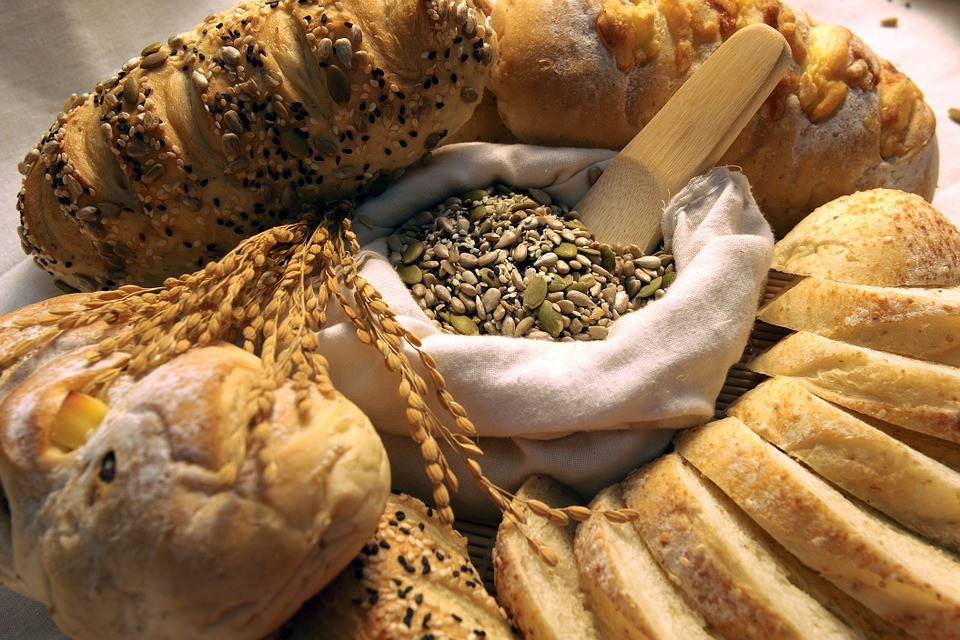
No matter what type of bread it is, they all contain carbohydrates.

Plant starches need to be processed into bread before humans can consume the energy found in wheat.

Image source: By unknown author CC0, via pxhere.com

In our daily lives, examples of carbohydrates include bread, pasta, and candy. They also show up a lot in processed foods. But despite the negative press they get in fad diets and from some celebrities, carbohydrates are necessary for survival.

Video

(Video) Biological Molecules

by CrashCourse

What do carbs, fats, and proteins all have in common? Not just that they're all found in your lunch. Check out this video for a crash course on the importance of molecules like carbohydrates in biology.

Expii: serving up some mean macromolecules

Image source: By Valeri Natole

Video

(Video) Biomolecules

by Amoeba Sisters

There are four major biomolecules, including carbohydrates, that make up life as we know it. In this video, the Amoeba Sisters go through the structures and functions of the different biomolecules.

Type a concept, like “slope” or “photosynthesis”.

↑ ↓ to choose · Enter to openSearch explanations and problems