Interactive · 1 question

+3 contributors



Carbon (Biology)
Carbon is known as the backbone of life. It's the second most abundant element in living things. The unique properties of carbon are what allows the four types of macromolecule to exist.

Image source: By Deena Hauze
This is the sixth element on the periodic table, so we know it has six electrons. Carbon has four valence (outer) electrons, six protons, and six neutrons. Recall that electrons are used to form chemical bonds. Carbon forms four covalent bonds with hydrogen, oxygen, phosphorus, nitrogen, and many others elements to make the molecules of life.
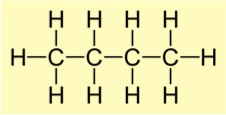
But wait, there's more. Carbon can even form bonds with itself. Now, that might not seem that remarkable, but it is actually one of the key reasons we're alive. Carbon can form single bonds, double bonds, and triple bonds with another atom, including itself.

Image source: By Deena Hauze
This unique bonding feature of carbon allows it to form chains, rings, and complex structures. Some of these complex structures are macromolecules like proteins, carbohydrates, and nucleic acids.

Image source: By Blausen.com staff (2014) "Medical gallery of Blausen Medical 2014" CC BY 3.0, via Wikimedia Commons
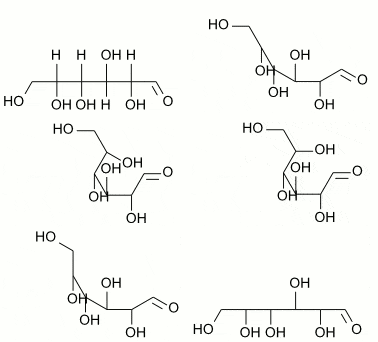
Glucose can be drawn as a straight chain for clarity, but it actually is a ring.
Image source: By Zephyris at the English language Wikipedia CC BY-SA 3.0, via Wikimedia Commons
Which of the following structures can carbon not form?
: The sixth element on the periodic table. It is the backbone of life.
: Any molecule made of carbon and hydrogen. Nitrogen, phosphorus, and oxygen are commonly found in them.
: Any molecule that can react with other molecules of the same or different makeup to form a chain, or polymer.
: A chain of monomers made of a specific type of compound.
: A polymer that has a large (macro) molecular mass. There are four main types in organisms: carbohydrates, proteins, lipids, and nucleic acids.