Catalysts (Enzymes) — Overview & Examples

Before this, knowWhat Are Enzymes? — Definition & Overview

Video

(Video) Function of Enzymes

by Study.com

Have you ever wished you had an enzyme's aid while building a snowman in the winter? Maybe not, but you will after watching this video. Watch and learn about an enzyme's job in biochemical reactions.

Something important to keep in mind about catalysts is that they only affect activation energy. They do not affect the amount of free energy in the reaction. That is, if a reaction releases 200kJ normally, it would still release 200kJ with an enzyme present.

Check Yourself. Continue to test your skills...\color{#8925AE}{\text{Check Yourself. Continue to test your skills...}}\\

Which of these is a reactant in the snowman-building reaction?

Choose one answer

Interactive · 2 questions

Speeding Up Reactions

Catalysts are substances that increase the rate of a chemical reaction. The catalysts do not undergo any permanent shape change and are not used up during the reaction.

A beaker filled with A and B and two catalysts. The second beaker is full of the product C and two catalysts.

Catalysts don't interact with the products they help create. They are not changed or used up during the reaction.

Image source: By Brazosport College CC BY-SA 3.0, via Wikimedia Commons

Catalysts lower activation energy. This is often shown using a graph.

Image source: By Smokefoot CC0, via Wikimedia Commons

Catalysts lower the activation energy of a reaction, written as (Ea_a) in the picture above. The energy of activation is the energy required to start a reaction. By lowering this barrier, reactions occur faster and easier.

What is a catalyst?

Choose one answer

Illustrated · 2 min

Enzyme Catalysis

Enzyme are proteins (chains of amino acids) that speed up chemical reactions.

Because they make reactions go faster, enzymes are called catalysts. (The process of speeding up a reaction is called catalysis).

Think of a normal chemical reaction as a road with a low speed limit. You can get from one end of the road to the other, but it will take a while.

This image shows a red car parked behind a speed limit 15 sign.

Image source: By John Harvey [Public domain], via Wikimedia Commons

An enzyme's job is to get rid of the speed limit and turbo-charge your car. Now you can get from one end of the road to the other way faster.

What Do Catalysts Do?

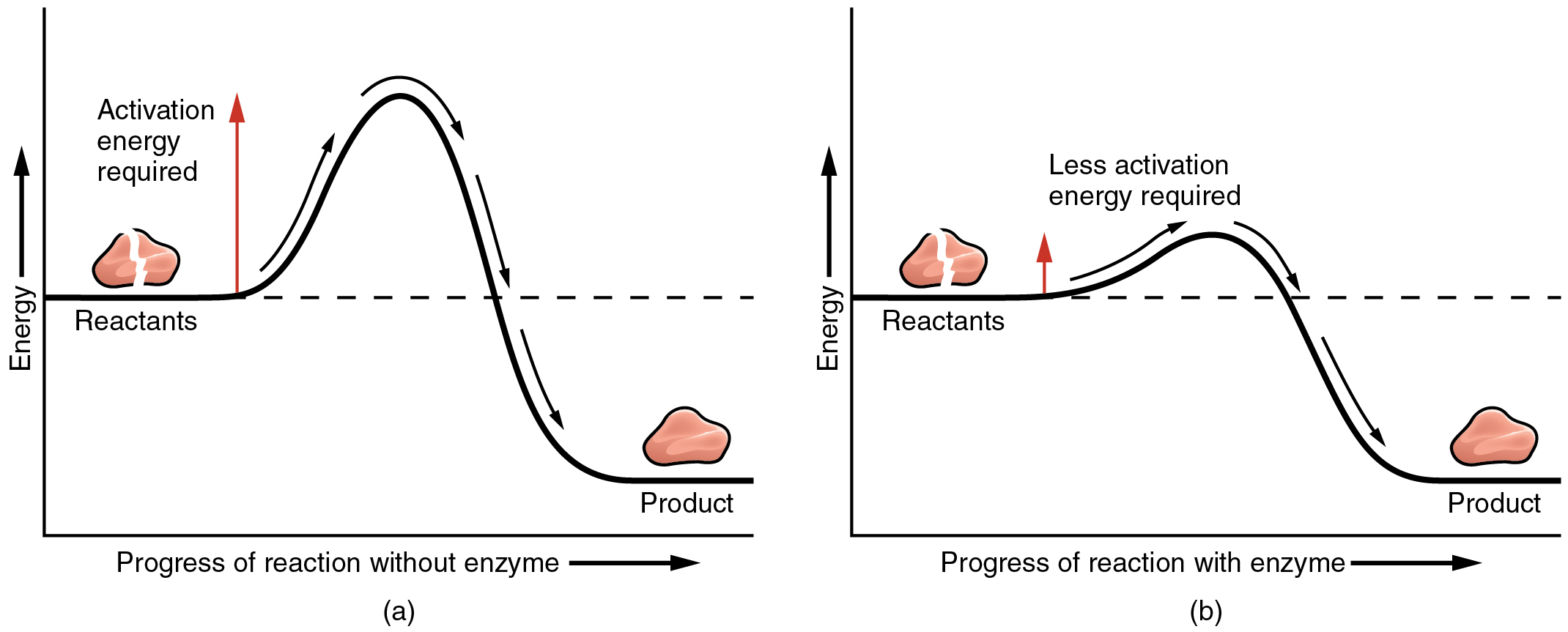
The amount of energy required for a chemical reaction to occur is called activation energy.

Enzymes help reactants overcome activation energy.

Image source: By Hannah Bonville

Enough energy has to be added to the reactants to get a reaction to start. It's like pushing a car up a hill: You have to keep adding more and more energy, but once you're at the top of the hill, the car (or the reaction) can begin to roll on its own.

It takes time to get enough energy to start a reaction. Catalysts shorten this time by reducing the activation energy required for a reaction to begin.

Activation energy for a reaction is lower when enzymes are involved.

Image source: By Hannah Bonville

Compare the two reactions. The reaction with a catalyst has a much lower energy barrier to overcome. It takes much less energy (and less time) for that reaction to begin.

What Does This Look like in a Cell?

Now that we understand what catalysts do, it's time to apply that knowledge to enzymes. Image a cell as a room full of molecules flying around. When certain molecules collide, they cause a reaction. But, there's no way of guaranteeing they will ever come together. It could take seconds, or it could take days before they collide.

Mechanisms of Enzymes

Enzymes help make reactions go faster by bringing the required molecules closer together. This way, they will react more quickly. Enzymes have spots called active sites, which are specific to certain molecules (substrates). That is, only molecules which match the shape and size of the active site can bind to it. When they do bind, it creates the enzyme-substrate complex. In this form, the enzyme changes shape to fit the substrate even better. This specific fit is known as an induced fit. After the substrates react, they are released back into the surrounding environment.

Enzymes work by reducing the amount of time and energy needed for substrates to come together and reactions to occur. Without them, chemical reactions in the body would happen by chance, and they may not happen fast enough for cells to survive.

Key Vocabulary:

  1. Enzyme
  2. Protein
  3. Activation energy
  4. Catalyst
  5. Enzyme complex

Illustrated · 1 min

A catalyst lowers the activation rate, speeds up the rate of a reaction, does not get used up in a reaction, and can be reused.

Image source: By Gabi Slizewska

Video

(Video) Enzymes and Catalysts

by Beverly Biology

Watch this video for a great explanation on what catalysts do, how they work, and how they are structured.

Type a concept, like “slope” or “photosynthesis”.

↑ ↓ to choose · Enter to openSearch explanations and problems