Enzyme are proteins (chains of amino acids) that speed up chemical reactions.
Because they make reactions go faster, enzymes are called catalysts. (The process of speeding up a reaction is called catalysis).
Think of a normal chemical reaction as a road with a low speed limit. You can get from one end of the road to the other, but it will take a while.
An enzyme's job is to get rid of the speed limit and turbo-charge your car. Now you can get from one end of the road to the other way faster.
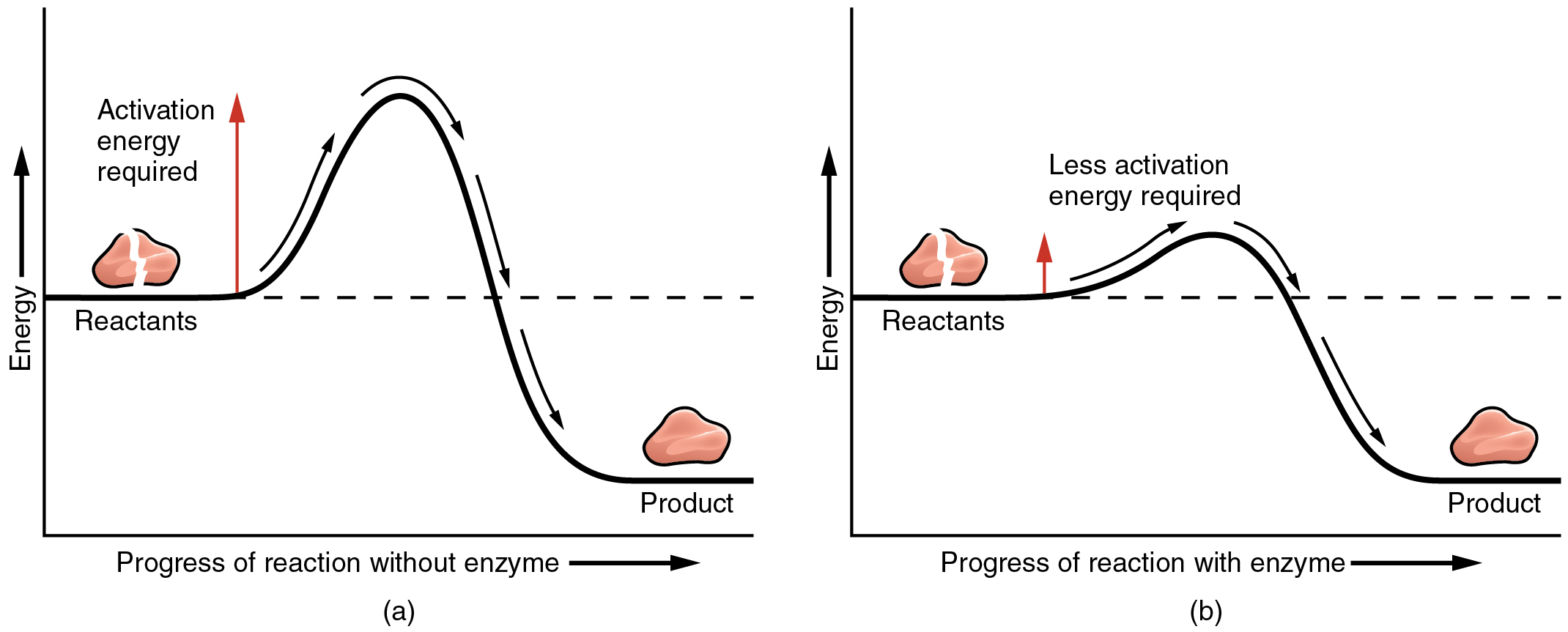
The amount of energy required for a chemical reaction to occur is called activation energy.
Enough energy has to be added to the reactants to get a reaction to start. It's like pushing a car up a hill: You have to keep adding more and more energy, but once you're at the top of the hill, the car (or the reaction) can begin to roll on its own.
It takes time to get enough energy to start a reaction. Catalysts shorten this time by reducing the activation energy required for a reaction to begin.
Compare the two reactions. The reaction with a catalyst has a much lower energy barrier to overcome. It takes much less energy (and less time) for that reaction to begin.
What Does This Look like in a Cell?
Now that we understand what catalysts do, it's time to apply that knowledge to enzymes. Image a cell as a room full of molecules flying around. When certain molecules collide, they cause a reaction. But, there's no way of guaranteeing they will ever come together. It could take seconds, or it could take days before they collide.
Mechanisms of Enzymes
Enzymes help make reactions go faster by bringing the required molecules closer together. This way, they will react more quickly. Enzymes have spots called active sites, which are specific to certain molecules (substrates). That is, only molecules which match the shape and size of the active site can bind to it. When they do bind, it creates the enzyme-substrate complex. In this form, the enzyme changes shape to fit the substrate even better. This specific fit is known as an induced fit. After the substrates react, they are released back into the surrounding environment.
Enzymes work by reducing the amount of time and energy needed for substrates to come together and reactions to occur. Without them, chemical reactions in the body would happen by chance, and they may not happen fast enough for cells to survive.