Dalton's Atomic Theory
Previously, we examined Dalton's atomic theory. He proposed five rules of chemistry.
-
All matter consists of atoms.
-
Atoms are indestructible. So, they are the foundational building blocks of everything.
-
All atoms of a pure element are the same.
-
Compounds are formed by multiple types of atoms in fixed whole-number ratios.
-
Atoms form different compounds when they combine in different ratios.
Overall, Dalton's theory is helpful. Even today, we use most of his precepts. His tenets about compounds prepared us to understand chemical reactions and molecular formulas. He even laid the groundwork for covalent bonding and the various reaction types. In future lessons, we'll study synthesis, decomposition, single replacement, and double replacement reactions. They go beyond Dalton's work. But he was the forerunner to that line of investigation.
Unfortunately, today we recognize that Dalton's theory had a central flaw. The atom is not indestructible. They consist of subatomic particles. Now, we know about protons, neutrons, and electrons. We even recognize that the subatomic particles have tinier constituents called quarks. But given the available information, Dalton's proposition made sense. Today, we'll investigate the experiment that altered our view of the atom.
Cathode Ray Tubes
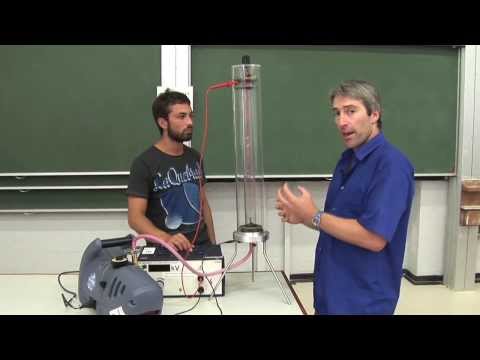
In the 1890's JJ Thomson investigated cathode rays. Cathode rays get produced by a unique apparatus. It's creatively called a cathode ray tube. The tube is a glass chamber with two metal discs. The metals get connected to a voltage source. The voltage sources cause one disc to become positively charged. The other becomes negatively charged. Next, we use a vacuum pump to remove the air within the tube. What's the result? A beam of particles travels from the cathode to the anode. But what particle makes the beam?
Experimental Work Before Thomson's
Before Thomson's work, many scientists had investigated cathode rays. For example, in the 1870s, William Crookes was the first to develop a cathode ray tube with a vacuum pump. The vacuum allows the particle beam to travel from the cathode to that anode in a straight line. Previously, the nitrogen and oxygen atoms in the air would get ionized. The ionization created a phosphorescent effect. So, it created a shadow within the tube. The low gas pressure created by the vacuum allowed the beam to travel through empty space. There was no shadow.
Crookes also placed a paddle wheel between the anode and cathode. The particle beam moved the paddle! So, the particles had momentum. He then applied an external magnetic field to the apparatus. What did he find? The particle beam bent toward the positive side of the magnet. That indicated the particles carried a negative charge. He concluded that the beam consisted of negatively charged molecules. But, they had to be in a fourth unknown phase of matter. Why? He needed to disregard molecular collisions. By ignoring the collisions, he could explain the beams bending.
Another physicist, Arthur Schuster, expanded Crooke's work. He performed a similar experiment. But, he used an external electric field. Again, the beam curved toward the positive side. Based on the curve's angle, he calculated the mass-to-charge ratio. He estimated that the particle was 1000 times smaller than an atom. He thought the beam consisted of hydrogen or nitrogen ions. So, other scientists assumed his calculations were errors.
At the same time, Ernest Rutherford was investigating radioactivity. He identified two types of radioactive particles. He named them based on their ability to infiltrate other kinds of matter. Alpha particles penetrate less than beta particles. Gamma radiation got discovered by another scientist a year later.
Thomson's Experiments and Conclusions
Finally, in 1897 we get to JJ Thomson. He was a rigorous and precise scientist. So, he started by confirming the work of Crooke and Schuster. Instead of assuming Schuster's mass-to-charge ratio was an error, he confirmed it. Next, he wondered if the beam changed based on the electrodes. So, he used different metals for the anode and cathode. Each time he applied an external magnetic and electric field. The metal was irrelevant. The particle beam experienced an identical deflection angle. He also expanded into radioactive materials. He established that beta particles had the same deflection angle as cathode rays. Next, he showed that the same particles were emitted from heated or illuminated materials. As a side note, historically this preceded blackbody radiation and the photoelectric effect. But we can see how it directly relates to those important discoveries!
So, what did Thomson actually discover? Foremost, Thomson's based his conclusions on all his experiments. There wasn't one specific experiment that determined everything. When he examined the cumulative data, he came to three conclusions.
- The particle is negatively charged.
- It's one-thousand times smaller than a hydrogen atom.
- The particle is a component of all atoms.
He had discovered the electron! Thomson's discovery created a whole new area of investigation within physical chemistry. For the first time, we had to ask, "what does the atom look like?" Thomson's plum-pudding model would be the first try. But, the heart of the scientific method is improvement based on new data. So, Rutherford's gold foil experiment and subsequent nuclear model would change the picture. Next, Neils Bohr's model would fix problems some problems with Rutherford's. But it wasn't quite right. So, Erwin Schrodinger would introduce quantum mechanics and the quantum mechanical model. We'll look at all of these in future lessons. But for now, know that Thomson's experiments revolutionized chemistry.