Cell Membrane — Structure & Function

Illustrated · 3 min

What Is the Cell Membrane?

The cell membrane (also called the phospholipid bilayer or plasma membrane) is one of the most important structures a cell has. If you think of the cell as a really popular nightclub, the membrane is the bouncer. It decides what enters and exits the cell.

The cell membrane acts like the cell's security guard.

Image source: By b1-foto CC0, via pixabay.com

Plant cells and animal cells both have cell membranes.

Image source: By domdomegg CC BY 4.0, via Wikimedia Commons

A membrane can be found around both eukaryotic cells and prokaryotic cells. It goes around the outside of an animal cell, like the blue line in the picture above. For animal cells, the plasma membrane separates the cell from things outside and holds all of the cell's contents in.

We know that plant cells have cell walls, but it's important to remember that they have plasma membranes, too. The membrane sits right inside the cell wall (the blue line just inside the yellow cell wall in the plant cell above).

What Does "Selectively Permeable" Mean?

Keep the image of the cell's membrane as a bouncer in your head for a minute.

Bouncers are confronted with hundreds of people every night, all trying to get into the club. They pick and choose who gets in.

Selectively permeable membranes only let some substances in and out.

Image source: By The Lilywhite Collection CC BY-ND 2.0, via flickr.com

The cell's membrane does the same thing. It selects what can enter and leave the cell. If the membrane is permeable to something, it allows it through. Because of that, we call the membrane selectively permeable. This feature helps cells maintain homeostasis.

Some things can go right through the membrane with no issues. These substances include extremely small molecules, some ions, and nonpolar molecules like fats. You'll see why this is the case in a moment.

Things that are too large or too polar have to use alternate routes to cross the membrane, including protein channels and gates.

What Is the Membrane Made Of?

Another name for the cell's membrane is the phospholipid bilayer. I like this name better because it tells you exactly what the membrane is: a double layer of phospholipids.

Let's take a close-up look at the membrane lipids and an individual phospholipid molecule.

The cell membrane is actually a phospholipid bilayer.

Image source: By Lizanne Koch - lgkoch (modified by expii) [Public domain], via Wikimedia Commons \\ Image source: By OpenStax CC BY 4.0, via Wikimedia Commons

The phospholipid bilayer is made up of two layers of phospholipids, shown in the picture above in red and yellow. Here's an up-close look:

Each phospholipid has a phosphate head (which is hydrophilic) and two fatty acid tails (which are hydrophobic).

Image source: By OpenStax CC BY 4.0, via Wikimedia Commons

The head part of each phospholipid is made of phosphate. It is hydrophilic. This means that it is attracted to water. On the other hand, the two tails (each made of one fatty acid) are hydrophobic. This means that the two tails strongly avoid water.

The phosphate heads always face outwards, towards the water-based environment outside the cell and also inside the cell.

The fatty acid tails always face inward, huddling together to stay away from water.

Another cool feature of the membrane is that these lipids can freely shift around with each other. This allows the membrane to move and change shape when it needs to. The term "fluid mosaic model" is used to describe the membrane's ability to move freely in this way.

The hydrophobic fatty acid tails face inward, away from water.

The phosphate heads (hydrophilic) face outward while the fatty acid tails (hydrophobic) face inward. \\ Image source: By LadyofHats [Public domain], via Wikimedia Commons

Nonpolar substances are able to easily diffuse through the nonpolar fatty acid tails.

The lipid bilayer also has embedded membrane proteins (like transmembrane proteins). These allow ions and other charged molecules to pass through into the interior of the cell. Specifically, these proteins help with passive and active transport. Cell membranes also allow for other functions such as cell signaling and adhesion, and provide a surface for the attachment of cell structures.

Key Vocabulary:

  1. Cell membrane
  2. Phospholipid
  3. Hydrophobic
  4. Hydrophilic
  5. Phospholipid bilayer
  6. Plasma membrane

Illustrated · 2 min

What Is the Membrane Made Of?

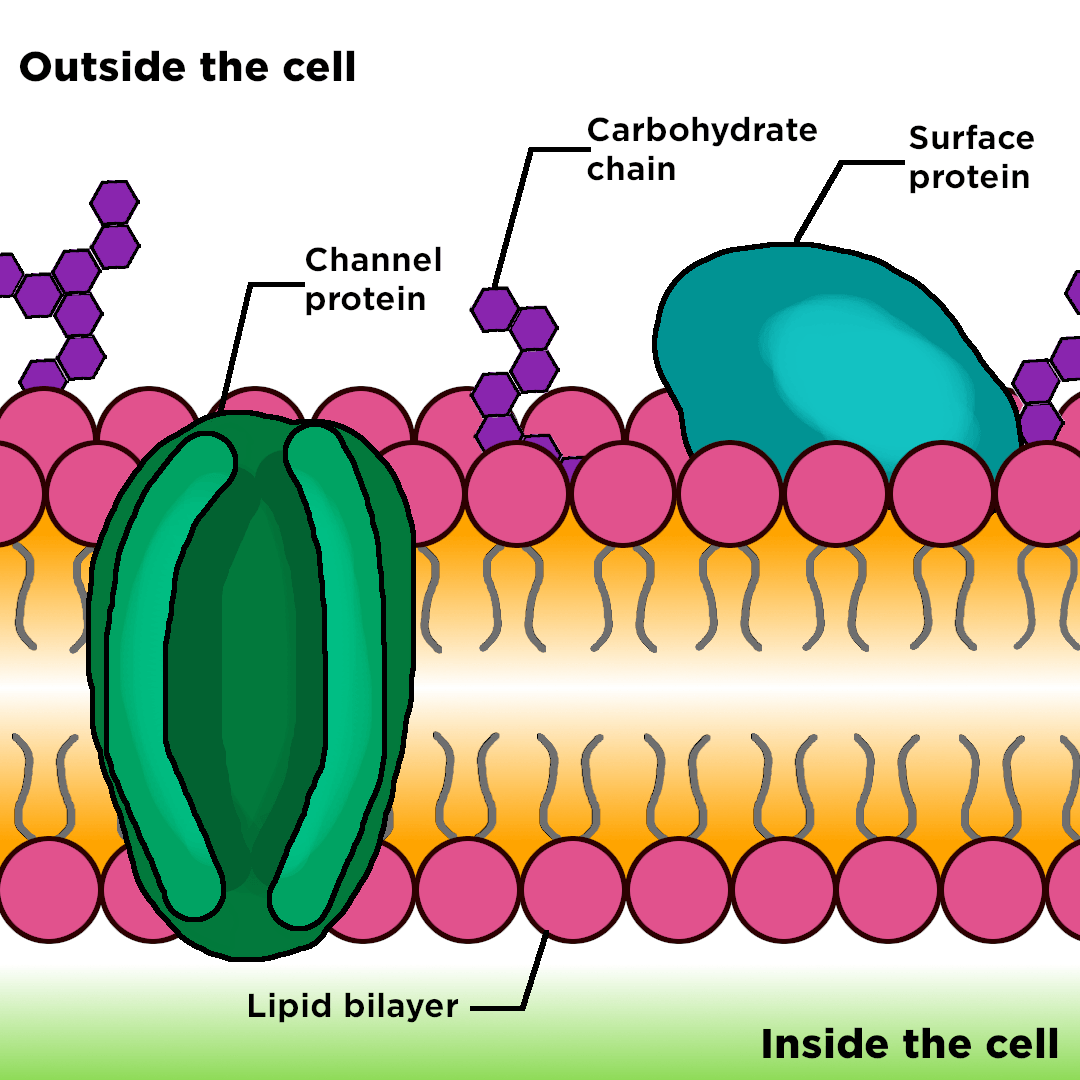
This image shows a cell membrane with a channel protein, a surface protein, and carbohydrate chains. The membrane itself is made of a lipid bilayer.

Image source: By Mario Janakis

The cellular membrane is the cell's protective barrier. It is actually made of many types of macromolecules. Can you recognize them in the picture above?

Let's talk about lipids first. Lipids make up the majority of the membrane. In the picture, they are the pink circles with gray tails. This is actually a specific type of lipid called a phospholipid. What makes it special is that the pink "head" is attracted to water, while the gray "tails" don't like water. You may have noticed that there is not one, but two layers of phospholipids. That's why we sometimes call this membrane a phospholipid bilayer. (Bi- means two, so "two layers".) The fact that the membrane has two layers is pretty cool. It helps make sure that only certain molecules can pass through into (or out of) the cell.

You will also find many proteins in the membrane. Some of them go all the way through to the other side. Some are only found on the surface. These proteins have many functions that help a cell stay alive. One of the biggest things they do is help bring molecules into the cell that can't come in on their own. These molecules might be too big or too charged. Proteins can also help with signaling between cells, holding the cell in place, and carrying molecules.

Finally, we might find carbohydrate chains. These chains help with cell recognition and also help the cell stick to things.

Keep in mind that the picture above is just a general diagram. The specific molecules we find in each membrane depends on what type of cell it is.

A cell surrounded by a cell membrane. The cell membrane is made of a phospholipid bilayer.

Image source: By LadyofHats; derivative work: Dhatfield CC BY-SA 3.0, via Wikimedia Commons

What Does the Membrane Do?

The phospholipid bilayer is a membrane that surrounds the whole cell. Plant and animal cells both have cell membranes that are semi-permeable (only certain things can pass through them), keeping the cells in a state of homeostasis. The membrane is made of a phospholipid bilayer. Plant cells also have a sturdy cell wall made of cellulose that surrounds the membrane and stabilizes the cell.

The phospholipid bilayer is made of hydrophobic tails sandwiched between hydrophilic heads.

The lipid component of the membrane forms a bilayer. \\ Image source: By OpenStax CC BY 4.0, via Wikimedia Commons

The cell membrane acts as a barrier keeping the cytoplasm in and everything unwanted out of the cell. Check out the following link for more information on its structure and function.

Vocabulary Review:\color{#8925AE}{\text{Vocabulary Review:}}

Cell Membrane\color{#8925AE}{\text{Cell Membrane}} : A barrier that surrounds cells (sometimes called a plasma membrane). It is mostly made of lipids and proteins

Cell Wall\color{#8925AE}{\text{Cell Wall}} : A thick, sturdy wall in plant cells that surrounds the membrane

Phospholipid Bilayer\color{#8925AE}{\text{Phospholipid Bilayer}} : The two layers of phospholipids that make up the cell's membrane

Phospholipid\color{#8925AE}{\text{Phospholipid}} : A molecule made of a glycerol backbone attached to two fatty acids chains and a phosphate group. A major component of plasma membranes

Protein\color{#8925AE}{\text{Protein}} : Complex polymer made of carbon, hydrogen, nitrogen, and oxygen. They are made of amino acids

Carbohydrate\color{#8925AE}{\text{Carbohydrate}} : A polymer of sugars or starch monomers

Lipid\color{#8925AE}{\text{Lipid}} : Fats and oils

Video

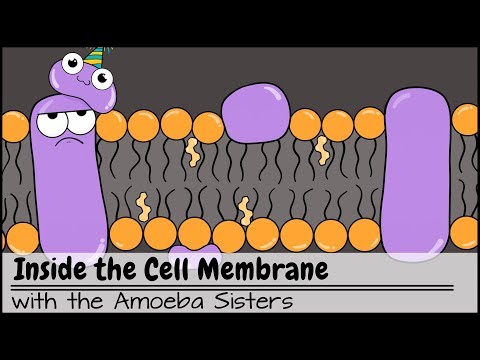
(Video) Inside the Cell Membrane

by Amoeba Sisters

What is a cell membrane? What's the point of it? In this video, the Amoeba Sisters explain what exactly's going on with this important part of the cell.

The cell membrane consists of a lipid bilayer. This membrane is the backbone of the cell. It protects the cell from foreign material, helps it maintain homeostasis, and much more. It also surrounds all of the cell's organelles, like the endoplasmic reticulum and nucleus.

Type a concept, like “slope” or “photosynthesis”.

↑ ↓ to choose · Enter to openSearch explanations and problems