Cell Organelle — Types & Functions

Before this, knowOrganelles in Plant CellsOrganelles in Animal Cells

Illustrated · 1 min

What Organelles Are in a Cell?

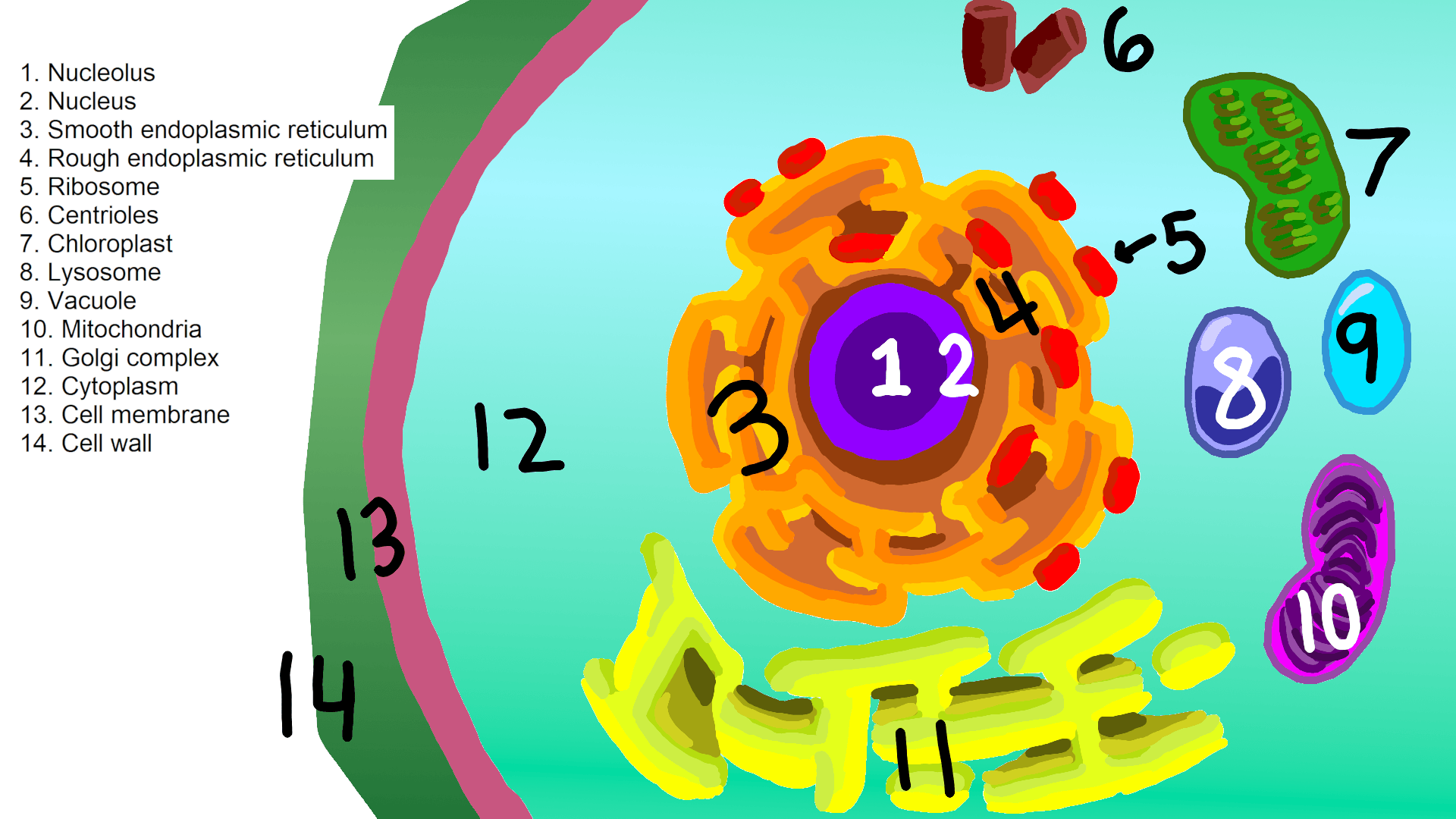
The image shows a cell with each of its organelles labeled. See below for more information on organelles.

Image source: By Sarah Morgan

Some of the most commonly found organelles in eukaryotic cells are:

The nucleus, which is what holds the DNA;

The nucleolus, which makes ribosomes;

The smooth endoplasmic reticulum, which packages proteins in vesicles;

The rough endoplasmic reticulum, which is covered in ribosomes that create proteins;

The centrioles, which guide the separation of the cell during mitosis;

The chloroplast, which photosynthesizes in plant cells;

The lysosome, which can destroy bacterial invaders;

The vacuole, which can store many materials;

The mitochondria, which perform cellular respiration;

The Golgi complex, which sends and receives protein packages.


Remember: Prokaryotic cells do not have membrane-bound organelles, so you will not find these structures inside them.

Video

(Video) The Grand Cell Tour

by Amoeba Sisters

Your cells may be small, but there's a lot going on in them. This grand tour of cells starts by reviewing the difference between prokaryotes and eukaryotes. Then it moves on to review types of organelles and their specific functions.

This image is an advertisement for the Grand Cell Tour.
"Get your free ticket right here for the Grand Cell Tour! See all the most famous organelles!"
There are four flags on the left and four on the right. Arrows point diagonally downward, alternating from left to right. Each flag has the name of an organelle next to it. From the top down are nucleus, ribosomes, endoplasmic reticulum, Golgi apparatus, mitochondria, chloroplasts, vacuoles, and vesicles.

Image source: By Valeri Natole

Interactive · 1 question

Review of Plant and Animal Cells

The nucleus contains the DNA of the cell. It is the brain of the cell. The nucleolus is the inner part of the nucleus that begins the assembly of ribosomes. The chloroplast captures energy from light for photosynthesis. They are solar panels of the cell. The Golgi body/apparatus modifies, sorts, and ships proteins and lipids. It is the post office of the cell. The mitochondria maxes ATP energy. It is the powerhouse of the cell. Ribosomes create polypeptide chains and proteins. They are the factories of the cell. The SER creates lipids for the cellular membrane. The RER assembles proteins and transports them into and out of the cell. Lysosomes use enzymes to break down old organelles and macromolecules. They are the garbage disposals of the cell. Vacuoles store water, salt, and carbohydrates. They are the kitchen of the cell. The cytoskeleton helps maintain the cell's shape and is involved in movement. Cytoplasm is the material that fills up the cell. Centrioles help organize animal cells during cell division. The cell wall gives plant cells extra stability and structure. The cell membrane controls what comes in and goes out of the cell.

Image source: By Deena Hauze

Animal Cell

A eukaryotic animal cell. It contains a Golgi apparatus, plasma membrane, lysosome, secretory vesicle, smooth and rough endoplasmic reticulum, ribosomes, and a nuclear envelope containing the nucleus.

An animal cell

Image source: By LadyofHats [Public domain], via Wikimedia Commons

Plant Cell

A eukaryotic plant cell that contains a Golgi apparatus, plasma membrane, cell wall, vacuoles, secretory vesicle, smooth and rough endoplasmic reticulum, ribosomes, and a nuclear envelope containing the nucleus.

A plant cell

Image source: By LadyofHats [Public domain], via Wikimedia Commons

Which organelles would you find in a plant cell?

Choose all correct answers

Video

(Video) Cell Structure and Function

by Mamunur Rashid

This video gives an overview of the structures within a cell and compares each of them to a specific building in a city.

Illustrated · 1 min

Organelle Review

All eukaryotic cells contain a nucleus, ribosomes, Golgi apparatus, endoplasmic reticulum, nucleolus, mitochondria, vacuoles, vesicles, a cytoskeleton, and flagella/cilia/pili. Only plant cells have a cell wall, chloroplasts, and a central vacuole. Only animal cells have lysosomes and centrosomes.

Image source: By Aaron Lauer et al.

Type a concept, like “slope” or “photosynthesis”.

↑ ↓ to choose · Enter to openSearch explanations and problems