Illustrated · 2 min

+6 contributors





Three Points of Modern Cell Theory
-
All living things are made of one or more cells.
-
The cell is the smallest unit of life in all organisms.
-
All living cells come from the division of pre-existing cells.
Cell theory says that cells are the smallest unit of life. In other words, this means that you cannot break down a cell into smaller parts and still call it living. For example, you can break down a whole organism such as a human into smaller components like organ systems, organs, and tissues. All of these components are still considered living. Plant and animal tissues can then be broken down further into cells, but that is the furthest life can be broken down.
What Did We Think Before?
This theory tells us that all cells come from existing cells. Your first thought might be, "Of course. Where else would cells come from?"
But before a few key experiments in the 1800s, scientists and society supported an idea called spontaneous generation. According to this hypothesis, living organisms could by produced by non-living things.
For example, it was believed that maggots sprouted directly from rotting meat, fleas were produced by dust, and salamanders came directly from mud.
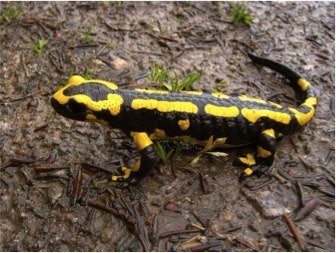
Salamanders were once believed to come directly from mud, rather than from other salamanders. This idea is called spontaneous generation.
Image source: By StefanHoffman CC0, via pixabay.com
The idea of spontaneous generation was replaced by cell theory, which states that all cells come from existing cells, not from non-living things. This process is also called biogenesis. Recall that bio means "living" and genesis has to do with how things are produced. Biogenesis means that living things must come from other living things.
: The simplest form of life and the basic unit of structure and function
: The theory that all living things are made up of cells, cells are the most basic unit of life, and new cells are made from old cells
: Eukaryotic cells contain a nucleus and membrane-bound organelles
: Prokaryotic cells do not contain a nucleus or membrane-bound organelles