Illustrated · 2 min
+3 contributors



Plant Cell Walls
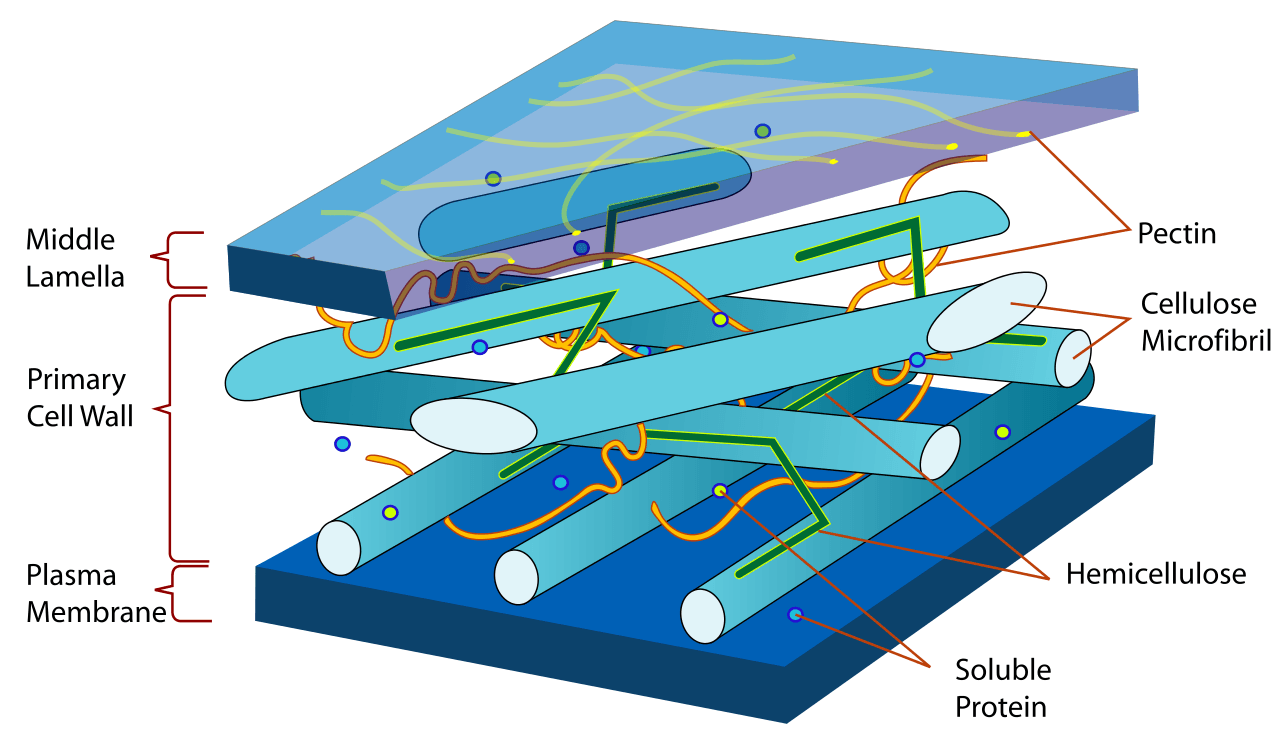
Among eukaryotic cells, plant cells have cell walls while animal cells do not. These walls are made of a polysaccharide (a huge sugar molecule) called cellulose.

This is a picture of about 30 onion cells. Onions are plants, so each onion cell has a cell wall, which are the white, straight outlines around each cell.
Image source: By kaibara87 CC BY 2.0, via Wikimedia Commons
Think of the walls of your room. They are straight and hard. The same is true for the walls of plant cells. They are straight and hard. This gives plant cells a rectangular shape with straight sides. The main function of these walls is to provide physical support and protection for plant cells.
By the way, plant cells still have a plasma membrane. It sits right inside the outer wall.

Here's another example. This picture shows about 15 moss cells. Notice that the walls are straight, but the cells aren't square here. That's okay. As long as the sides of the cell are straight, we know that a cell wall is there.
Image source: By Kristian Peters -- Fabelfroh CC BY-SA 3.0, via Wikimedia Commons
Turgor Pressure
We mentioned above that one of the jobs of the cell wall is to give the plant support and structure. The straight, strong walls give the plant cells tensile strength and allow them to stack on top of each other. This enables plants to grow upwards.

Plant cells are like little bricks that can be stacked on each other to create huge structures.
Image source: By Bernard Gagnon CC BY-SA 3.0, via Wikimedia Commons
However, we've all seen wilted plants. How can we explain that?
To do this, we need to think about the large central vacuole in plant cells that stores water.
Think of the vacuole like a balloon. When it's full, it takes up a bunch of space inside the cell, pushing on the walls.
But, when the vacuole is empty, it deflates. The cell walls don't have anything pushing on them, so they slump inward. The pressure of the vacuole on the walls of the cell is called turgor pressure.

(a) The vacuoles are empty, so the turgor pressure is low. The plant cell walls slump and the plant wilts. (b) The vacuoles are full, so the turgor pressure is high. The vacuoles push on the cell walls, keeping the plant upright.
Image source: By CNX OpenStax CC BY 4.0, via Wikimedia Commons
If many of a plant's cells have empty vacuoles, the whole plant looks wilted. But, when you water a plant, the cells fill up their vacuoles and the plant "comes back to life".
Bacterial Cell Walls
Many bacterial cells have walls too. However, their walls are made mostly from peptidoglycan (a mix of amino acids and sugars).
The function is pretty much the same in plant cells and bacterial cells: to provide structure and support.

Notice that bacterial cells don't have the same straight sides as plant cells. Peptidoglycan is more flexible than cellulose, so the cell wall actually takes on a rounded shape.
Image source: By CNX OpenStax CC BY 4.0, via Wikimedia Commons