Cells — Definition & Overview

Before this, knowWhat Are Organelles? — Definition & Overview

Illustrated · 1 min

What Is a Cell?\textbf{What Is a Cell?}

===

The size of a single-celled organism compared to the size of a penny.

Image source: By Gabi Slizewska

Cells are the tiniest form of life. Some bacterial cells can be just one micrometer across, but the cells in our bodies are closer to 100 micrometers long. To put this in perspective, you could fit over 360 million of the smallest bacterial cells on top of a penny. Some organisms are only made of a single cell, but we humans have over 30 trillion cells in our bodies.

All cells require a few basic components. They need to have DNA (genetic material) and a membrane that wraps around the entire cell.

From here, cells can differ widely. The two basic types of cells are prokaryotic and eukaryotic cells.

Image showing eukaryotic vs. prokaryotic cells

Image source: By Gabi Slizewska

Eukaryotic Cells

The defining element of a eukaryotic cell is the nucleus. This structure stores the cell's DNA and separates it from the rest of the cell with a special membrane called the nuclear envelope. Because it stores DNA, the nucleus is often called the control center of the eukaryotic cell. That's because the DNA holds all the instruction the cell needs to function.

Additionally, eukaryotic cells tend to be bigger and more complex than prokaryotic cells. They often have organelles, which are small, specialized, membrane-bound structures that perform specific functions in the cell. The nucleus is just one type of organelle.

Eukaryotic cells make up the human body. They can also make up some single-celled organisms as well as plants and animals.

Prokaryotic Cells

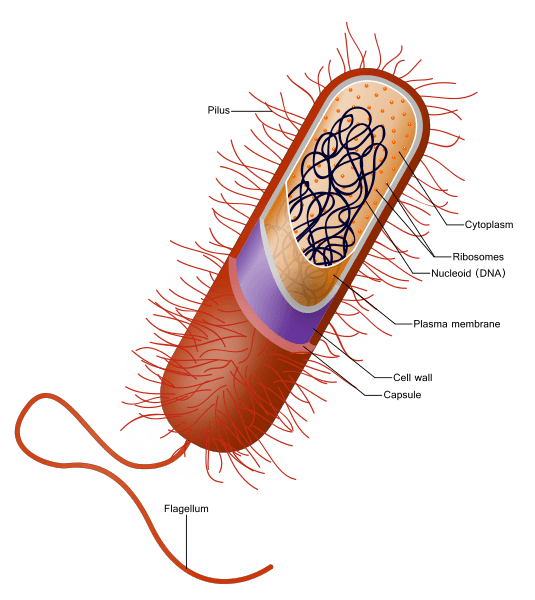
Prokaryotic cells tend to be much smaller and less complex than eukaryotic cells. They make up single-celled organisms like bacteria. They have DNA just like eukaryotic cells, but they don't have a nucleus. Instead, the DNA is found loosely inside the cell. Prokaryotic cells don't really have other organelles either. Still, these simple cells can do everything they need to survive.


Illustrated · 2 min

What's the Difference Between Eukaryotic and Prokaryotic Cells?

Cells are called the building blocks of life for a reason. Every living organism, no matter how big or small, is made up of cells.

What's inside a cell depends on what type of cell it is. An elephant cell looks very different from a daffodil cell. It also depends on whether the organism is eukaryotic (think humans, birds, grass, or any other plant or animal) or prokaryotic (think creepy bacteria). Eukaryotic cells have a nucleus, while prokaryotic cells don't.

Though these types of cells look and act in extremely different ways, they all have one common trait: they store genetic material.

An image of a eukaryotic cell with labeled organelles

Image source: By Mediran CC BY-SA 3.0, via Wikimedia Commons

Above is a eukaryotic cell, like what a human would have. A prokaryotic cell is pictured below.

Image of a prokaryotic cell

Image source: By Ali Zifan CC BY-SA 4.0, via Wikimedia Commons

Multicellular Organisms

Most of the things that come to mind when we think of eukaryotes are multicellular, or made up of more than one living cell. All multicellular organisms are eukaryotic. Trees, dogs, humans, and even tiny ants are multicellular. Think about building a house: one cell equals one brick. No matter how big or small a house is, it is made up of multiple bricks. In the same way, organisms can be made up of multiple cells even if they are drastically different in size.

Any organism that you can see with your bare eye is multicellular. Just remember, these larger multicellular organisms only account for a small fraction of all the multicellular organisms out there. Most are so small you need a microscope to see them.

A cell is to an organism as a brick is to a house.

Image source: By Valeri Natole

Unicellular Organisms

Prokaryotic organisms are unicellular. These organisms can only ever be seen with a microscope. They are like a single brick. Though they are still considered to be living, they are relatively simple compared to some of the more complex multicellular organisms out there. By comparison to unicellular organisms, humans are made up of approximately ten trillion cells.

All prokaryotes are unicellular, but not all unicellular organisms are prokaryotes (kind of like how all squares are rectangles, but not all rectangles are squares). Unicellular organisms can be prokaryotic or eukaryotic.

Video

(Video) The wacky history of cell theory - Lauren Royal-Woods

by TED-Ed

In the video above, Lauren Royal-Woods explains the history of cell theory, including how cells came to be discovered and what tools were used to determine their structures and functions.

Video

(Video) Levels of Organization

by BioMagica

In this video, BioMagica shows the biological levels of organization from cells all the way up to the biosphere. Cells are the simplest level of organization in biology. They can form functional units like tissues, which can then form organs. Several organs work together to form an organ system. As we get to higher levels of organization, the complexity increases.

The highest level of organization for an individual is the organism itself.

Illustrated · 1 min

Cells Are the Smallest Unit of Life{\text{Cells Are the Smallest Unit of Life}}

===

The chemical level is the smallest level of organization. Hydrogen and oxygen atoms form bonds to form a water molecule. On the cellular level, a variety of molecules combine to form the fluid and organelles of a muscle cell.

Image source: By OpenStax CC BY 4.0, via Wikimedia Commons

Eukaryotic cells are the ones that make up multicellular organisms. Multicellular means "multiple cells". It even kinda sounds like it. They contain specialized organelles that perform specific jobs, like transportation and movement. Cells carry their DNA in a nucleus and their organelles are bound by membranes. They reproduce and store hereditary information in their DNA.

You, your mother, and everyone or everything you've ever known are multicellular.

Eukaryotic and prokaryotic cell, side by side. Prokaryotes are tube-shaped and much simpler.

Image source: By Science Primer (National Center for Biotechnology Information). Vectorized by Mortadelo2005. [Public domain], via Wikimedia Commons

Prokaryotic cells are known as single-celled organisms. They are generally the creepy bacteria and microorganisms that you first think of when someone says "cell".

Vocabulary Review:\color{#8925AE}{\text{Vocabulary Review:}}

Organelle\color{#8925AE}{\text{Organelle}} : Specialized structures within a cell

Cell\color{#8925AE}{\text{Cell}} : The smallest unit of life

Organism\color{#8925AE}{\text{Organism}} : An individual living thing

Type a concept, like “slope” or “photosynthesis”.

↑ ↓ to choose · Enter to openSearch explanations and problems