Illustrated · 1 min

+1 contributors

Conic sections are a group of shapes which can be obtained by cutting through a on a .
For instance, if you cut through a cone with a horizontal plane (one that is perpendicular to the axis of the cone) you will get you a circle shape. On the other hand, if you cut through a cone with a plane that is more angled you can get an ellipse or a parabola or a hyperbola. The image below gives a depiction of this:
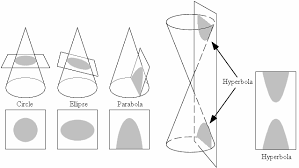
Image source: Linn-Benton Community College Math Department
As we see in the image, there are four types of conic sections: Circle, Ellipse, Parabola, and Hyperbola. They all share similar defining characteristics which include:
- Center
- Foci
- Eccentricity
The of a conic section is the midpoint point between the foci.
- Circles and Parabolas have only one focus
- Ellipses and Hyperbolas have two foci
The of a conic section is the midpoint point between the foci. (Since a circle only has one foci, its center is located at the same spot as the focus, i.e center = focus).
is the amount the conic section deviates from being perfectly circular.
- Circle has eccentricity = 0
- Ellipse has eccentricity between and not including 0 and 1
To calculate the eccentricity of a Ellipse:
- For horizontal ellipse, where :
- For vertical ellipse, where :
- Parabola has eccentricity = 1
- Hyperbola has eccentricity > 1
To calculate the eccentricity of a Hyperbola: